Book · Julian R. Sterling
The Production Capacity Planning Handbook
Rough-Cut Capacity, Bottlenecks, Shift Patterns, Utilization Targets, and the Capital Decisions Behind Adding Capacity in a Plant
Paperback, $32.99 PDF edition, $19.99
About the book
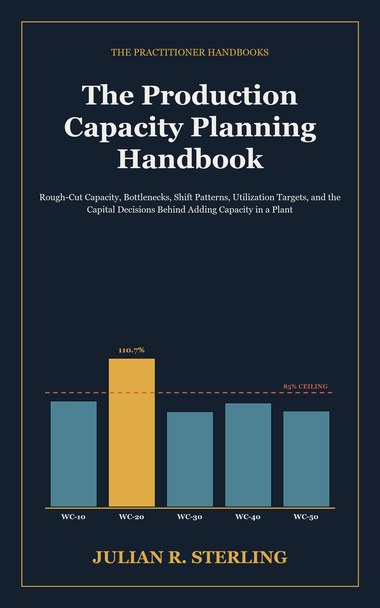
Average plant utilization hides fatal bottlenecks behind underloaded departments. This handbook bridges industrial engineering and corporate finance, walking operations leaders and CFOs from honest rated capacity and Rough-Cut Capacity Planning (RCCP) through Theory of Constraints, Kingman queueing physics, SMED exploitation, shift patterns, ASC 330 normal capacity, and five-year after-tax capital decisions.
Every calculation is worked on one fictional U.S. precision manufacturer, Kestrel Precision Components, Inc. (110,000 sq ft, five work centers, 24,000 units surging 25.0 percent to 30,000 units): isolating Work Center 20 at 110.7 percent load, unlocking 936 standard hours via a $45,000 SMED/PM program, and proving why pairing SMED with a fifth 5-axis CNC machine ($845,000 upfront, 81.9 percent load) beats adding a third shift by $803,241 in 5-year NPV (49.1 percent incremental IRR, 19.0-month payback vs. third shift).
Paperback, $32.99, shipping included to the United States, the United Kingdom, Europe, and Australia.
PDF edition, $19.99, DRM-free, delivered at once by email.
What is inside
- Introduction
- Chapter 1: Theoretical, Scheduled, Rated, and Demonstrated Capacity
- Chapter 2: The Capacity Planning Hierarchy: S&OP, RCCP, and CRP
- Chapter 3: Worked Rough-Cut Capacity Plan Across Five Work Centers
- Chapter 4: Identifying the True Constraint and Throughput Accounting
- Chapter 5: Utilization Ceilings, Kingman's VUT Equation, and Little's Law
- Chapter 6: Drum-Buffer-Rope Scheduling and Finite Capacity Execution
- Chapter 7: Exploiting the Bottleneck Before CapEx: SMED, PM, and Off-Loading
- Chapter 8: Shift Patterns, Crew Rotations, and Labor Capacity Math
- Chapter 9: Overtime Economics, FLSA Compliance, and Fatigue Risk
- Chapter 10: Adding a Third Shift vs. Buying a Machine: The Operational Trade-Off
- Chapter 11: Overhead Absorption and Idle Capacity Under FASB ASC 330
- Chapter 12: Capital Budgeting for New Equipment: NPV, IRR, Payback, and 2026 Tax Shields
- Chapter 13: Demand Uncertainty, Volume Sensitivity, and Real Options
- Chapter 14: Multi-Line Balancing, Changeover Sequencing, and Product Mix Shifts
- Chapter 15: The 12-Month Capacity Implementation Roadmap and S&OP Governance
- Conclusion
- Appendix A: Glossary
- Appendix B: Formulas and Worked Checks
- Appendix C: Checklists and Decision Templates
- Appendix D: Companion Files
Free companion files
Unlocked Excel workbooks, blue inputs, black formulas, zero macros, and a Controls tab that reads 0.
Complete case model
Kestrel Production Capacity Workbook
8 tabs reproducing every number in the book.
Download Production_Capacity_Workbook.xlsx24 KBStandalone practitioner tool
Capacity Planning Calculator
Isolate your plant bottleneck, size your protected gap, and price overtime vs. 3rd shift vs. new machine.
Download Capacity_Planning_Calculator.xlsx16 KB
Want the standalone tool first? Open the free Capacity Planning Calculator page.
Worked articles from the book
- Rough-Cut Capacity Planning (RCCP) Example: Five-Work-Center WalkthroughHow to compute honest Rated Capacity, build a Bill of Resources, isolate a 110.7 percent bottleneck, and separate your raw deficit from your protected capacity gap.
- Bottleneck Analysis and Theory of Constraints: Throughput Mix, Queueing, and SMEDWhy Throughput per Constraint Hour beats unit gross margin, how Kingman's VUT equation explodes queues above 85 percent, and how SMED unlocks hidden hours before CapEx.
- Add a Third Shift or Buy a New Machine? The 5-Year After-Tax Capital MathComparing weekend overtime, adding a third shift, and buying a fifth CNC machine on 5-year after-tax NPV, IRR, 2026 bonus depreciation, and 1-year temporary surge risk.
Questions practitioners ask
Who is this handbook written for?
Plant managers, operations directors, production planners, manufacturing engineers, plant controllers, and CFOs evaluating capacity bottlenecks and capital expansion.
Which standards and frameworks are covered?
ASCM/APICS RCCP and CRP, Theory of Constraints and Drum-Buffer-Rope, Kingman's VUT equation and Little's Law, SMED, FLSA 29 U.S.C. Section 207, OSHA General Duty Clause, FASB ASC 330-10-30, and 2026 U.S. federal 100 percent bonus depreciation and 7-year MACRS (as read in November 2026).
Are the Excel workbooks included free?
Yes. Both Production_Capacity_Workbook.xlsx and the standalone Capacity_Planning_Calculator.xlsx are free on this page with zero macros.