Book · Julian R. Sterling
The Asphalt Paving Company Owner
Starting, Buying and Running a Paving and Sealcoating Business: Takeoffs and Tons, Pricing per Ton and per Square Foot, Asphalt, Trucking and Milling, Crews and Overtime, Equipment, Commercial Bids and Driveways, Weather, Cash and Valuation
About the book
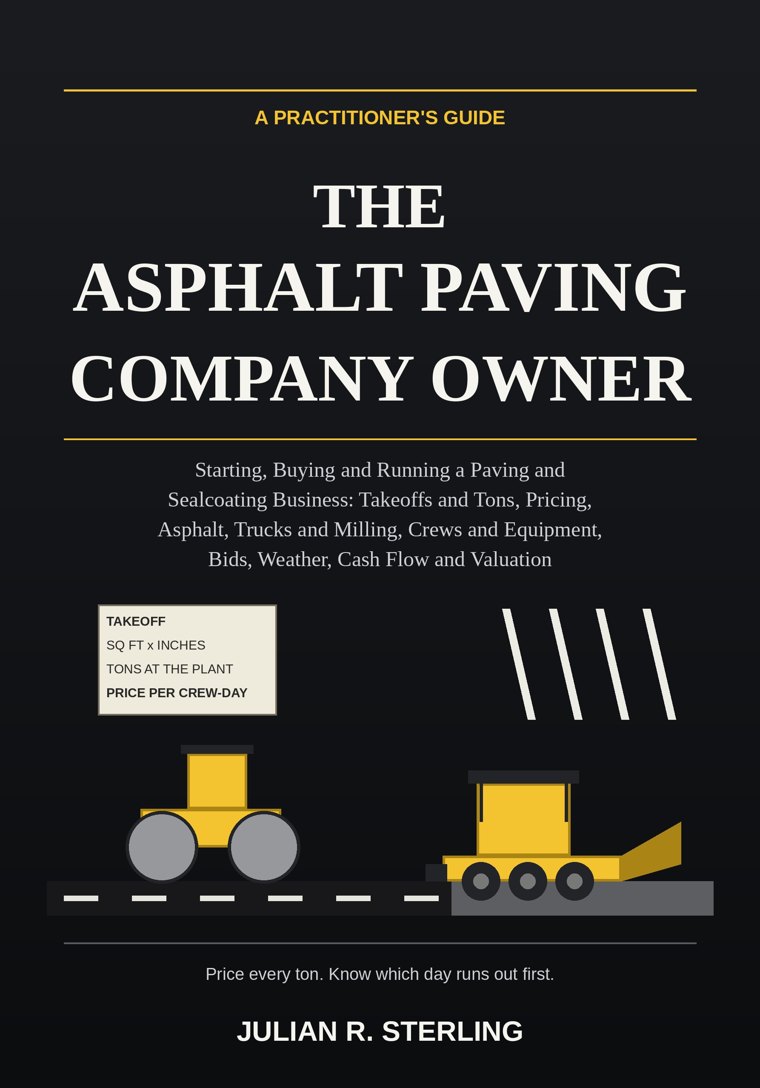
An asphalt paving company has about thirty weeks a year to earn its living. The crews are paid for every week of the season, rain or shine; the plant is paid a month after each load; commercial clients pay weeks after the job; and the yard, the insurance and the equipment loans run all winter. This guide works through the numbers that decide how the year ends: the takeoff that turns square feet into tons, the bid that prices the crew at its real cost per day, the trucks and the milling behind every ton, and the crew-day as the resource that runs out first.
One fictional company runs through every chapter: Fairlow Paving & Sealcoating, with one paving crew of 8, one sealcoat crew of 4, two dump trucks and work from homeowners, property managers, community associations and general contractors. In 2026 it billed $3,719,031, placed 12,320 tons of asphalt and earned adjusted EBITDA of $471,125 (12.7%). The book follows its bids, its crews, its spring cash trough, a three-year plan and two offers for the company.
What is inside:
- 16 chapters in five parts: the company and its numbers, crews and equipment, where the work comes from, profit and cash, starting, buying and selling
- Tons from square feet and compacted inches, a commercial bid built line by line ($39,736, $168.98 a ton) and a job minimum of $2,400 that turns a losing patch into $712 of contribution
- Contribution per crew-day: a commercial mill and overlay leaves $11,111 a day at a 29.3% margin, a driveway $5,586 at 59.1%, and residential sealcoating $1,028, below the crew’s cost
- Asphalt, hired trucks and the milling subcontract; the silica rule for milling machines, CDL groups for dump trucks, ADA counts when a lot is restriped, and bonds on federal work
- Break-even at 88 of 120 paving days, a wet season that costs $261,236 of EBITDA, and cash that keeps falling into June
- A second sealcoat crew, a milling machine that saves $73,328 a year (not $345,600), start-up costs of $554,000 and two offers for the company; check-lists and a glossary
Free: the asphalt paving company model in Excel
The Fairlow model from the book, simplified, with live formulas: five job types with tons, prices and every cost line, contribution per crew-day, crews and overhead, the P&L with adjusted EBITDA and SDE, break-even and stress tests, cash month by month and two offers for the company. No macros, nothing locked.
What is inside
- Chapter 1: The Paving Company on One Page
- Chapter 2: Takeoffs, Tons and the Estimate
- Chapter 3: Pricing: Per Ton, Per Square Foot and the Job Minimum
- Chapter 4: Asphalt, Trucks and Milling
- Chapter 5: Sealcoating, Crack Sealing and Striping
- Chapter 6: Crews, Pay and Overtime in a Short Season
- Chapter 7: Crew-Days Are the Constraint
- Chapter 8: Equipment: Own, Rent or Subcontract
- Chapter 9: Commercial Clients, Bids and Bonds
- Chapter 10: Driveways and Homeowners: Leads, Estimates and Reviews
- Chapter 11: The P&L, Adjusted EBITDA and SDE
- Chapter 12: Break-Even, Weather and Stress Tests
- Chapter 13: Cash Through the Year
- Chapter 14: The Second Sealcoat Crew and the Milling Machine
- Chapter 15: Starting or Buying a Paving Company
- Chapter 16: What the Company Is Worth and How to Sell It
- Conclusion
- Appendix A: The Paving Company Model, Tab by Tab
- Appendix B: Check-Lists
- Appendix C: Glossary
Read first
To read: How much does an asphalt paving company make?
To read: How much does it cost to start an asphalt paving company?
To read: How to estimate asphalt tons and price a paving job
Updates
Contractor licensing, home improvement contract rules, prevailing wages and bonds on public work, work zone permits, sealant restrictions, accessibility codes, wage and hour rules, tax rules on equipment and SBA lending rules change, and many differ by state, county and city. This page will note material changes that affect the book.
Doing the dirt work before the paving? See The Excavation Contractor Business Owner and how to calculate dirt cubic yards and truck loads.
Also by Julian R. Sterling
Related titles. The full list is on the author page.