Book · Julian R. Sterling
The Section 302 and 304 Handbook
Corporate Stock Redemptions and Related-Party Acquisitions Under US Tax Law: Section 302(b) Tests, Section 318 Constructive Ownership, Family Attribution Waivers, Section 304 Brother-Sister and Parent-Subsidiary Rules, Section 306 Stock, and E&P Mechanics
About the book
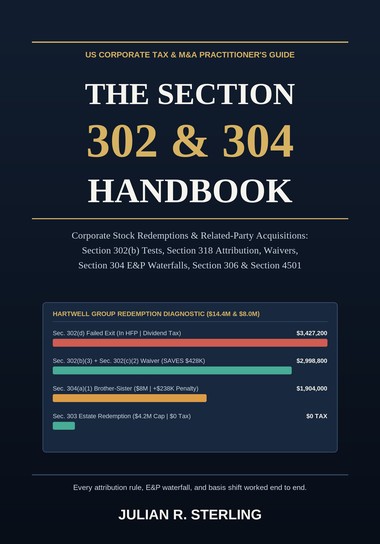
Corporate stock redemptions and related-party stock sales are among the most expensive traps in Subchapter C. One overlooked partnership interest, one misread Section 318 attribution chain, or one unmodeled brother-sister sale under Section 304(a)(1) can convert a planned capital gain exchange into a gross Section 301 dividend with zero basis recovery, shift basis onto another shareholder's shares, or destroy millions of dollars of corporate basis step-up.
One complete fictional corporate group carries every calculation from cap table to tax return. In Hartwell Industrial Corp. (1,000 shares, $40,000,000 equity value, $18,000,000 E&P), an unrelated C-corporation (Meridian Growth Corp.) passes Section 302(b)(2) on a 100-share redemption ($4,000,000, tax $315,000), while daughter Claire Hartwell fails on an identical 100-share redemption because Section 318 attribution holds her at 66.67%, triggering a $238,000 cash tax penalty. Sequencing founder Arthur Hartwell's partnership exit ahead of his 360-share complete termination unlocks a valid Section 302(c)(2) waiver that saves $428,400 immediately and preserves $7,920,000 of corporate E&P under Section 312(n)(7). Brother-sister Section 304(a)(1) ($8,000,000 sale exhausting $6,000,000 of HLC E&P plus $2,000,000 of HIC E&P), parent-subsidiary Section 304(a)(2) ($4,000,000 cost basis win), Section 302(b)(4) partial liquidations, Zenz bootstraps, Section 1059 extraordinary dividends, Section 306 bailouts, Section 303 death-tax redemptions ($0 tax), and Section 4501 Form 7208 excise tax ($750,000) are worked on the exact same quantitative spine.
What is inside:
- 15 chapters in four parts covering IRC Sections 301, 302, 303, 304, 306, 311(b), 312(n)(7), 317, 318, 1059, and 4501 (including T.D. 10002 procedural rules, T.D. 10037 final substantive regulations, and 2026 rates under P.L. 119-21)
- Full Section 318 constructive ownership matrix (family, upward/downward entity, option priority, no double family, no sidewise attribution)
- Exact shrinking-denominator formulas for Section 302(b)(2), Section 302(c)(2) family and entity waivers, United States v. Davis meaningful reductions, Section 302(b)(4) partial liquidations, and Zenz v. Quinlivan bootstraps
- Complete Section 304(a)(1) brother-sister and Section 304(a)(2) parent-subsidiary modeling, modified 5% corporate attribution, combined Section 304(b)(2) E&P waterfalls, and Section 304(b)(3) acquisition debt exceptions
- Corporate-level Section 311(b) gain, Section 312(n)(7) ratable E&P caps, Treas. Reg. 1.302-2(c) basis shifts, Section 162(k) invoice splitting, Section 1059(e)(1)(A) corporate DRD clawbacks, Section 306 bailouts, Section 303 + Section 6166 estate coordination, and Form 7208 compliance
- Copy-ready Section 302(c)(2)(A)(iii) waiver and Treas. Reg. 1.302-2(b)(2) significant holder return attachment templates
Free: the Section 302 & 304 Redemption Calculator in Excel
Computes the full Section 318 constructive ownership matrix, Section 302(b)(2) 50%/80% verdicts and minimum share thresholds, Section 302(b)(3) waiver savings, Section 304(a)(1)/(a)(2) two-tier E&P waterfalls, Section 1059 basis cuts, Section 312(n)(7) E&P caps, and Section 4501 Form 7208 excise tax. Pre-loaded with the Hartwell Group, 100% live formulas, zero macros, nothing locked.
Contents
- Chapter 1: The Statutory Architecture of Corporate Redemptions (IRC Sections 301, 302, 316, 317)
- Chapter 2: Section 318 Constructive Ownership Rules and Full Attribution Matrix
- Chapter 3: Section 302(b)(2) Substantially Disproportionate Redemptions
- Chapter 4: Section 302(b)(3) Complete Terminations and the Section 302(c)(2) Family Waiver
- Chapter 5: Section 302(b)(1) Not Essentially Equivalent to a Dividend (United States v. Davis)
- Chapter 6: Section 302(b)(4) and Section 302(e) Partial Liquidations
- Chapter 7: Bootstrap Acquisitions and Zenz v. Quinlivan
- Chapter 8: Section 304(a)(1) Brother-Sister Redemptions and Combined E&P Waterfalls
- Chapter 9: Section 304(a)(2) Parent-Subsidiary Redemptions and Anti-Abuse Rules
- Chapter 10: Section 304 vs. Section 351 Overlap, Acquisition Debt, and Basis Mechanics
- Chapter 11: Corporate-Level Consequences: Section 311(b), Section 312(n)(7), and Basis Shifting
- Chapter 12: Corporate Shareholders and the Section 1059 Extraordinary Dividend Trap
- Chapter 13: Section 306 Preferred Stock Bailouts
- Chapter 14: Section 303 Death Tax Redemptions and Section 4501 Buyback Excise Tax
- Chapter 15: End-to-End Structuring Playbook, Tax Reporting, and 30/60/90-Day Execution
- Conclusion & Appendices A, B, and C (Full Schedules, Checklists, Waiver Templates, Glossary)
Read first
To read: Section 302(b)(2) Substantially Disproportionate Redemption Test: 50% and 80% Formulas Worked
To read: Section 318 Constructive Ownership and the Section 302(c)(2) Family Attribution Waiver
To read: Section 304 Brother-Sister and Parent-Subsidiary Redemptions: E&P Waterfalls and Basis Traps
Updates
All statutes, Treasury Regulations (including T.D. 10002 procedural Form 7208 rules and T.D. 10037 final substantive regulations under Section 4501), Revenue Rulings, and 2026 federal tax rates under P.L. 119-21 are stated as of November 2026. Any future Subchapter C updates will be posted here.
Also by Julian R. Sterling
Related US corporate tax, M&A, and partnership tax handbooks. The full list is on the author page.