Real Estate Fund Model in Excel, Pro Edition
An integrated closed-end real estate fund model: up to eight assets, management fees and fund costs, a European or American distribution waterfall, and net returns, with 30 built-in checks.
Enter your fund terms and up to eight assets. The workbook projects each asset's NOI, capital expenditure, debt, optional refinancing and sale, rolls them up into fund capital calls and distributions, charges management fees and fund costs, and runs the distribution waterfall.
Real Estate Fund Model, Pro Edition: $129
One zip file: the model with a worked example, a blank copy and a 19-page PDF user guide. Single-user license.
Secure checkout by Stripe. Also in the Pro Models Bundle, $199 for the three Pro models. Want to try the method first? The free distribution waterfall model stays free.
Watch the five-minute demo
- 0:00 Intro: assets, fees and waterfall in one model
- 0:28 Fund terms: commitments, fees, waterfall terms
- 1:06 Assets: eight slots, debt, refinancing, exit
- 2:12 Fund cash flows and the J-curve
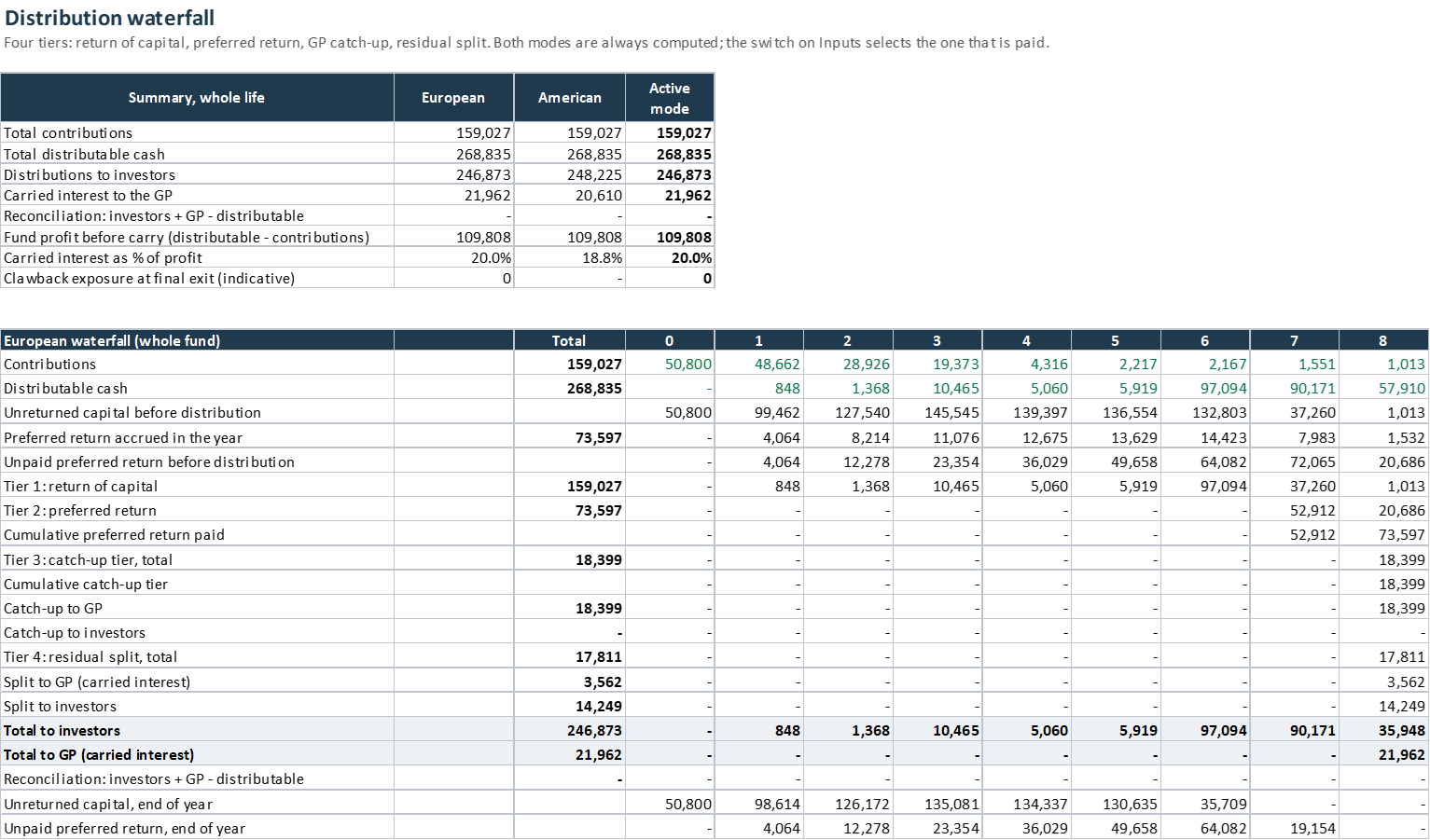
- 2:43 The waterfall: European and American modes
- 3:46 Returns, scenarios and sensitivity grid
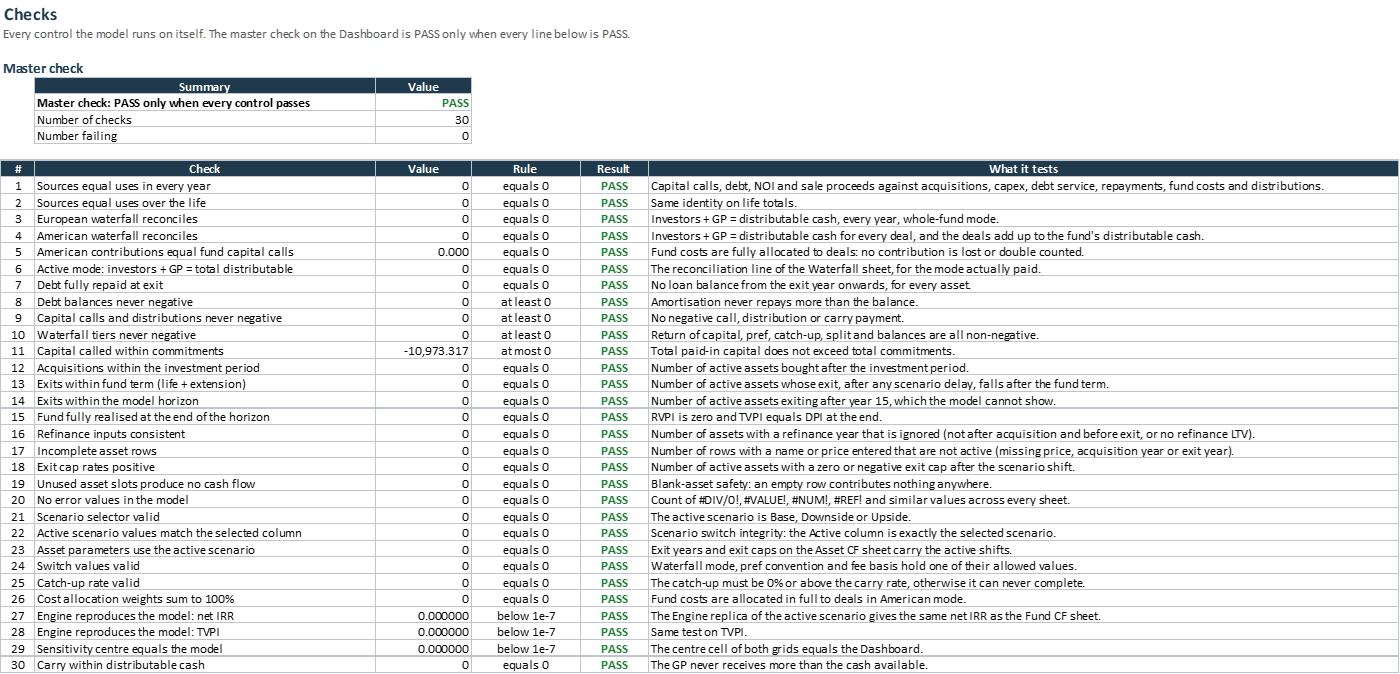
- 4:27 30 integrity checks
- 4:45 What you get
The example fund and its assets are fictitious. AI-generated voice over real captures of the workbook. Not investment advice.
What the model does, tab by tab
The tabs run from inputs to outputs. Blue text on a pale yellow fill marks an input; every other cell is a formula.
- Cover
- What the model does, the color code, how to use it, conventions, limitations, version and license.
- Dashboard
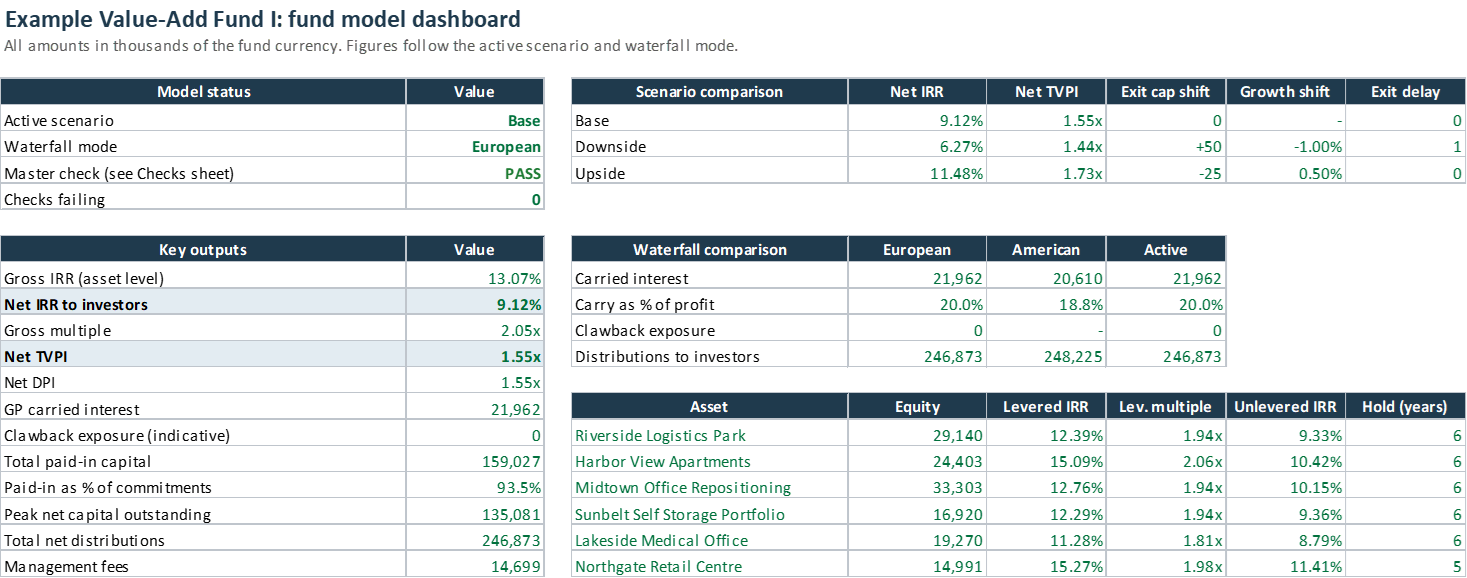
- Model status and master check, key outputs, scenario comparison, European against American comparison, asset returns, and two charts: net cash flow by year and the J-curve.
- Inputs
- Fund terms, waterfall terms, and derived settings: fund term, last exit year, switch codes, clawback exposure.
- Scenarios
- The active scenario selector and the Base, Downside and Upside shifts: exit cap, NOI growth, interest rate, exit delay.
- Assets
- Eight asset slots, plus two capital expenditure tables by year of ownership: % of NOI and fixed amounts.
- Asset CF
- Scenario-adjusted parameters, asset returns (levered and unlevered IRR and multiple) and one 16-line cash flow block per asset.
- Fund CF
- Fund returns summary, then the annual fund cash flows: calls, fees, distributions, carry, net cash flow, J-curve, NAV proxy, DPI, RVPI, TVPI, and a sources and uses proof.
- Waterfall
- Summary by mode, the European waterfall, the total of the American deals, the amounts actually paid, and the eight deal-by-deal waterfalls.
- Sensitivity
- Net IRR and TVPI for 25 combinations of exit cap shift and NOI growth shift, on top of the active scenario.
- Checks
- The master check, then 30 controls, each with its value, rule, PASS or FAIL, and what it tests.
- Engine
- 28 compact replicas of the full model: three for the stored scenarios and 25 for the sensitivity grid. No inputs.
The worked example
The example is a fictitious 2026 value-add and core-plus fund with $170 million of commitments and six assets: 1.50% fee on commitments, then 1.25% on invested equity, an 8% compounded preferred return, a 100% catch-up and an 80/20 split. Base case, European mode, amounts in $000:
| Measure | Value |
|---|---|
| Capital called | 159,027 (93.5% of commitments) |
| Gross IRR | 13.07% |
| Net IRR | 9.12% |
| Net TVPI | 1.55x |
| Bottom of the J-curve | 135,081, in year 3 |
| Management fees over the life | 14,699 |
| GP carried interest | 21,962 (20.0% of a 109,808 profit) |
| American mode: net IRR / carry | 9.04% / 20,610 |
| Downside: net IRR | 6.27%, no carry paid |
In the deal-by-deal mode the GP earns less carry in total but is paid from year 6 instead of year 8, which is why investors receive more cash yet show a slightly lower net IRR. In the Upside, American carry exceeds 20% of the fund's profit and the model shows an indicative clawback exposure of 271. The example and every figure in it are fictitious and illustrative.
Working on a private equity fund rather than a property fund? The Private Equity Fund Model, Pro Edition ($129) works investor by investor: equalization, fee offsets, both waterfalls with clawback, subscription line, NAV facility and capital accounts.
Who it is for
- Fund managers preparing a fund or a deal pipeline.
- Investor relations and finance teams who need to explain fee and carry mechanics.
- Limited partners who want to test a manager's projections against the terms of the limited partnership agreement.
What you receive
- The model with a worked example fund.
- A blank copy ready for your own fund.
- A 19-page PDF user guide: every sheet, the waterfall arithmetic, the checks, the conventions and a walk-through of the example.
- A short read-me file. Everything comes in one zip file, downloaded right after checkout.
Technical notes
- Annual periods over 15 years, amounts in thousands of the fund currency.
- Standard formulas only (IRR, PMT, INDEX, MATCH, CHOOSE, SUMIF, SUMIFS, SUMPRODUCT, IFERROR): no macros, no data tables, no circular references, no external links, no locked cells.
- Built for Excel, LibreOffice and Google Sheets.
- Each configuration of the model was recalculated in LibreOffice and compared cell by cell with an independent Python implementation, with no mismatch and no error cell.
- Limitations, stated in the guide: annual timing, eight asset slots, one acquisition loan and one optional refinancing per asset, a single-tier promote, no recycling, no subscription line, no taxes or FX.
- Single-user license. Not investment advice.
Questions people ask about it
Does the fund model handle both European and American waterfalls?
Yes. It always calculates both: a whole-fund waterfall and one waterfall per asset, and pays the mode you select. The Dashboard compares them, and an indicative clawback exposure is shown for the deal-by-deal mode.
Can I set a simple or compounded preferred return, and a partial catch-up?
Yes. The pref can compound or accrue simply, and the catch-up can be 100%, partial or zero. A catch-up that could never complete is flagged by a control.
How is it different from the free distribution waterfall model?
The free model works the waterfall on the case of Real Estate Fund Management. The Pro Edition is a general tool: it integrates up to eight assets, their debt, fees and the waterfall in one chain of formulas, switches modes and scenarios, and verifies itself with 30 controls. The free model stays free.
Does it use macros or data tables?
No. The sensitivity grid and the scenario comparison run on an Engine sheet of ordinary formulas, so they stay live in Excel, LibreOffice and Google Sheets.
What does the model leave out?
It is annual, with eight asset slots over 15 years, one loan and one optional refinancing per asset, and a single-tier promote. There is no recycling, no subscription line, no tax and no FX. The guide lists every simplification.
Can I use it for a real fund?
Yes, the blank copy is built for that. The license is single-user, the example fund is fictitious, and nothing in the model is investment advice.
Get the Real Estate Fund Model, Pro Edition
$129, single-user license. Download right after checkout. Digital download: no refunds once the file has been downloaded.
Start free with the free distribution waterfall model, or read Real Estate Fund Management, the book behind it.
Other Pro models
- LBO Model, Pro EditionSeven-year buyout, four debt tranches, covenants, management ratchet, 31 checks, an 18-page guide. $99.
- Real Estate Acquisition and Development Model, Pro EditionMonthly over 60 months, S-curves, construction loan and mezzanine, bulk or unit sales, JV waterfall, 33 checks, a 14-page guide. $99.
- The Pro Models BundleThe three Pro models in one purchase, $199 instead of $327.