Book · Julian R. Sterling
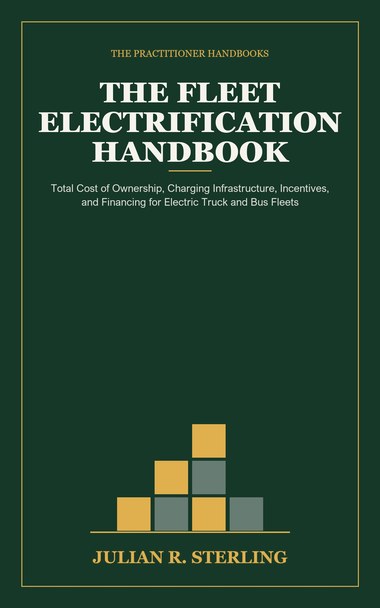
The Fleet Electrification Handbook
Total Cost of Ownership, Charging Infrastructure, Incentives, and Financing for Electric Truck and Bus Fleets
Paperback, $32.99 PDF edition, $19.99
Buying for your firm? Add your company name and VAT number at checkout and they go on the invoice. For a team: team license, up to 10 people, $59.99 · firm-wide license, $139.99.
About the book
Commercial fleet electrification after Public Law 119-21 is an energy engineering and capital allocation discipline, not a federal subsidy exercise. This handbook gives fleet executives, CFOs, equipment lenders, and transit directors one rigorous quantitative and contractual playbook.
Every calculation is worked on two fictional cases: Pacific Crest Freight, LLC at Inland Valley Terminal (30 Class 8 tractors, 80,000 mi/yr, $1.050/mi vs. $1.323/mi diesel, +$2,029,636 8-year NPV savings with HVIP and LCFS vs. -$5,732,954 unincentivized, $901,200/yr OCPP 2.0.1 smart-charging savings, $472,159/yr net LCFS credits, $2,854,440 Year 1 100% bonus depreciation at a simplified 27% combined rate ($2,220,120 federal-only in California), and $16,780,250 TRAC lease NPV) and Metro Valley Transit Authority (20 buses, $21,760,000 FTA Low-No grant, $3,524,748 local NPV saved).
Paperback, $32.99, shipping included to the United States, the United Kingdom, Europe, and Australia.
PDF edition, $19.99, DRM-free, delivered at once by email.
What is inside
- Introduction: Why Fleet Electrification Is Now an Energy and Capital Allocation Problem
- Chapter 1: Duty-Cycle Screening, Route Feasibility, and Fleet Segmentation
- Chapter 2: Heavy-Duty Vehicle Specifications, Payload Penalties, and 23 U.S.C. Section 127(s)
- Chapter 3: Battery Chemistry, Degradation Curves, Warranties, and Residual Values
- Chapter 4: Complete 8-Year Total Cost of Ownership (TCO) Modeling: Electric vs. Diesel
- Chapter 5: Depot Charging Architecture, Charger Sizing, and NEC Article 625 Design
- Chapter 6: Utility Interconnection, Make-Ready Programs, and Transformer Lead Times
- Chapter 7: Commercial EV Tariffs, Demand Charges, and Managed Load Economics
- Chapter 8: Behind-the-Meter Solar, BESS Peak Shaving, and Depot Resilience
- Chapter 9: Post-OBBBA Federal Tax Landscape: Sections 45W, 30C, and 100 Percent Bonus Depreciation
- Chapter 10: State Voucher Programs, Utility Rebates, and Incentive Stacking Rules
- Chapter 11: Low Carbon Fuel Standard (LCFS) and Clean Fuel Credit Monetization
- Chapter 12: Navigating Post-ACF/ACT Regulatory Whiplash and Shipper ESG Mandates
- Chapter 13: Fleet Financing Structures: Cash, Loans, TRAC Leases, and EaaS
- Chapter 14: Public Transit and School Bus Electrification: FTA Low-No Grants and Municipal Finance
- Chapter 15: Depot Operations, Uptime SLAs, Driver Training, Maintenance, and Insurance
- Conclusion: Building Bankable Electric Fleets Without Federal Crutches
- Appendix A: Practitioner Glossary of Commercial Fleet Electrification
- Appendix B: Worked Formulas and Quantitative Reference
- Appendix C: Fleet Electrification Due Diligence, Utility, Incentive, and Lender Checklists
- Appendix D: Companion Excel Workbooks Guide
Free companion files
Unlocked Excel workbooks, blue inputs, black formulas, zero macros, zero circular references, and a Controls tab that reads 0.
Complete case model
Pacific Crest Fleet Electrification Case Workbook
8 tabs reproducing Class 8 BEV vs. diesel 8-year TCO, 12% FET, HVIP, managed vs. unmanaged utility tariffs, CARB LCFS EER 5.0 credits, IRC 168(k) 100% bonus depreciation, Cash vs. Loan vs. TRAC Lease vs. EaaS, 3x3 sensitivity matrix, and MVTA 20-bus transit finance.
Download Pacific_Crest_Fleet_Electrification_Case_Workbook.xlsx25 KBStandalone practitioner tool
Fleet Electrification TCO and Financing Model (Excel)
Interactive 6-tab calculator with 3-scenario selector, managed electricity & LCFS engine, Cash/Loan/TRAC/EaaS comparison, 3x3 diesel-vs-electricity sensitivity matrix, and Controls = 0.
Download Fleet_Electrification_TCO_and_Financing_Model.xlsx18 KB
Want the standalone calculator first? Open the free Fleet Electrification TCO and Financing Model (Excel) page.
Worked articles from the book
- Class 8 Electric Truck TCO vs. Diesel: Complete 8-Year Math After Section 45WHead-to-head 30-tractor pro forma ($1.050/mi BEV vs. $1.323/mi diesel, +$2,029,636 NPV savings with HVIP + LCFS vs. -$5,732,954 unincentivized).
- Commercial EV Depot Charging and Demand Charges: How OCPP 2.0.1 Saves $901,200/YearManaged 2,000 kW subscription charging ($1,136,400/yr) vs. unmanaged 2,700 kW peaks ($2,037,600/yr), PG&E BEV-2-S, SCE TOU-EV-9, and NEC 625.42.
- Fleet Electrification Incentives, LCFS Credits, and TRAC Lease Financing After Public Law 119-21Navigating zero 45W/30C, permanent 100% bonus depreciation ($2,854,440 Yr 1), $472,159/yr LCFS, $16,780,250 TRAC lease NPV, and FTA Low-No transit grants.
Questions practitioners ask
Who is this handbook written for?
Commercial fleet directors, corporate CFOs, equipment finance lenders, municipal transit managers, and depot EPC engineers underwriting, designing, financing, or operating electric truck and bus fleets.
Does it reflect the 2025-2026 federal tax and CARB regulatory changes?
Yes. It models zero federal IRC Sections 45W and 30C under Public Law 119-21, permanent 100 percent IRC Section 168(k) bonus depreciation (IRS Notice 2026-11), CARB ACF/ACT status, active California HVIP and LCFS credits, and FTA Low-No transit grants as verified in November 2026.
Are the Excel fleet electrification TCO workbooks included free?
Yes. Both Pacific_Crest_Fleet_Electrification_Case_Workbook.xlsx and the standalone Fleet_Electrification_TCO_and_Financing_Model.xlsx are free on this page, unlocked, and macro-free with Controls = 0.