Book · Julian R. Sterling
The UK Corporate Interest Restriction Handbook
TIOPA 2010 Part 10 and Schedule 7A in Practice: The GBP 2M De Minimis Allowance, Fixed Ratio vs Group Ratio Method, Adjusted and Qualifying Net Group-Interest Expense (ANGIE and QNGIE), Public Infrastructure Exemption, Disallowance Allocations, and HMRC CIR Returns
About the book
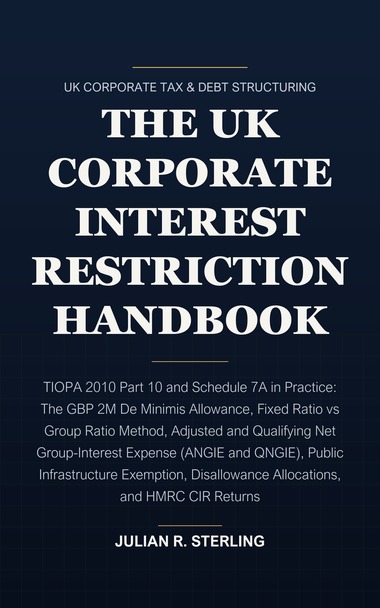
The UK Corporate Interest Restriction (CIR) under TIOPA 2010 Part 10 and Schedule 7A is one of the most mechanically demanding provisions in UK Corporation Tax. Groups with Aggregate Net Tax-Interest Expense (ANTIE) above the £2.00m de minimis threshold must coordinate UK Tax-EBITDA, consolidated IFRS Adjusted Net Group-Interest Expense (ANGIE) and Qualifying Net Group-Interest Expense (QNGIE), related-party debt exclusions under s. 414, 5-year unused interest allowance carry-forwards, indefinite company-level disallowed interest balances, and strict Schedule 7A return mechanics (including the Finance Act 2026 reporting company reforms).
One complete UK-headed multinational group carries every calculation from trial balance to HMRC Interest Restriction Return. Across FY2024 to FY2026, Thamesbridge Infrastructure & Industrial Group plc generates £3.00m of unused interest allowance in FY2024 (ANTIE £9.00m vs. £12.00m Fixed Ratio allowance), faces a £5.10m Fixed Ratio disallowance in FY2025 after acquisition leverage pushes ANTIE to £16.50m, cuts that disallowance to £3.50m by electing the Group Ratio Method at 35.71% (saving £1.60m of deductions and £0.40m in cash tax at 25% UK CT), allocates the disallowance across consenting and non-consenting subsidiaries while respecting the £0.70m statutory pro-rata cap on OpCo 2, evaluates a Public Infrastructure Exemption (PIE) election reducing FY2025 disallowance further to £2.85m, and reactivates the full £3.50m balance in FY2026 to recover £0.88m of UK Corporation Tax.
What is inside:
- 15 chapters in four parts covering TIOPA 2010 ss. 372-498, Schedule 7A, HMRC CFM95000-CFM99000, and Finance Act 2026 administrative and s. 407 technical amendments
- Complete ANTIE and Aggregate Tax-EBITDA reconciliations from UK CT600 computations, including negative Tax-EBITDA offsetting and the zero aggregate floor
- Side-by-side Fixed Ratio Method (30% cap + ANGIE Fixed Ratio Debt Cap) vs. Group Ratio Method (QNGIE / Group-EBITDA capped at 100% + QNGIE Debt Cap) with s. 414 related-party and results-dependent exclusions
- Public Infrastructure Exemption (PIE, ss. 432-449) eligibility, limited-recourse debt rules, 5-year irrevocability lock-in, and exact quantitative trade-off modeling
- Schedule 7A disallowance allocations (consenting vs. non-consenting paras 22-23 pro-rata caps), indefinite company-level carry-forwards, and FY2026 reactivation mechanics
- Special sectors (UK REITs, private equity funds, banking, insurance, oil and gas, securitisation), IAS 12 / FRS 102 deferred tax accounting, Pillar Two interaction, and a 30/60/90-day compliance calendar
Free: the UK CIR Disallowance Calculator in Excel
Computes the 3-year Thamesbridge Group CIR model (ANTIE, Tax-EBITDA, ANGIE, QNGIE, FRM vs. GRM toggle, £2m de minimis, 5-year unused allowance, and reactivations), Schedule 7A consenting/non-consenting allocations, the FY2025 PIE election comparison, three standalone edge cases, and a 100% dynamic Controls tab. Live formulas, no macros, nothing locked.
Contents
- Introduction: Why the UK Corporate Interest Restriction Reshapes Group Debt Architecture
- Chapter 1: Statutory Architecture, Worldwide Group Boundaries, and Period of Account Rules
- Chapter 2: Tax-Interest Expense, Tax-Interest Income, and Aggregate Net Tax-Interest Expense (ANTIE)
- Chapter 3: Tax-EBITDA and Aggregate Tax-EBITDA Computations
- Chapter 4: Interest Capacity, the GBP 2 Million De Minimis Allowance, and Unused Allowance Carry-Forward
- Chapter 5: The Fixed Ratio Method (30% Cap) and the Fixed Ratio Debt Cap (ANGIE)
- Chapter 6: The Group Ratio Method (GRM), QNGIE, and Related-Party Debt Exclusions
- Chapter 7: Elections Modifying ANGIE, QNGIE, and Group-EBITDA
- Chapter 8: The Public Infrastructure Exemption (PIE) Under TIOPA 2010 Sections 432-449
- Chapter 9: Disallowance Allocations, Consenting vs. Non-Consenting Companies, and Indefinite Carry-Forward
- Chapter 10: Interest Reactivations, Multi-Period Tracking, and Cash Tax Recovery
- Chapter 11: Special Sectors: Real Estate (REITs), Private Equity, Banking, Insurance, Oil and Gas, and Securitisation
- Chapter 12: Schedule 7A Administration, Reporting Companies, and HMRC Interest Restriction Returns
- Chapter 13: Deferred Tax Accounting (IAS 12 and FRS 102) and Financial Statement Disclosures
- Chapter 14: Interaction with Transfer Pricing, Hybrid Mismatches, Pillar Two, and the Regime Anti-Avoidance Rule
- Chapter 15: End-to-End Group Tax Playbook, Debt Structuring, and 30/60/90-Day Compliance Calendar
- Conclusion & Appendices A, B, and C (Master CIR Schedules, Filing & PIE Checklists, Statutory Glossary)
Read first
To read: UK CIR Fixed Ratio vs. Group Ratio Method: Complete Worked Example Under TIOPA 2010
To read: UK CIR Public Infrastructure Exemption (PIE): Eligibility, Trade-Offs, and Worked Calculation
To read: UK CIR Unused Interest Allowance Carry-Forward and Reactivation Rules Explained
Updates
Statutory references and HMRC guidance (CFM95000-CFM99000) are stated as of November 2026, incorporating Finance Act 2026 Schedule 7A reporting company appointment reforms (effective for periods ending on or after 31 March 2026) and s. 407 Tax-EBITDA technical amendments. Future Finance Act changes will be posted here.
Also by Julian R. Sterling
Related corporate tax, international tax, and treasury handbooks. The full list is on the author page.