Book · Julian R. Sterling
The State Unemployment Tax Handbook
An Employer's Guide to SUTA Rates, Experience Rating, Taxable Wage Bases, Multistate Wage Localization, Successor and SUTA Dumping Rules, Benefit Charges, FUTA Credit Reduction and Form 940
Paperback, $32.99 PDF edition, $19.99
About the book
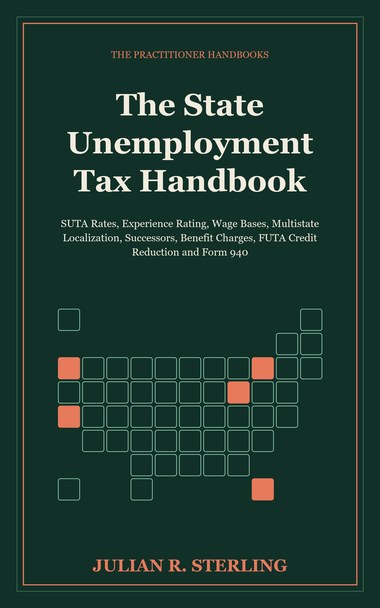
Unemployment tax is one federal return and as many state accounts as there are states, each with its own wage base, its own rate, its own notice and its own calendar. FUTA is 6.0 percent of the first $7,000 with a credit of up to 5.4 percent, until a state carries federal loans and its employers lose part of the credit. State rates come from experience formulas that reward and punish different things, and every layoff, transfer, acquisition and new site changes what the employer owes.
The State Unemployment Tax Handbook works the whole discipline on one fictional employer, Wexmoor Provisions, Inc., a foodservice distributor with sites in California, New York, Florida, Pennsylvania and Washington. In 2026 it pays $84,300.00 of employer unemployment tax for 173 people: $13,665.00 of FUTA and $70,635.00 to five state accounts. The book follows its rate notices, California's credit reduction, a New York voluntary contribution, a layoff charged to its reserve account, a territory representative and a supervisor who changes states, an acquisition, a SUTA dumping pitch the controller refuses, and a nonprofit choosing between contributions and reimbursement. Every name, wage, rate notice and balance is invented for illustration. Rules, bases and rates are described as read in November 2026.
Who it is for
- Payroll tax managers and state account desks of multistate employers who register accounts, load rates and wage bases, and file Form 940 and the quarterly reports.
- Controllers and CFOs who budget unemployment tax by site, weigh a voluntary contribution, or review an acquisition or a staffing restructuring.
- HR directors who answer claim notices, document separations and see the cost of a layoff on the next rate notice.
- Payroll service providers, PEOs and accountants who run unemployment tax for client employers and carry the filing risk.
What is inside
Introduction
- Introduction
Part I, The Federal Layer
- Chapter 1: How Unemployment Insurance Is Paid For: FUTA, SUTA and the Employer's Bill
- Chapter 2: Who Owes FUTA and on Which Wages
- Chapter 3: The 5.4 Percent Credit and Credit Reduction States
- Chapter 4: Form 940 and Schedule A, Line by Line
Part II, State Unemployment Tax Basics
- Chapter 5: State Taxable Wage Bases
- Chapter 6: New Employer Rates and Opening an Account in a New State
- Chapter 7: Reading the Rate Notice: Components, Surcharges and Add-On Taxes
Part III, Experience Rating
- Chapter 8: Reserve Ratio Systems: California and New York Worked
- Chapter 9: Benefit Ratio and the Other Systems: Florida, Washington and Pennsylvania
- Chapter 10: Voluntary Contributions: When Buying Down the Rate Pays
Part IV, Claims and Benefit Charges
- Chapter 11: Benefit Charges, Claim Responses and Protests
Part V, Multistate Employers and Business Changes
- Chapter 12: Localization: Which State Gets the Wages
- Chapter 13: Employees Who Move Between States During the Year
- Chapter 14: Acquisitions, Successors and SUTA Dumping
Part VI, Special Employers and the Annual Cycle
- Chapter 15: Nonprofits, Reimbursing Employers, PEOs and Common Paymasters
- Chapter 16: Deposits, Quarterly Reports, the Annual Calendar and Controls
Conclusion and appendices
- Conclusion
- Appendix A: The Companion Workbook
- Appendix B: Unemployment Tax Calendar and Checklists
- Appendix C: 60 Review Questions with Answers
- Appendix D: Glossary
The Wexmoor case in figures
Every figure below is computed by the book's model and reproduced in the companion workbook. Wexmoor Provisions, Inc. and every person in the case are fictional; wages, rates and balances are invented for illustration, and the two rate-table excerpts used to turn ratios into rates are hypothetical.
| Item | Value |
|---|---|
| FUTA per employee at the full credit / California 2025 / California 2026 | $42.00 / $126.00 / $147.00 |
| 2026 FUTA wages, first $7,000 per person across five states | $1,142,500.00 |
| California credit reduction at 0.015 (Schedule A, line 11) / total 2026 FUTA | $6,810.00 / $13,665.00 |
| Credit reduction paid 2024 / 2025 / 2026 / three-year total | $6,307.20 / $5,652.00 / $6,810.00 / $18,769.20 |
| 2026 state contributions: California (with ETT) / New York (with RSF) | $13,620.00 / $30,327.60 |
| 2026 state contributions: Florida / Pennsylvania / Washington | $3,174.00 / $5,733.00 / $17,780.40 |
| Cost per employee: Florida full-time / Washington hourly | $122.50 / $1,098.00 |
| California reserve ratio for 2026 / for 2027 / for 2027 without one layoff | 4.43 percent / 5.55 percent / 6.86 percent |
| Benefits charged for one laid-off warehouse lead | $9,360.00 |
| New York voluntary contribution / saving on 2026 contributions | $1,350.00 / $4,267.20 |
| Territory representative reported to the wrong state: extra cost | $493.40 |
| Supervisor moving to Washington: transfer credit reading difference | $62.70 |
| Acquisition: FUTA saved by the successor rule / Florida reading difference | $255.00 / $488.75 |
| SUTA dumping pitch against the 5.6 percent notice rate (refused) | $9,144.00 |
| Nonprofit, 2026 to 2028: contributions / reimbursing / 2028 excess of reimbursing | $25,225.20 / $16,320.00 / $5,031.60 |
| Employer unemployment tax 2026: state / FUTA / total | $70,635.00 / $13,665.00 / $84,300.00 |
Free companion files
The live Excel files behind every table in the book. Blue inputs, black formulas, no macros, and a Checks tab that must read zero. No sign-up required for book readers.
Appendix A, chapters 1 to 16
The Wexmoor companion workbook
Twenty tabs: README, Inputs, Roster_2026, FUTA_2025, FUTA_2026, Credit_Reduction, State_Bases, SUTA_2026, Rate_Notices, Reserve_Ratio, Benefit_Ratio, Voluntary, Benefit_Charges, Localization, Transfer, Successor, Nonprofit, Quarterly, Cost_per_Employee and Checks. The 2026 roster, the 2025 and 2026 Form 940 with Schedule A, the credit reduction history, the state bases and contributions by quarter, the rate notices, the reserve ratio and benefit ratio computations, the voluntary contribution, the benefit charges, the localization, transfer and successor readings, the nonprofit comparison, the deposit calendar and the cost per employee.
Download SUTA_Workbook.xlsx78 KBStandalone practitioner tool
SUTA and FUTA Calculator
Enter each state's base, assigned rate, add-on and credit reduction rate, then the wages paid to each employee in each state. Read the FUTA wages of each employee counted once across states, net FUTA, the credit reduction by state as on Schedule A, state taxable wages and contributions, and the total unemployment tax cost per employee and in all. Prefilled with Example Co., an illustrative employer.
Download SUTA_FUTA_Calculator.xlsx18 KB
Want the calculator first? Open the free SUTA and FUTA Calculator page for what it computes and the Excel download.
Worked articles from the book
- FUTA Credit Reduction 2026: California at 1.5 PercentCalifornia is the only 2026 credit reduction state, at 1.5 percent: $147.00 of FUTA per employee instead of $42.00, paid with the fourth-quarter deposit.
- SUTA Wage Base 2026 by StateState unemployment tax stops at each state's taxable wage base: $7,000 in California and Florida, $17,600 in New York, $78,200 in Washington for 2026.
- How Unemployment Tax Experience Rating WorksStates set each employer's rate from its account: reserve ratio or benefit ratio, a new employer rate until there is history, and benefit charges that move the next notice.
Questions practitioners ask
Who is this book for?
Payroll tax managers and payroll specialists of multistate employers, controllers and CFOs of growing companies, HR directors who answer claims, payroll service providers and PEOs, and accountants who prepare Form 940 and the state returns for their clients.
What does it cover?
FUTA liability and wages, the 5.4 percent credit and credit reduction states, Form 940 and Schedule A, 2026 state wage bases, new employer rates and rate notices, reserve ratio and benefit ratio systems, voluntary contributions, benefit charges and protests, the four localization tests, employees who move between states, successors and SUTA dumping, nonprofits and reimbursing employers, PEOs, deposits and quarterly reports, all as read in November 2026.
Does it work real figures from start to finish?
Yes. One fictional employer with 173 people in five states runs through every chapter: $84,300.00 of employer unemployment tax in 2026, of which $13,665.00 of FUTA and $70,635.00 paid to five state accounts, with its rate notices, a layoff, a transfer, an acquisition and its Form 940.
Are the companion files free?
Yes. The 20-tab workbook and the standalone SUTA and FUTA Calculator are free on this page, with no sign-up for book readers.
Is this tax advice?
No. The book explains the federal rules and five states' rules as read in November 2026. Wage bases, rates and the credit reduction change every year; the state agency, the IRS instructions and your adviser decide what applies to your payroll.
Also by Julian R. Sterling
Related titles. Full list on the author page.