Book · Julian R. Sterling
The State Revolving Fund Handbook
Clean Water and Drinking Water SRFs: Federal Capitalization Grants, State Match, Leveraged Bond Programs, Loan Pools and Subsidies, Cross-Collateralization, and the Credit Math of Program Managers, Borrowers and Bond Investors
Google Play Paperback, $32.99 PDF edition, $19.99
Buying for your firm? Add your company name and VAT number at checkout and they go on the invoice. For a team: team license, up to 10 people, $59.99 · firm-wide license, $139.99.
About the book
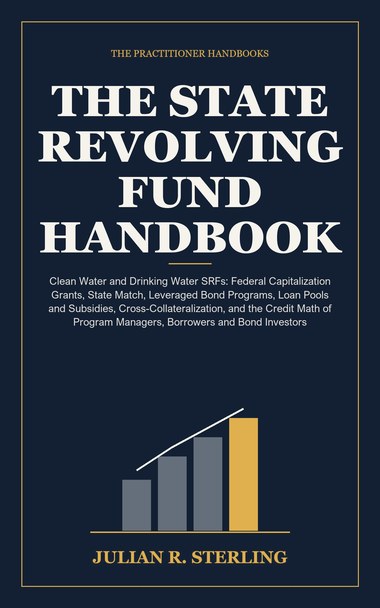
Clean Water and Drinking Water State Revolving Funds are the quiet backbone of American water infrastructure finance. This handbook shows SRF program managers, municipal finance directors, and AAA municipal bond investors how federal capitalization grants, 20 percent state match, IIJA principal forgiveness, Cash Flow leveraged bond structures, and cross-collateralized Master Trust Indentures work from the inside out.
Every calculation is worked end to end on one fictional state authority, Mid-Valley Water Infrastructure Authority (MVWIA), and two local borrowers (City of Alderbrook and Town of Pinecrest): deploying $160,000,000 of net equity alongside $240,000,000 of 4.25 percent AAA bonds to fund $400,000,000 of repayable loans plus $55,350,000 in principal forgiveness ($455,350,000 total infrastructure), achieving 1.42x DSCR, 1.77x asset-to-debt, 55.0 percent four-year zero-recovery default tolerance, and +$3,075,468 net PV borrower savings after BABA and Davis-Bacon cross-cutter costs.
Paperback, $32.99, shipping included to the United States, the United Kingdom, Europe, and Australia.
PDF edition, $19.99, DRM-free, delivered at once by email.
What is inside
- Introduction
- Part I: Federal Grants, State Match, and Program Architecture
- Chapter 1: Statutory Architecture of the Clean Water and Drinking Water SRFs
- Chapter 2: Federal Capitalization Grants, IIJA Tranches, and Set-Aside Math
- Chapter 3: State Match Mechanics, Match Bonds, and Capital Velocity
- Chapter 4: Direct-Loan Programs vs. Leveraged Bond Programs
- Part II: Leveraged Bond Structuring, Subsidies, and Cross-Collateralization
- Chapter 5: Reserve Fund vs. Cash Flow Leveraged SRF Structures
- Chapter 6: Loan Pricing, Interest Subsidies, and Principal Forgiveness
- Chapter 7: Cross-Collateralization Between CWSRF and DWSRF
- Part III: Local Borrower Economics, Underwriting, and Compliance
- Chapter 8: SRF Loan Terms and Net Present Value Math for Local Borrowers
- Chapter 9: Federal Cross-Cutters and the True All-In Cost of SRF Borrowing
- Chapter 10: Underwriting Municipal Water and Sewer Borrowers
- Part IV: Bond Investor Credit Math, Tax Compliance, and Program Governance
- Chapter 11: Debt Service Coverage, Asset-to-Debt Ratios, and Default Tolerance
- Chapter 12: Rating Agency Stress Tests: Large Obligors and Interest Rate Shocks
- Chapter 13: Federal Tax Compliance: Arbitrage, Yield Restriction, and Pooled Bond Rules
- Chapter 14: Continuing Disclosure, GASB Enterprise Accounting, and EPA Audits
- Chapter 15: Portfolio Surveillance, Workout Protocols, and Long-Term Corpus Strategy
- Conclusion: Ten Operating Rules for State Revolving Fund Practitioners
- Appendix A: Glossary
- Appendix B: Formulas and Worked Checks
- Appendix C: Checklists and Governance Templates
- Appendix D: Companion Files
Free companion files
Unlocked Excel workbooks, blue inputs, black formulas, zero macros, and a Controls tab that reads 0.
Complete case model
MVWIA Leveraged SRF Case Workbook
8 tabs reproducing every grant tranche, Option A vs. Option B bond comparison, 20-year waterfall, default and cross-collateralization stress test, and borrower NPV table in the book.
Download MVWIA_SRF_Case_Workbook.xlsx24 KBStandalone practitioner tool
SRF Leveraged Program Model
Editable 6-tab Excel model for sizing leveraged SRF bonds, testing borrower defaults and +100 bps bond yield shocks, and running municipal borrower cross-cutter breakeven tests.
Download SRF_Leveraged_Program_Model.xlsx17 KB
Want the standalone template first? Open the free SRF Leveraged Program Model (Excel) page.
Worked articles from the book
- How State Revolving Funds Work: Grants, State Match, Set-Asides, and Equity MathTracing Clean Water and Drinking Water SRF capitalization grants, 20 percent state match, IIJA principal forgiveness, and set-aside caps down to deployable equity.
- Leveraged SRF Bond Structures: Reserve Fund vs. Cash Flow, DSCR, and Default ToleranceWhy modern AAA leveraged SRF programs prefer Cash Flow overcollateralization over Reserve Funds, plus worked default tolerance and cross-collateralization math.
- SRF Loan Terms for Local Borrowers: Net Present Value and Cross-Cutter Breakeven MathWorked municipal borrower NPV comparison of SRF loans vs. standalone revenue bonds after BABA, AIS, Davis-Bacon, and Single Audit compliance costs.
Questions practitioners ask
Who is this handbook written for?
State SRF program directors and CFOs, municipal finance directors and utility advisors, public finance bankers, bond counsel, and institutional municipal bond investors.
Which federal statutes and regulations are covered?
Clean Water Act Title VI (33 U.S.C. 1381-1388; 40 CFR Part 35 Subpart K), Safe Drinking Water Act Section 1452 (42 U.S.C. 300j-12; 40 CFR Part 35 Subpart L including 35.3530(d) and EPA's joint guidance on Transfer and Cross-Collateralization of the CWSRF and DWSRF, issued alongside 65 FR 48286), Bipartisan Infrastructure Law (Pub. L. 117-58), IRC Sections 103, 141, 148, and 149(f), SEC Rule 15c2-12, 2 CFR Part 200 Subpart F ($1,000,000 Single Audit threshold), 11 U.S.C. 928, and GASB Statement No. 34, all as read in November 2026.
Are the Excel workbooks included free?
Yes. Both MVWIA_SRF_Case_Workbook.xlsx and the standalone SRF_Leveraged_Program_Model.xlsx are free on this page, unlocked, and macro-free.