Book · Julian R. Sterling
The Software Costs Accounting Handbook
ASC 350-40 After ASU 2025-06, Cloud Computing Implementation Costs, and ASC 985-20 for Controllers and Preparers: Capitalization Thresholds, Agile Sprints, Amortization, Impairment, Cash Flows, Transition and IAS 38 Comparisons
About the book
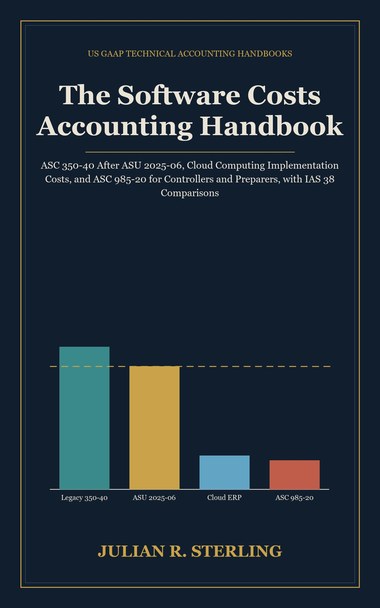
On September 18, 2025, the FASB issued ASU 2025-06, removing the legacy three-stage model from ASC 350-40 and replacing it with a probable-to-complete recognition threshold anchored on significant development uncertainty. At the same close, controllers still account for cloud ERP implementations under ASU 2018-15 (operating cash flows and operating expense amortization) and on-premise licensed software under ASC 985-20 (technological feasibility, greater-of amortization, and annual Net Realizable Value testing). This handbook works all three frameworks through one live US GAAP case.
The Software Costs Accounting Handbook follows one fictional company, Kestrelway Systems, Inc. (revenue $18,400,000, 22 engineers, $3,920,000 annual loaded compensation), across five software projects in fiscal 2026 and a 2027 to 2029 runoff: internal-use SaaS capitalization comparing Legacy ASC 350-40 ($1,767,200) against ASU 2025-06 ($1,526,000), abandonment and canceled-project write-offs ($325,000), a cloud ERP implementation ($420,000) contrasted against IAS 38 / IFRIC 2021, an ASC 985-20 licensed product with a 2027 NRV write-down ($20,429), and a web portal after ASC 350-50's supersession. Every figure ties to a live, unlocked Excel workbook.
What is inside
- Introduction
- Chapter 1: Scope First: Internal-Use, Cloud Hosting, and External-Use Software
- Chapter 2: Legacy ASC 350-40 vs. ASU 2025-06: From Project Stages to Significant Development Uncertainty
- Chapter 3: Capitalizable vs. Expensed Costs: Payroll, Stock-Based Compensation, Contractors, and Overhead
- Chapter 4: Agile Sprints, Time Tracking, and Audit Evidence
- Chapter 5: Capitalized Interest, Data Conversion, Training, and Website Costs
- Chapter 6: Upgrades, Enhancements, and Routine Maintenance
- Chapter 7: Amortization, Useful Life, and Readiness for Intended Use
- Chapter 8: Impairment, Abandonment, and Canceled Projects
- Chapter 9: Cloud Computing Hosting Arrangements Under ASC 350-40
- Chapter 10: Software to Be Sold, Leased, or Marketed Under ASC 985-20
- Chapter 11: Balance Sheet, Income Statement, Cash Flow, and EBITDA Impact
- Chapter 12: Adopting ASU 2025-06: Effective Dates, Transition Methods, and ASC 360-10 Disclosures
- Chapter 13: Deferred Taxes and the Divergence From Federal Tax Rules
- Chapter 14: IFRS Comparison: IAS 38 and the IFRIC Cloud Computing Decisions
- Chapter 15: Month-End Close Controls, Accounting Policy Memos, and Audit Readiness
- Conclusion
- Appendix A: The Kestrelway Model, Tab by Tab
- Appendix B: Practitioner Checklists and Close Controls
- Appendix C: Glossary of Software Accounting Terms
Free companion files
The live Excel workbooks behind every figure of the book. Inputs in blue, formulas in black, automated Controls tab reading zero. No sign-up required for book readers.
Appendix A, chapters 1 to 15
Kestrelway companion workbook
Seven tabs: Inputs, Project A - IUS (Legacy vs. ASU 2025-06), Project B - Impairment, Project C - Cloud (with IFRS contrast), Project D - ASC 985-20, Roll-Forward & P&L (EBITDA, leverage covenant, cash flows, transition, deferred tax), and Controls.
Download companion workbook (.xlsx)17 KBStandalone practitioner calculator
Software Cost Capitalization Model
Four clean tabs pre-loaded with a worked example so you can enter your own projects immediately.
Download free calculator (.xlsx)9 KB
Want the standalone calculator first? Open the free software cost capitalization model page for the worked example and Excel download.
Worked articles from the book
- ASC 350-40 software capitalization rules after ASU 2025-06How ASU 2025-06 removes sequential project stages, introduces significant development uncertainty, folds in website costs, and changes capitalization, amortization, and transition.
- Cloud computing implementation costs: ASC 350-40 accountingThe two-criterion license vs. service contract test, what cloud setup costs qualify for capitalization, how amortization reduces EBITDA, operating cash flow classification, and the IFRIC 2021 gap.
- ASC 350-40 vs. ASC 985-20: internal-use and external softwareWhere the scope boundary sits between hosted SaaS and on-premise licenses, probable-to-complete vs. technological feasibility, greater-of amortization, and annual Net Realizable Value testing.
Also by Julian R. Sterling
Related accounting handbooks. Full list on the author page.