Book · Julian R. Sterling
The Rolling Forecast Handbook
Driver-Based Forecasts, 12-to-18-Month Horizons, Budget vs Forecast, Variance Commentary, and the Planning Cadence of FP&A Teams
Google Play Paperback, $32.99 PDF edition, $19.99
Buying for your firm? Add your company name and VAT number at checkout and they go on the invoice. Copies for a whole team: write to us.
About the book
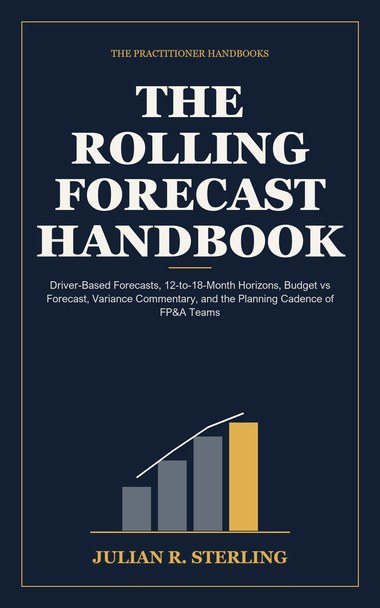
Static annual budgets take three months to build, break by April, and shrink management visibility to a two-month stub every autumn. This handbook shows CFOs, FP&A leaders, controllers, and operating executives how to build a monthly 18-month driver-based rolling forecast tied directly to working capital, bank covenants, decision-grade variance commentary, and Forecast Value Added (FVA) governance.
Every calculation is worked on one fictional U.S. mid-market manufacturer, Kestrel Precision Instruments, Inc.: cutting annual budget effort by 65.0 percent (2,400 to 840 hours), compressing monthly forecast turnaround from 18 to 6 business days, lowering 1-month revenue WAPE from 9.4 percent to 2.6 percent (+0.4 percent bias), holding year-end leverage at 1.97x (avoiding an unmitigated 3.05x covenant breach), and paying back its $112,000 investment in 4.6 months ($620,129 3-year NPV at 10.0 percent).
Paperback, $32.99, shipping included to the United States, the United Kingdom, Europe, and Australia.
PDF edition, $19.99, DRM-free, delivered at once by email.
What is inside
- Introduction
- Chapter 1: Why Static Annual Budgets Break and What a Rolling Forecast Fixes
- Chapter 2: Choosing the Horizon, Cadence, and Granularity (12 vs. 18 Months)
- Chapter 3: Budget vs. Forecast vs. Actual: Running Both Without Double Work
- Chapter 4: Designing the Driver Tree: From Operational Metrics to P&L
- Chapter 5: Driver-Based Revenue Forecasting: Bookings, Backlog, and Recurring Waterfalls
- Chapter 6: Cost of Goods Sold, Capacity, and Headcount-Driven OpEx
- Chapter 7: Extending the Rolling Forecast to the Balance Sheet, Cash Flow, and Debt Covenants
- Chapter 8: Multi-Baseline Variance Analysis: Actual vs. Budget, Prior Forecast, and Prior Year
- Chapter 9: Writing Decision-Grade Variance Commentary
- Chapter 10: Forecast Accuracy Metrics: MAPE, WAPE, Bias, and Forecast Value Added (FVA)
- Chapter 11: Scenarios, Sensitivities, and Trigger-Based Contingency Plans
- Chapter 12: The Monthly Planning Cadence: Closing and Rolling in Six Business Days
- Chapter 13: Spreadsheet Architecture, Version Control, and EPM Readiness
- Chapter 14: External Governance: Lenders, Boards, U.S. GAAP, and Public Disclosure Rules
- Chapter 15: Implementation Roadmap, Change Management, and the FP&A Business Case
- Conclusion: Ten Operating Rules for a Rolling Forecast That Stays Alive
- Appendix A: Glossary
- Appendix B: Formulas and Worked Checks
- Appendix C: Checklists and Templates
- Appendix D: Companion Files
Free companion files
Unlocked Excel workbooks, blue inputs, black formulas, zero macros, and a Controls tab that reads 0.
Complete case model
Kestrel Rolling Forecast Case Workbook
8 tabs reproducing every calculation, vintage, PVM bridge, covenant test, and FVA table in the book.
Download Rolling_Forecast_Case_Workbook.xlsx25 KBStandalone practitioner tool
18-Month Rolling Forecast Template
Driver-based 18-month model, Scenario Selector, Budget vs. Forecast variance commentary, WAPE/Bias tracker, and 6-day cadence calendar.
Download Rolling_Forecast_Template.xlsx22 KB
Want the standalone template first? Open the free Rolling Forecast Template (Excel) page.
Worked articles from the book
- Rolling Forecast vs. Annual Budget: Running Both Without Double WorkWhy static annual budgets break by April, how an 18-month rolling forecast cuts budgeting hours by 65 percent, and the full pre-tax ROI business case.
- Driver-Based Forecast Model in Excel: 12 Drivers, Cash Sweep, and ControlsHow to build an unlocked, macro-free 18-month rolling forecast in Excel with a dynamic Actual/Forecast switch, exact PVM bridge, and Controls = 0.
- Forecast Accuracy for FP&A Teams: WAPE, MAPE, Bias, and FVAWhy WAPE beats MAPE across corporate portfolios, how to track directional Bias, and how Forecast Value Added (FVA) audits commercial overrides.
Questions practitioners ask
Who is this handbook written for?
CFOs, VPs of Finance, FP&A directors and managers, corporate controllers, and operating executives who run monthly planning and board reporting.
Which accounting and disclosure rules are covered?
FASB ASC 205-40 (going concern), ASC 330 (inventory standard costing and PPV), ASC 340-40 (contract acquisition costs), ASC 350-20 and ASC 360-10 (impairment), ASC 606 (revenue recognition), ASC 740-270 (interim taxes), plus PSLRA 15 U.S.C. 78u-5, SEC Regulation FD, and Regulation G / Item 10(e), all as read in November 2026.
Are the Excel workbooks included free?
Yes. Both Rolling_Forecast_Case_Workbook.xlsx and the standalone Rolling_Forecast_Template.xlsx are free on this page, unlocked, and macro-free.