Book · Julian R. Sterling
The Revenue-Based Financing Handbook
Lending Against Recurring Revenue: RBF Structures, Repayment Caps and Holdback Rates, Underwriting SaaS and E-Commerce Cash Flows, Warrants and Covenants, Platform Economics, and the Credit Math of Lenders and Founders
Google Play Paperback, $32.99 PDF edition, $19.99
Buying for your firm? Add your company name and VAT number at checkout and they go on the invoice. For a team: team license, up to 10 people, $59.99 · firm-wide license, $139.99.
About the book
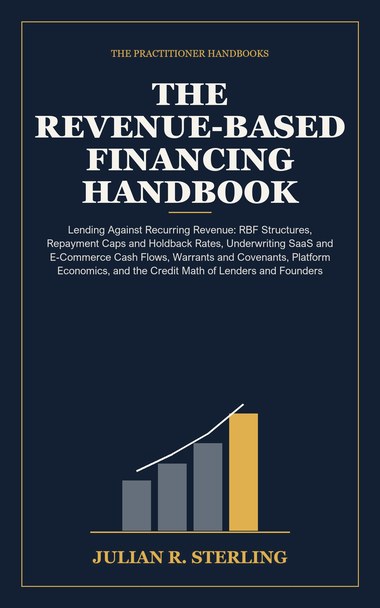
Revenue-based financing (RBF) occupies the white space between dilutive venture equity and rigid commercial bank debt, yet both founders and lenders routinely misprice repayment caps, holdback margin drag, and warehouse facility triggers. This handbook provides the complete credit math, underwriting playbook, legal and regulatory architecture, GAAP and tax accounting, and institutional warehouse modeling of recurring-revenue lending.
Every calculation is worked deterministically across three fictional reference cases: VantageFlow Software, Inc. ($250,000 MRR, $1,500,000 advance, 1.45x cap, 8.0 percent holdback: 53 months Base payback at 16.45 percent EAR, 40 months Upside at 20.90 percent, $19.85 million Equity indifference exit), Harborline Home Goods, LLC ($300,000 e-commerce advance at 41.19 percent to 45.89 percent EAR), and Meridian Revenue Capital Partners, LP ($100.0 million portfolio, 75.0 percent warehouse line delivering 24.96 percent Base ROE and 6.12 percent Recession Stress ROE).
Paperback, $32.99, shipping included to the United States, the United Kingdom, Europe, and Australia.
PDF edition, $19.99, DRM-free, delivered at once by email.
What is inside
- Introduction
- Chapter 1: The Revenue-Based Financing Spectrum
- Chapter 2: Repayment Caps, Holdback Rates, and the RBF Growth Paradox
- Chapter 3: Maturity Backstops, Minimum Payments, and Prepayment Step-Downs
- Chapter 4: E-Commerce and DTC Revenue-Based Financing Economics
- Chapter 5: Underwriting B2B SaaS Cohorts, Retention, and Churn
- Chapter 6: Unit Economics, CAC Payback, and Deployment Discipline
- Chapter 7: Underwriting E-Commerce, Marketplace, and Multi-Channel Cash Flows
- Chapter 8: Sizing the Advance: MRR Multiples, Cash-Flow Coverage, and Severe Stress
- Chapter 9: RBF vs. Venture Debt vs. Equity Dilution
- Chapter 10: Warrants, Equity Kickers, Covenants, and Intercreditor Friction
- Chapter 11: Legal Structure, Recharacterization Risk, UCC Article 9, and Disclosure Laws
- Chapter 12: U.S. GAAP Accounting and Federal Income Tax Treatment of RBF
- Chapter 13: RBF Platform Unit Economics, Vintage Curves, and Loss Modeling
- Chapter 14: Warehouse Credit Facilities, Advance Rates, and Levered Platform ROE
- Chapter 15: Portfolio Monitoring, Early Warning Signals, and Distressed Workouts
- Conclusion: The Five Iron Rules of Revenue-Based Financing
- Appendix A: Glossary of Revenue-Based Financing, SaaS Credit, and Warehouse Terms
- Appendix B: Worked Reference Formulas and Summary Tables
- Appendix C: RBF Credit Committee Underwriting Checklist and Institutional Term Sheet Framework
- Appendix D: Companion Excel Workbooks User Guide
Free companion files
Unlocked Excel workbooks, blue inputs, black formulas, zero macros, zero circular references, and a Controls tab that reads 0.
Complete case model
VantageFlow RBF Credit Case Workbook
8 tabs reproducing every SaaS scenario, prepayment step-down, GAAP Year 1 schedule, Venture Debt & Equity comparison, Harborline e-commerce run, Meridian warehouse stress test, and Controls = 0.
Download VantageFlow_RBF_Credit_Workbook.xlsx40 KBStandalone practitioner tool
RBF Repayment & Comparison Model (Excel)
Interactive 60-month RBF repayment, effective IRR/APR, Venture Debt vs. Equity dilution comparison, and Lender Warehouse ROE template.
Download RBF_Repayment_Model.xlsx22 KB
Want the standalone template first? Open the free RBF Repayment Model (Excel) page.
Worked articles from the book
- How Revenue-Based Financing Works: Caps, Holdbacks, and the Growth ParadoxExact monthly repayment math, effective annualized IRR vs. nominal APR, prepayment step-downs, and SaaS vs. e-commerce RBF economics.
- Revenue-Based Financing vs. Venture Debt vs. Equity DilutionSide-by-side cash-flow burden, warrant dilution, Month 13 amortization cliff, and exact indifference exit valuation on a $1.5 million SaaS raise.
- Underwriting Recurring-Revenue Loans and RBF Warehouse FacilitiesGRR vs. NDR cohort audits, Severe Stress loss severity, UCC Article 9 and DACA perfection, and $100M warehouse facility Levered ROE.
Questions practitioners ask
Who is this handbook written for?
B2B SaaS and e-commerce founders and CFOs evaluating non-dilutive growth capital, as well as private credit underwriters, RBF fund managers, warehouse lenders, and corporate finance advisors.
Does the book cover 2026 state disclosure laws and post-OBBBA Section 163(j)?
Yes. Chapters 11 and 12 cover all eleven active state commercial financing disclosure statutes (California SB 1235, New York CFDL 23 NYCRR Part 600, Utah, Virginia, Florida HB 1353, Georgia, Connecticut, Kansas SB 345, Missouri SB 1359, Louisiana HB 470, and Texas HB 700), UCC Article 9 and DACAs, ASC 470-10-25 and ASC 835-30, CPDI rules, and IRC Section 163(j) after Public Law 119-21 restored EBITDA-based ATI.
Are the Excel RBF models included free?
Yes. Both VantageFlow_RBF_Credit_Workbook.xlsx and the standalone RBF_Repayment_Model.xlsx are free on this page, unlocked, and macro-free with Controls = 0.