Book · Julian R. Sterling
The Loyalty Program Handbook
A Practitioner's Guide for Finance, Marketing and Accounting Teams: Program Economics, Breakage Estimation, ASC 606 Points Accounting, Co-Brand Cards and Incrementality
About the book
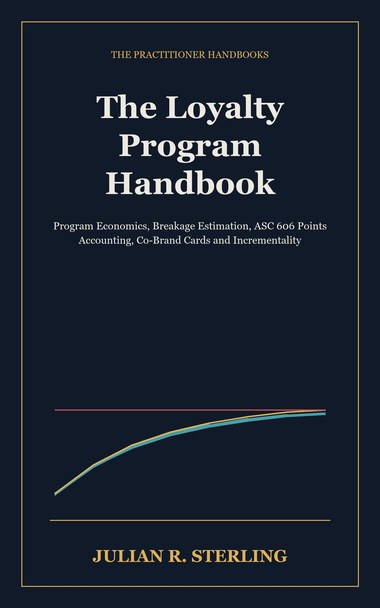
A loyalty program issues a currency. Every point is a promise of a future discount, so it is at once a marketing tool, a cost that arrives later and a liability on the balance sheet. Marketing sees engagement, finance sees a deferral it cannot explain, and the board sees member sales that look like a triumph. This handbook joins the three views: what a point costs, how many points will ever come back, how the sale is split between goods and points under ASC 606, how the liability moves, and what the program really earns.
The Loyalty Program Handbook works the whole discipline on one fictional company, Larkspur Home & Outdoor, Inc., a Columbus, Ohio specialty retailer with 214 stores in 17 states and net sales of $1,840,000,000 in 2025. Its program issues 1,413,120,000 points in 2025; a redemption triangle and a chain ladder put the ultimate redemption rate of the year's cohorts at 75.7 percent; a point is priced at $0.01476; the points liability rolls forward to $10,380,696.95; and a randomized holdout test shows an 8.5 percent lift that returns 18.0 percent on program cost, where the naive view credited the program with $494,592,000.00. The earn rates, reward values, redemption data, costs, test results and partner terms of the case are illustrative. Standards, tax rules and regulatory positions are described as read in November 2026.
Who it is for
- Controllers, revenue accountants and auditors who must support the breakage estimate, the standalone selling price of a point, the roll-forward and the disclosure.
- CFOs and FP&A teams who budget the program, forecast reward cost and the liability, and answer the board on what the program returns.
- Loyalty and marketing leaders who design earn rates, rewards and tiers and need to know what each change costs before it ships.
- Tax directors and advisors who need the advance payment rules, the co-brand card allocation and the regulatory exposure in one place.
What is inside
Introduction
- Introduction
Part I, The Economics of a Points Currency
- Chapter 1: What a Loyalty Program Is For: Behavior, Data and Margin
- Chapter 2: Designing the Currency: Earn Rates, Reward Value and Tiers
- Chapter 3: What a Point Costs: Reward Funding, Program P&L and Cost per Point
Part II, Measuring Redemption
- Chapter 4: Redemption Behavior: Curves, Cohorts and the Triangle
- Chapter 5: Estimating Ultimate Redemption: Chain Ladder, Tails and Judgment
Part III, Accounting for Points
- Chapter 6: Points as a Material Right under ASC 606
- Chapter 7: Pricing a Point: Standalone Selling Price and Allocation
- Chapter 8: Recognizing Revenue: Redemptions, Breakage and Changes in Estimate
- Chapter 9: The Points Liability: Roll-Forward, Disclosure, Audit and IFRS
- Chapter 10: Partners and Co-Brand Credit Cards
Part IV, Value, Risk and Operation
- Chapter 11: Proving the Program Works: Incrementality and ROI
- Chapter 12: Tax, Expiration and the Regulators
- Chapter 13: Budgeting and Forecasting the Program
- Chapter 14: Governance, KPIs and Program Changes
Conclusion and appendices
- Conclusion
- Appendix A: The Companion Workbook, Tab by Tab
- Appendix B: Templates and Checklists
- Appendix C: Forty Questions for Your Loyalty Program
- Appendix D: Glossary
The Larkspur case in figures
Every figure below is computed by the book's model and reproduced in the companion workbook. Larkspur Home & Outdoor, Inc. and every person in the case are fictional; the earn rates, reward values, redemption data, costs, test results and partner terms are illustrative.
| Item | Value |
|---|---|
| Net sales 2025 / member share / member sales | $1,840,000,000 / 64 percent / $1,177,600,000 |
| Earn rate / reward / face value of a point | 1 point per $1 (Gold 1.5) / $10 per 500 points / $0.02 |
| Points issued in 2025 / redeemed / expired | 1,413,120,000 / 1,017,112,733 / 319,930,131 |
| Ultimate redemption rate of the 2025 cohorts / breakage | 75.7 percent / 24.3 percent |
| SSP of a point for 2025 sales ($0.02 x 73.8 percent) | $0.01476 |
| $100.00 purchase: allocated to points, Member / Gold rate | $1.45 / $2.17 |
| Revenue allocated to points earned in 2025 / share of member sales | $20,480,067.76 / 1.74 percent |
| Loyalty revenue 2025: redemptions / breakage / total | $14,665,527.36 / $4,808,358.08 / $19,473,885.44 |
| Change in estimate (cumulative catch-up, adds to the liability) | $426,689.44 |
| Points liability: January 1, 2025 / December 31, 2025 | $9,374,514.63 / $10,380,696.95 |
| Liability with URR minus 3 points / plus 3 points | $9,463,844.04 / $11,336,659.89 |
| Legacy incremental cost view (not acceptable under ASC 606) | $6,289,936.11 |
| Reward cost 2025 at face / at merchandise cost / operating costs | $20,342,254.66 / $11,798,507.70 / $12,500,000 |
| Holdout test: lift / incremental gross margin | 8.5 percent / $38,746,838.71 |
| Net contribution and return: margin view / cash view | $5,904,584.05 (18.0 percent) / $14,448,331.01 (59.5 percent) |
| Co-brand card year 1 consideration / allocated to points | $13,740,000 / $5,406,955.47 |
| 2026 plan: revenue allocated / loyalty revenue / closing liability | $23,042,084.88 / $21,760,665.66 / $11,662,116.17 |
| Taxed in 2026 before recognition in the financial statements | $1,081,930.36 |
Free companion files
The live Excel files behind every table in the book. Blue inputs, black formulas, no macros, and a Checks tab that must read zero. No sign-up required for book readers.
Appendix A, chapters 1 to 14
The Larkspur companion workbook
Fifteen tabs: README, Inputs, Cohorts, Triangle, Chain_Ladder, Allocation, Recognition, Rollforward, Sensitivity, Economics, Incrementality, CoBrand, Plan_2026, Tax and Checks. The quarterly cohorts, the redemption triangle and the chain ladder, the SSP of a point and the allocation, revenue recognition with breakage, the liability roll-forward and its sensitivity, the program economics and the holdout test, the co-brand card allocation, the 2026 plan, the tax schedule and the checks.
Download Loyalty_Program_Workbook.xlsx44 KBStandalone practitioner tool
Loyalty Points Liability Calculator
Enter your point value, two earn rates and up to 12 quarterly cohorts with their cumulative redemptions; read the chain-ladder factors, the ultimate redemption rate and breakage of each cohort, the SSP of a point, the allocation of a purchase, the revenue to date and the points liability by cohort, with a sensitivity table. Prefilled with Example Co., an illustrative program to replace.
Download Loyalty_Points_Liability_Calculator.xlsx27 KB
Want the calculator first? Open the free Loyalty Points Liability Calculator page for what it computes and the Excel download.
Worked articles from the book
- How to Estimate Loyalty Program Breakage: Redemption Triangles and the Chain LadderBreakage is one minus the ultimate redemption rate, estimated cohort by cohort with a redemption triangle and chain-ladder factors, then weighted by points. Worked on a retailer's 12 quarterly cohorts.
- Accounting for Loyalty Points under ASC 606: Material Right, SSP, Breakage and the LiabilityPoints are a material right: price them at reward value times expected redemption, allocate the sale, recognize revenue as points are redeemed and roll the liability forward. Worked to the cent.
- How to Measure Loyalty Program ROI: Incrementality, Holdout Tests and Cost per PointROI comes from the sales a program causes, measured against a randomized holdout group, net of rewards and operating costs. Worked on one retailer's 8.5 percent lift, in two views.
Questions practitioners ask
Who is this book for?
Controllers, revenue accountants and auditors, CFOs and FP&A teams, loyalty and marketing leaders, tax directors and the advisors who work with retailers, restaurants, travel and hospitality businesses and any company that runs a points program.
Which standards and rules does it cover?
ASC 606 as the main framework (material rights, standalone selling price, breakage, principal versus agent and disclosure), IFRS 15 in boxes, US federal tax under IRC 451 and Treas. Reg. 1.451-8, gift card and unclaimed property rules, and the positions of US regulators on devaluation, all as read in November 2026.
Does it show a full breakage and liability calculation?
Yes. One fictional retailer builds a redemption triangle by quarterly cohort, develops it with a chain ladder to an ultimate redemption rate of 75.7 percent, prices a point at $0.01476, allocates $20,480,067.76 of 2025 sales to points and rolls the liability forward to $10,380,696.95, with a cumulative catch-up for the change in estimate.
Are the companion files free?
Yes. The 15-tab workbook and the standalone Loyalty Points Liability Calculator are free on this page, with no sign-up for book readers.
Is this accounting or tax advice?
No. The book explains the standards, practitioner methods and calculations as read in November 2026. Check the current standards, your program terms and your auditors' and tax advisers' views before acting.
Also by Julian R. Sterling
Related titles. Full list on the author page.