Book · Julian R. Sterling
The Inventory Carrying Cost Handbook
Capital, Storage, Handling, Insurance, Obsolescence, and Shrink Costs of Holding Stock, and What a Lower Inventory Is Worth
Paperback, $32.99 PDF edition, $19.99
About the book
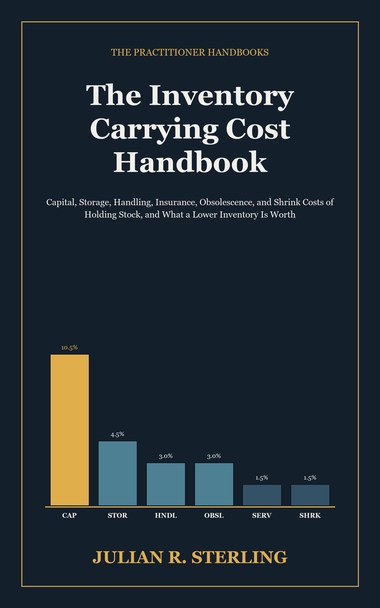
Most executives underprice holding stock by 3x because carrying costs hide across six separate general ledger departments. This handbook shows finance and supply chain leaders how to measure every dollar of capital, storage, handling, insurance, property tax, obsolescence, and shrinkage cost, separate fixed leases from marginal cash savings, and quantify exactly what a lower inventory is worth.
Every calculation is worked on one fictional U.S. industrial distributor, Bramwell Industrial Components, Inc. ($64,000,000 revenue, $40,000,000 COGS, $12,000,000 average book inventory): cutting $3,000,000 of excess stock (25.0 percent) to save $918,000/year in economic cost (30.6 percent marginal rate), $603,000/year in recurring EBITDA, and $2,500,000 in net cash ($6,721,000 Equity Value at 7.0x EV/EBITDA) with only an $8,500 dip in ABL borrowing-base availability.
Paperback, $32.99, shipping included to the United States, the United Kingdom, Europe, and Australia.
PDF edition, $19.99, DRM-free, delivered at once by email.
What is inside
- Introduction
- Chapter 1: The Inventory Carrying Cost Formula and the General Ledger Blind Spot
- Chapter 2: Cost of Capital: WACC, Incremental Borrowing Rate, and Opportunity Cost
- Chapter 3: Storage Space Costs: Fixed Leases, ASC 842, and Variable Overflow
- Chapter 4: Handling, Re-Slotting, and Inventory Administration Costs
- Chapter 5: Service Costs: Stock Insurance, Property Taxes, and IRC Section 263A
- Chapter 6: Risk Costs: Obsolescence, LCNRV Write-Downs, Shrinkage, and Damage
- Chapter 7: Fully Loaded vs. Marginal Carrying Cost: What Actually Changes When Stock Drops
- Chapter 8: Carrying Cost by Aging Tier and SKU Segment
- Chapter 9: EOQ, Order Sizing, and the Supplier Quantity Discount Trap
- Chapter 10: Quantifying Excess and Obsolete (E&O) Inventory and Liquidation Math
- Chapter 11: Four Levers to Cut Inventory Without Hurting Fill Rates
- Chapter 12: Cash Flow, ABL Borrowing Base, and Working Capital Liquidity
- Chapter 13: What a Lower Inventory Is Worth: EBITDA, DCF, and Enterprise Value
- Chapter 14: The 12-Month Reduction Roadmap and Quarterly Financial Bridge
- Chapter 15: Governance, KPIs, and Embedding Carrying Cost Into Commercial Decisions
- Conclusion: Ten Rules for Turning Shelves Back Into Cash and Equity Value
- Appendix A: Glossary
- Appendix B: Formulas and Worked Checks
- Appendix C: Checklists and Governance Templates
- Appendix D: Companion Files
Free companion files
Unlocked Excel workbooks, blue inputs, black formulas, zero macros, and a Controls tab that reads 0.
Complete case model
Bramwell Inventory Carrying Cost Workbook
8 tabs reproducing every number in the book.
Download Inventory_Carrying_Cost_Workbook.xlsx24 KBStandalone practitioner tool
Inventory Carrying Cost Calculator
Audit your 6 GL buckets, estimate Equity Value of lower stock, and test 10 supplier bulk-discount pitches.
Download Inventory_Carrying_Cost_Calculator.xlsx18 KB
Want the standalone tool first? Open the free Inventory Carrying Cost Calculator page.
Worked articles from the book
- Inventory Carrying Cost Formula: Six General Ledger Buckets and Marginal SavingsHow to build an auditable carrying cost formula from your trial balance, why 13-point averages beat year-end snapshots, and how fixed leases separate from marginal cash savings.
- Inventory Carrying Cost Percentage: Benchmarks, Aging Tiers, and the EOQ TrapWhy 20 to 30 percent benchmarks diverge by WACC, state property tax, and aging tier, and how naive bank rates corrupt EOQ and supplier volume discounts.
- The Cost of Excess Inventory: Liquidation Math, ABL Liquidity, and Equity ValueWhy holding dead stock destroys cash, how four surgical levers cut 25 percent of stock without hurting fill rates, and why lower inventory is worth $2.24 per dollar cut.
Questions practitioners ask
Who is this handbook written for?
CFOs, corporate controllers, supply chain vice presidents, warehouse directors, and inventory planning managers.
Which accounting and tax standards are covered?
FASB ASC Topic 330 (LCNRV and obsolescence), FASB ASC Topic 842 (fixed vs. variable warehouse leases), IFRS IAS 2, IRC Section 263A UNICAP and Section 448(c) thresholds, state inventory property taxes, and ABL borrowing-base conventions, all as read in November 2026.
Are the Excel workbooks included free?
Yes. Both Inventory_Carrying_Cost_Workbook.xlsx and the standalone Inventory_Carrying_Cost_Calculator.xlsx are free on this page with zero macros.