Book · Julian R. Sterling
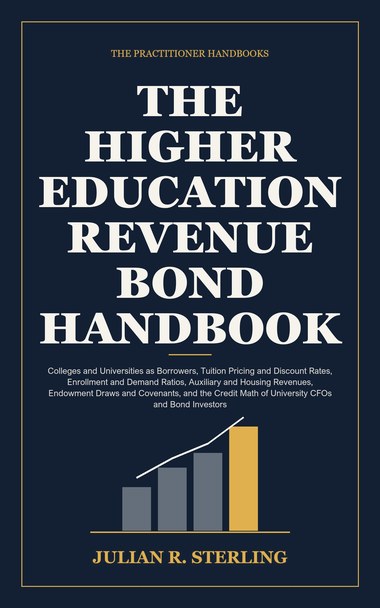
The Higher Education Revenue Bond Handbook
Colleges and Universities as Borrowers, Tuition Pricing and Discount Rates, Enrollment and Demand Ratios, Auxiliary and Housing Revenues, Endowment Draws and Covenants, and the Credit Math of University CFOs and Bond Investors
Google Play Paperback, $32.99 PDF edition, $19.99
Buying for your firm? Add your company name and VAT number at checkout and they go on the invoice. For a team: team license, up to 10 people, $59.99 · firm-wide license, $139.99.
About the book
Colleges and universities behave neither like corporate borrowers nor like general obligation cities. Enrollment misses compound over four cohorts, tuition discounting accelerates to defend incoming class size, tenured payroll stays fixed, and auxiliary debt service continues on empty residence hall beds. This handbook equips university CFOs and municipal bond analysts with the exact credit math of higher education revenue bonds.
Every calculation is worked on one fictional U.S. private 501(c)(3) comprehensive university, Alderbrook University (4,200 FTE, $156,000,000 operating revenue, 45.2 percent blended tuition discount, $185,000,000 endowment, and $125,000,000 pro forma direct debt including $45,000,000 Series 2026 bonds at 4.75 percent): generating $21,000,000 EBIDA (13.5 percent margin), 2.32x Base MADS coverage ($9,044,425 MADS), 1.69x TCI to Adjusted Debt, 1.08x Available Resources to Direct Debt, 260 Unrestricted Days Cash on Hand, a 2.93 Department of Education Composite Score, and full stress testing from 1.16x Moderate Stress to 0.17x Unmitigated Severe Stress and 1.20x Mitigated recovery.
Paperback, $32.99, shipping included to the United States, the United Kingdom, Europe, and Australia.
PDF edition, $19.99, DRM-free, delivered at once by email.
What is inside
- Introduction: Why University Credit Breaks Differently
- Chapter 1: Colleges and Universities as Municipal Borrowers
- Chapter 2: Public vs. Private University Financial Statements (GASB 35 vs. FASB ASC 958)
- Chapter 3: Enrollment Funnels, Selectivity, Yield, and Demographic Demand Ratios
- Chapter 4: Gross Tuition, Tuition Discount Rates, and Net Tuition Realization
- Chapter 5: Auxiliary Enterprises: Student Housing, Dining, Parking, and Athletics
- Chapter 6: Endowments, UPMIFA Draws, Gift Flows, and IRC Section 4968
- Chapter 7: University Cost Structure, Tenure Rigidity, and Operating Margins
- Chapter 8: Debt Architecture, MADS, and Debt Service Coverage Ratios
- Chapter 9: Balance Sheet Liquidity, Available Resources, and Days Cash on Hand
- Chapter 10: Security Pledges, Master Trust Indentures, and Bond Covenants
- Chapter 11: Credit Rating Methodologies: Moody's and S&P Global Ratings
- Chapter 12: U.S. Department of Education Composite Score and Title IV Risk
- Chapter 13: Enrollment Stress Testing, Sensitivity Matrices, and CFO Action Plans
- Chapter 14: Continuing Disclosure (SEC Rule 15c2-12), EMMA, and Investor Surveillance
- Chapter 15: Capital Planning, Distressed Turnarounds, Mergers, and Teach-Outs
- Conclusion: Credit Discipline for University CFOs and Municipal Investors
- Appendix A: Higher Education Credit and Municipal Bond Glossary
- Appendix B: Worked Formulas and Credit Ratio Compendium
- Appendix C: CFO Issuance Checklist and Bond Investor Due Diligence Questions
- Appendix D: Companion Excel Workbooks Guide
Free companion files
Unlocked Excel workbooks, blue inputs, black formulas, zero macros, and a Controls tab that reads 0.
Complete case model
Alderbrook University Bond Case Workbook
8 tabs reproducing every admissions, tuition discount, auxiliary NOI, endowment draw, Series 2026 MADS, liquidity, Composite Score, and 4-scenario stress table in the book.
Download Higher_Education_Bond_Case_Workbook.xlsx25 KBStandalone practitioner tool
Higher Education Credit Model Template
Unlocked Excel model for any college or university issuer: admissions funnel, gross-to-net tuition, auxiliaries, MADS coverage, Available Resources to Debt, DCOH, and two-way enrollment stress matrix.
Download Higher_Education_Credit_Model_Template.xlsx17 KB
Want the standalone template first? Open the free Higher Education Credit Model Template (Excel) page.
Worked articles from the book
- What Are Higher Education Revenue Bonds? Conduit Issuers, Tax Rules, and PledgesHow public and private 501(c)(3) universities issue tax-exempt revenue bonds under IRC Sections 145, 147(f), and 148, plus Master Trust Indenture security pledges.
- Tuition Discount Rate and Net Tuition: How Pricing Drives University Bond CreditGross-to-net tuition accounting under FASB ASC 958 and GASB 35, the exact break-even discount creep formula, and freshman vs. all-undergraduate discount trends.
- University Debt Service Coverage and Liquidity: EBIDA, MADS, DCOH, and Stress MathWorked credit ratios for university CFOs and municipal bond analysts: MADS coverage, Moody's TCI vs. S&P Available Resources, Days Cash on Hand, and enrollment shocks.
Questions practitioners ask
Who is this handbook written for?
University CFOs, treasurers, budget directors, finance committee trustees, municipal bond analysts, portfolio managers, and municipal advisors who structure or underwrite higher education revenue bonds.
Which tax, accounting, and rating frameworks are covered?
IRC Sections 103, 141, 145, 147(f), 148, and 2026 tiered Section 4968; FASB ASC 958 and ASC 842; UPMIFA; GASB Statements No. 35, 68, 75, 87, and 96; SEC Rule 15c2-12 and EMMA; 34 CFR Part 668 Subpart L Composite Scores; and Moody's and S&P Global Ratings higher education criteria.
Are the Excel workbooks included free?
Yes. Both Higher_Education_Bond_Case_Workbook.xlsx and the standalone Higher_Education_Credit_Model_Template.xlsx are free on this page, unlocked, and macro-free.