Book · Julian R. Sterling
The ESOP Handbook
Selling Your Company to an Employee Stock Ownership Plan: Feasibility, Valuation, Leveraged Financing, Section 1042, S Corporation ESOPs and the Repurchase Obligation
About the book
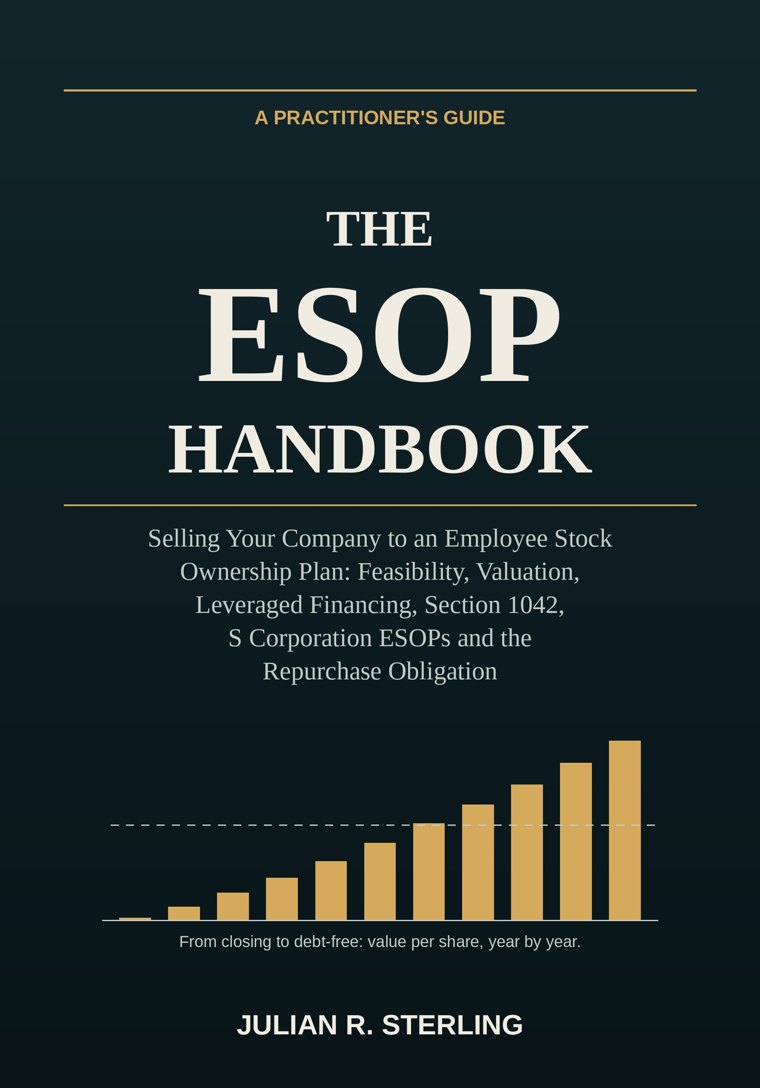
An employee stock ownership plan can let an owner sell at fair market value to a buyer who keeps the company independent, defer the federal tax on the gain and give every employee a stake. It can also load a healthy company with more debt than it has ever carried, turn half of the price into a subordinated seller note and create buyback payments that run for decades. This guide shows how to tell the two outcomes apart before signing.
One fictional company runs through every chapter: Carrow Fastener Supply, an industrial distributor with 142 employees and $6.40 million of adjusted EBITDA, sold 100% to its ESOP for $32.76 million. The book follows the feasibility screen, the founder's after-tax comparison with a strategic offer of $37.00 million, the appraiser's price, a $15.00 million bank loan and a $19.50 million seller note with warrants, the internal loan and the 25% limit, Section 1042, the S election, governance, the participants' accounts, the repurchase obligation, the accounting and a ten-year projection with a stress case.
What is inside:
- 14 chapters in three parts: the decision, the transaction, life after closing
- The seller's money after tax: $27.11 million from the strategic sale against $32.76 million kept invested with full Section 1042 deferral
- Sources and uses, senior debt, seller note and warrants, with the share value from $0.05 after closing to $51.75 ten years later
- The 2026 limits of IRS Notice 2025-67 applied: 415(c), 401(a)(17), 409(o)
- A stress case with EBITDA 15% below plan every year, and a repurchase obligation projection
- Three checklists: feasibility, closing and the annual cycle; a glossary
Free: the ESOP transaction model in Excel
The Carrow model from the book, with live formulas: valuation, sources and uses, the internal loan and the 25% test, ten-year projection, stress case, repurchase schedule and the seller's after-tax comparison. No macros, nothing locked.
What is inside
- Chapter 1: What an ESOP Is (and What It Is Not)
- Chapter 2: Feasibility: Is Your Company a Candidate?
- Chapter 3: The Seller's Economics: ESOP Against a Third-Party Sale
- Chapter 4: Valuation and Adequate Consideration
- Chapter 5: Financing the Purchase: Senior Debt, Seller Notes and Warrants
- Chapter 6: The Internal Loan, Share Release and Contribution Limits
- Chapter 7: Section 1042: Deferring the Seller's Gain
- Chapter 8: The S Corporation ESOP
- Chapter 9: Trustee, Board and Governance
- Chapter 10: Participants: Eligibility, Allocation, Vesting and Diversification
- Chapter 11: Distributions, the Put Option and the Repurchase Obligation
- Chapter 12: Accounting for a Leveraged ESOP
- Chapter 13: The Ten-Year Plan: Carrow's Cash Waterfall Under Stress
- Chapter 14: When ESOPs Go Wrong, and How They End
- Appendix A: The Carrow Model, Tab by Tab
- Appendix B: Checklists
- Glossary
Read first
To read: How does a leveraged ESOP buyout work?
To read: How does the Section 1042 ESOP rollover work?
To read: How do you calculate an ESOP repurchase obligation?
Updates
Dollar limits in the book are the 2026 amounts of IRS Notice 2025-67. The Department of Labor's rule on ESOP valuations was proposed in January 2025 and withdrawn; new rules have been announced. This page will note material changes.
Also by Julian R. Sterling
Related titles. The full list is on the author page.