Courses · Text and Excel course
Unitranche & All-in Yield: price a direct lending deal from margin, OID, fees and call protection
What a direct lender really earns, computed in Excel: the first-out and last-out pieces of a unitranche, the coupon with its floor, OID and fees turned into a yield, the all-in spread and the discount margin, call protection, PIK toggle and delayed draws, and the return of the fund that holds the loan.
$49, or included in All Access
A Course Book in 5 modules, the Case Workbook of a $178.5m unitranche with live IRR, RATE and YIELD formulas, a start file and a solution file for every module, an Exercise Workbook that checks your answers, a 50-question quiz app, and the certificate exam online. Study online in your learner account or download everything, right after payment.
Secure checkout by Stripe. 14-day money-back guarantee. Not sure yet? Read module 1 free and try ten questions below.
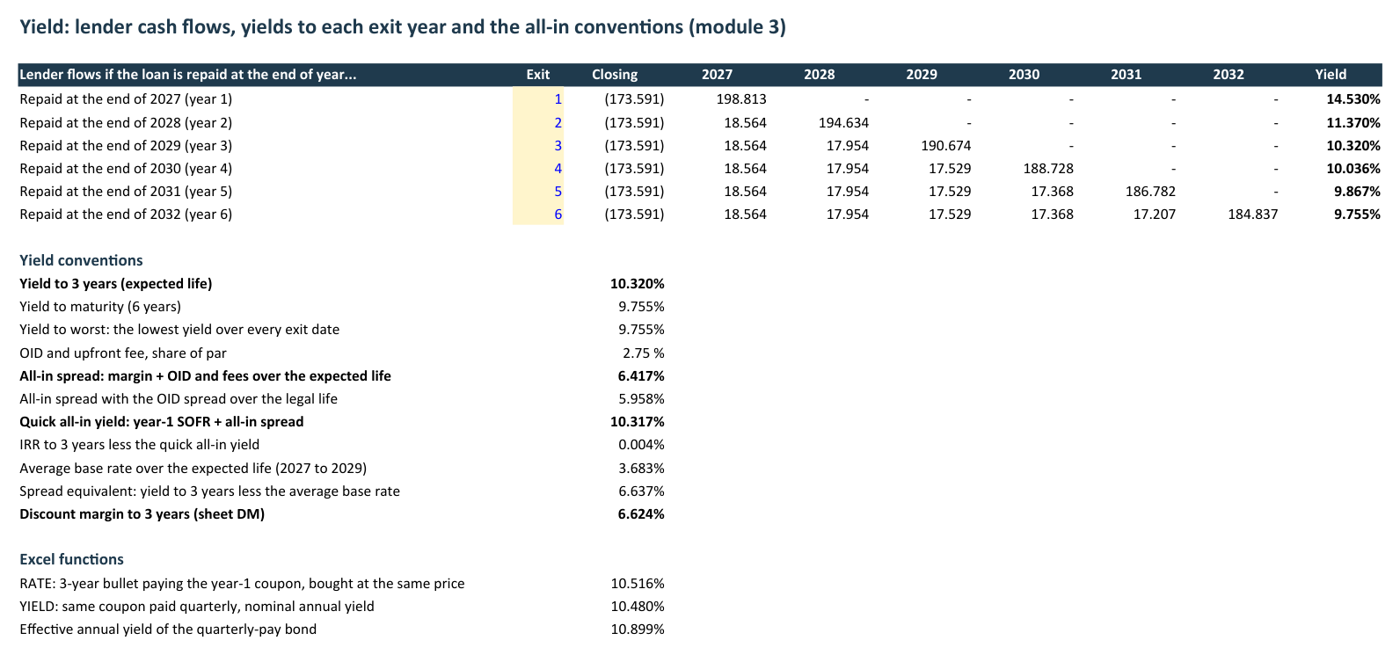
A loan at SOFR + 5.50% bought at 97.25% does not yield SOFR + 5.50%. Repaid after three years it yields 10.32%; held to maturity, 9.75%; repaid in year one under a 102 call, 14.53%. Its last-out piece earns 10.83% and recovers 68.9% in a default where the first-out recovers everything. This course shows where each of those numbers comes from, and how to check it in a spreadsheet.
What you will be able to do
- Split a unitranche into first-out and last-out pieces, find the last-out margin and price each piece on its own recovery.
- Build the coupon from SOFR or Euribor, the floor and the margin, and measure what the floor is worth when rates fall.
- Turn OID and upfront fees into a price, lender cash flows and a yield to three years, to maturity and to worst.
- Use the all-in spread convention, the spread equivalent and the discount margin, and Excel's IRR, RATE and YIELD, knowing what each one measures.
- Value call protection (hard call, soft call, make-whole), a PIK toggle and the ticking and upfront fees of a delayed draw term loan.
- Go from the yield of a loan to the net return of a levered direct lending fund, and compare a unitranche with senior plus mezzanine for the borrower.
- Avoid three classic errors: OID spread over the legal life, the floor ignored, fees counted twice.
The program
5 modules. In each one you read the module in the Course Book, build the module in the workbook from its start file, check yourself in the Exercise Workbook, then take the module quiz.
- 1. Unitranche structure: first-out, last-out and the AALOne loan for the borrower, two risks for the lenders: how an agreement among lenders splits a unitranche into a first-out and a last-out piece, and what each piece earns and recovers. Read the module in the Course Book; build the module exercise in the workbook.
- 2. The coupon: base rate, floor and marginSOFR or Euribor, the floor and the margin: the coupon year by year, the interest on an amortizing balance, and what a floor is worth when rates fall. Read the module in the Course Book; build the module exercise in the workbook.
- 3. OID, fees and the all-in yieldFrom a price of 97.25 to a yield: the lender's cash flows, the yield to three years and to maturity, the all-in spread convention, the discount margin and the Excel functions IRR, RATE and YIELD. Read the module in the Course Book; build the module exercise in the workbook.
- 4. Call protection, PIK toggle and delayed drawsWhat the lender earns if the borrower repays early, pays part of the interest in kind, or draws a delayed draw term loan later: yields to each call date, PIK accretion, ticking and commitment fees. Read the module in the Course Book; build the module exercise in the workbook.
- 5. The fund, the borrower and the pitfallsFrom asset yield to the net return of a levered direct lending fund, the borrower's cost of a unitranche against senior plus mezzanine debt, and three classic errors in yield arithmetic. Read the module in the Course Book; build the module exercise in the workbook.
Try it free
Module 1 in full. Download module 1 of the Course Book (PDF): the unitranche, the agreement among lenders, the first-out and last-out arithmetic and the waterfall in a default, with the worked example and the questions.
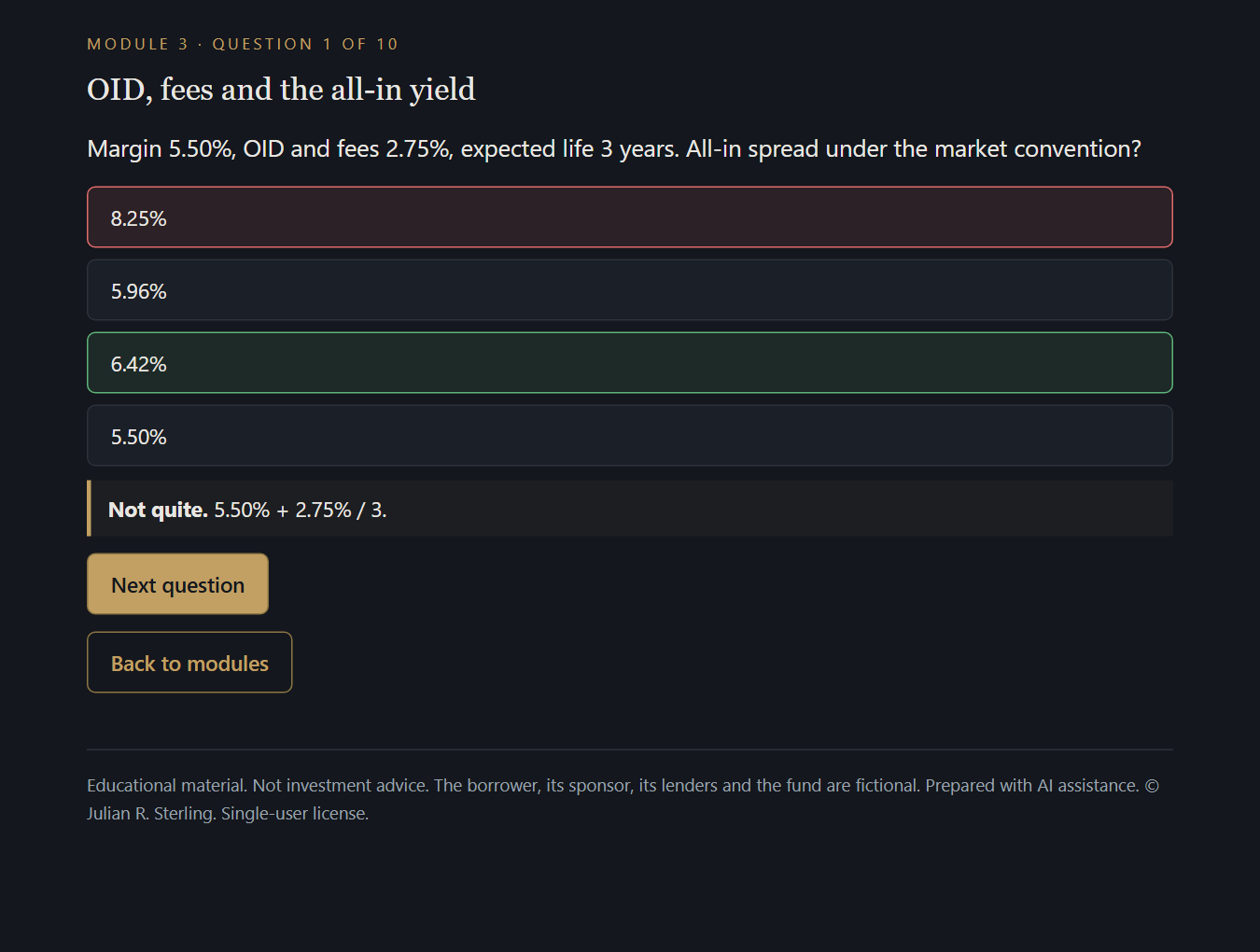
Ten quiz questions. Click an answer: it turns green or red and the explanation appears. The questions use the running case:
Marston Applied Controls (fictional): a US industrial company owned by a sponsor, financed by a $178.5m unitranche at SOFR + 5.50% with a 1.00% floor, an OID of 2.00% and an upfront fee of 0.75%, 1% amortization a year, six years to maturity and a 102 / 101 call schedule.
Module 1
1. A unitranche loan is...
Answer: One loan with one set of terms and one blended rate, replacing a senior and a junior layer. The borrower sees one facility, one agent and one coupon.
Module 1
2. The agreement among lenders (AAL) is...
Answer: A contract between the lenders that splits payments and rights between a first-out and a last-out piece. The borrower is usually not a party to it, or signs only an acknowledgment.
Module 1
3. Compared with the last-out piece, the first-out piece...
Answer: Is paid first from enforcement proceeds and earns a lower margin. Priority in the waterfall is bought with margin.
Module 1
4. Marston's unitranche is $178.5m and the first-out piece is 20% of it. First-out amount?
Answer: $35.70m. 178.5 x 20%.
Module 1
5. The borrower pays a blended margin of 5.50%. The first-out piece (20%) earns 3.50%. Last-out margin?
Answer: 6.00%. (5.50% - 20% x 3.50%) / 80% = 6.00%.
Module 1
6. Year 1: SOFR 3.90%, last-out amount $142.80m at SOFR + 6.00%. Year-1 interest on the last-out piece?
Answer: $14.14m. 142.80 x 9.90%.
Module 2
7. SOFR is...
Answer: The Secured Overnight Financing Rate, a rate on overnight loans secured by US Treasuries, published by the Federal Reserve Bank of New York. US dollar loans now reference SOFR, usually a term or compounded version.
Module 3
8. Original issue discount (OID) means...
Answer: The lender funds less than par while the borrower owes par. OID and upfront fees both raise the lender's yield.
Module 4
9. A hard call at 102 in year 1 means...
Answer: Any voluntary repayment in year 1 costs the borrower 2% of the amount repaid. Call protection defends the yield the lender underwrote.
Module 5
10. Annual probability of default 2.5%, loss given default 28%. Expected loss a year?
Answer: 0.70%. 2.5% x 28%.
Try the module 1 exercises
The 6 results that close module 1, from the data of the case. Type your answers: they are checked at once. No sign-up.
Inside the course
How you learn
What you receive
| File | What it is |
|---|---|
| Course_Book.pdf | 5 modules: objectives, lesson, worked example, pitfalls, summary and questions; glossary and dated sources. |
| Case_Workbook.xlsx | The Marston unitranche priced from the lender's side: structure, coupon, yields, discount margin, call protection, PIK toggle, delayed draw, fund return, borrower's alternative, checks. |
| Step_Files | 10 workbooks: a start file and a solution file for each module. |
| Exercise_Workbook.xlsx | 5 exercise tabs, 34 answers checked automatically, hidden solution tabs. |
| Quiz_App.html | 50 questions, 10 per module, with explanations. |
| Certificate exam | Online from your order page or your account: 40 questions from a private bank, 60 minutes, 80% to pass, verifiable certificate. |
| Video lessons | Being added to the course, included at no extra cost. |
The running case
Marston Applied Controls, fictional, is the borrower of the Private Credit Modeling course. Here its unitranche is priced line by line:
| Measure | Marston |
|---|---|
| Unitranche term loan / price paid by the lenders | $178.5m / 97.25% |
| First-out (20%) / last-out margin | 3.50% / 6.00% |
| Coupon in 2027 (SOFR 3.90% + 5.50%) | 9.40% |
| All-in spread (3-year convention) / discount margin | 6.417% / 6.624% |
| Yield to 3 years / to maturity | 10.320% / 9.755% |
| Yield with a two-year PIK toggle | 10.471% |
| Net return of a fund levered 1.0x | 8.92% |
| Borrower: senior plus mezzanine / unitranche | 9.07% / 10.32% |
Part of the private credit track
This course sits between Private Credit Modeling, which underwrites and models the same loan, and Credit Documentation & Covenants, which reads and tests its contract. See certifications.
Not ready yet?
Join the reader list: one short email when a new course, case or correction goes up. No spam, unsubscribe in one click.
Join the reader list Run by MailerLite. How your address is used.
Questions people ask
Who is the course for?
Analysts and associates of private credit funds and leveraged finance teams, investors who read direct lending reports, and finance teams of sponsor-backed companies that borrow in the direct lending market. You need basic Excel and the idea of an internal rate of return.
Is it a video course?
It is a text course with Excel: a Course Book of 5 modules, a Case Workbook, step files, an Exercise Workbook and a quiz app. Video lessons are being added and are included at no extra cost.
How long does it take?
Most learners need three to four hours: each of the 5 modules is a short read in the Course Book, a build in the workbook, an exercise tab and a quiz.
Do I need the Private Credit course first?
No. The loan is the unitranche of Marston Applied Controls, the borrower of Private Credit Modeling, but every figure this course needs is given. That course underwrites and models the loan; this one prices it, piece by piece.
Which Excel functions does it use?
IRR for the lender's cash flows, RATE for a bullet loan, YIELD for a quarterly-pay bond, and a bisection table for the discount margin. No macro, no goal seek, no circular reference: everything recalculates in Excel, LibreOffice and Google Sheets.
What do I get exactly?
Right after payment, one zip: the Course Book (PDF), the Case Workbook with live formulas and a Checks sheet, 10 step files, the Exercise Workbook (34 answers checked automatically) and the Quiz App (50 questions). The certificate exam opens from your order page or your learner account.
How does the certificate exam work?
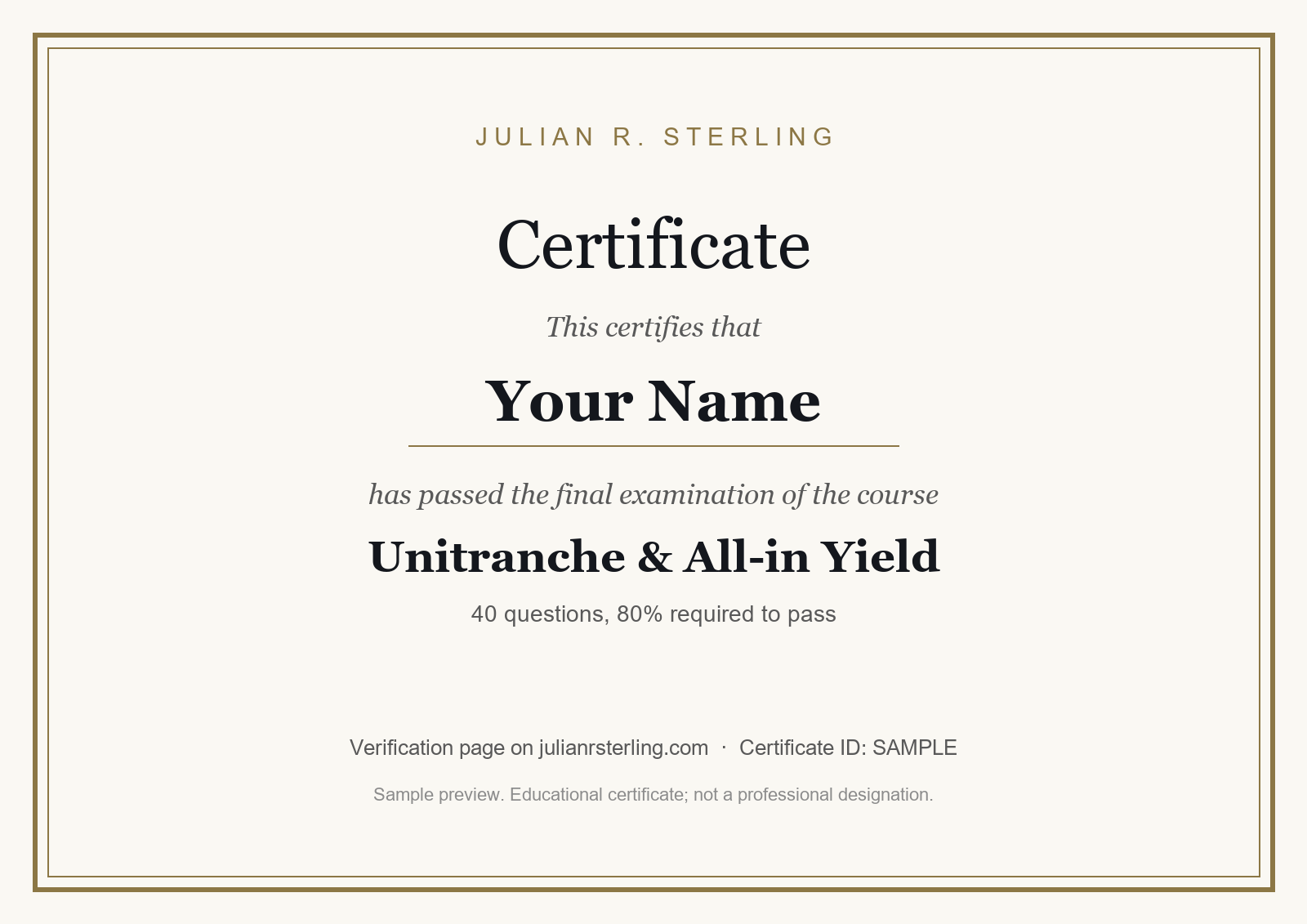
40 questions drawn at random from a private bank, 60 minutes, graded on the server, 80% to pass, retake as often as you need. You receive a certificate with a public verification page. How certificates work.
Are the rates and terms real market data?
No. The SOFR path, margins, fees, call schedule and fund terms are assumptions of a fictional case, chosen to be plausible. The course teaches the arithmetic, which is the same whatever the market.
Can I study online?
Yes. Sign in to your learner account with the email of your order, no password needed: each module shows what to read in the Course Book and what to build in the workbook, the module quizzes sit between the modules, and your progress is saved on every device.
Can I get a refund?
Yes. Every course has a 14-day money-back guarantee: write to [email protected] within 14 days of your purchase and you get a full refund, no reason needed. Details in the terms of sale.
Is it investment advice?
No. The borrower, its sponsor, its lenders and the fund are fictional. The course teaches how a direct loan is priced and how to check the arithmetic.
Unitranche & All-in Yield: $49
The Course Book, the Case Workbook, the step files, the exercises, the quiz app and the certificate exam. Study online in your learner account or download everything, right after payment. 14-day money-back guarantee.
Want every course? All Access opens all of them, with their certificate exams.
Related
- Private Credit ModelingUnderwrite a direct loan: structure, returns, downside and recovery.
- Credit Documentation & CovenantsRead and test the credit agreement of the same loan.
- Fund FinanceSubscription lines and NAV facilities of private funds.
- All coursesReal estate, private credit, fund finance, project finance, data centers, LBO, property funds, fund reporting, infrastructure and credit.