Courses · Video course
Credit Documentation & Covenants: reading and testing a credit agreement
What the terms of a leveraged loan really allow, measured in Excel: covenant EBITDA and its add-backs, the leverage and cover tests, headroom, the breach and the equity cure, the baskets for debt and dividends, the cash sweep, the margin ratchet and the compliance certificate. You test one loan over four quarters along the way.
$149, or included in All Access
26 short video lessons (about 65 minutes of video), 11 of them built live in Excel, the Case Workbook of a $178.5m unitranche loan, a start file and a solution file for every build lesson, an Exercise Workbook that checks your answers, a 48-question quiz app, a Course Summary, and the certificate exam online. Download right after payment.
Secure checkout by Stripe. 14-day money-back guarantee. Not sure yet? Watch module 1 and a build lesson free, read the summary of module 1 and try ten questions below.
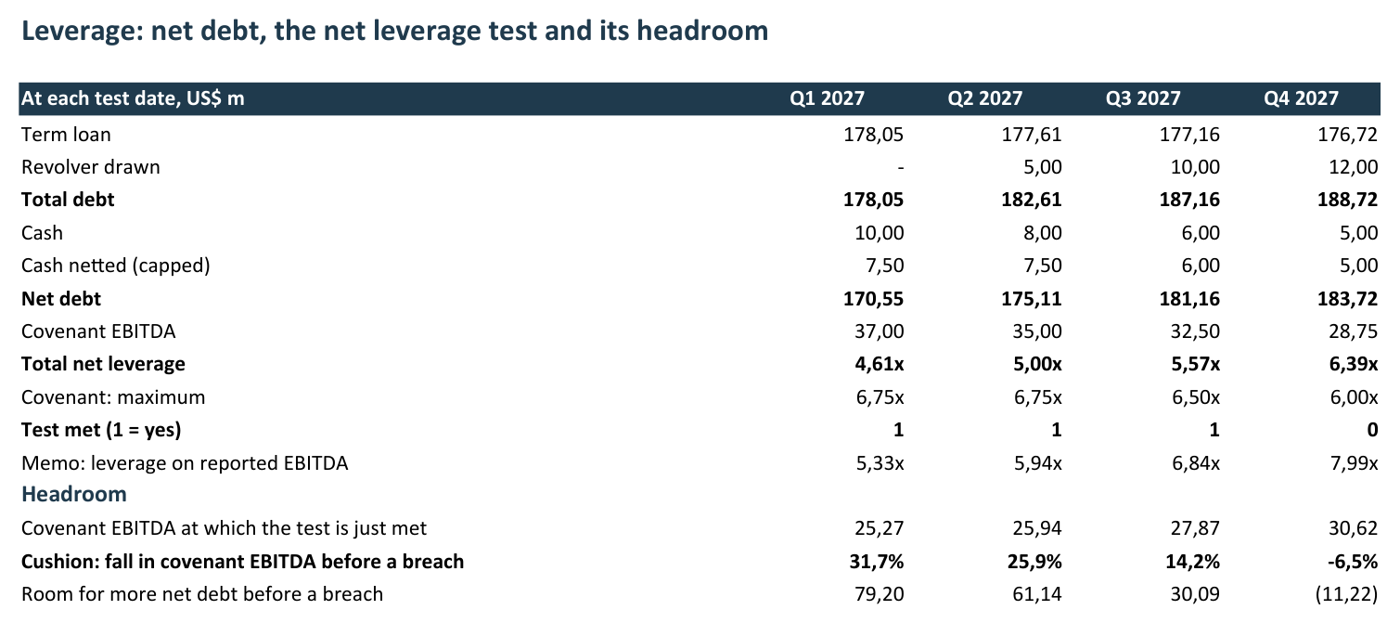
Two loans can share a headline: the same leverage, the same covenant. One has capped definitions and tight baskets, the other does not, and they are not the same risk. This course shows where the difference sits and how to compute it: a leverage of 4.61x that reaches 6.39x in four quarters, a breach against 6.00x, a cure of $1.87m or $11.22m depending on one sentence of the contract.
What you will be able to do
- Find your way in a credit agreement and read the definitions that decide every ratio.
- Compute covenant EBITDA with its add-backs and caps, and net debt with capped cash netting.
- Test a leverage covenant and a fixed charge cover covenant, and measure headroom as a fall in EBITDA.
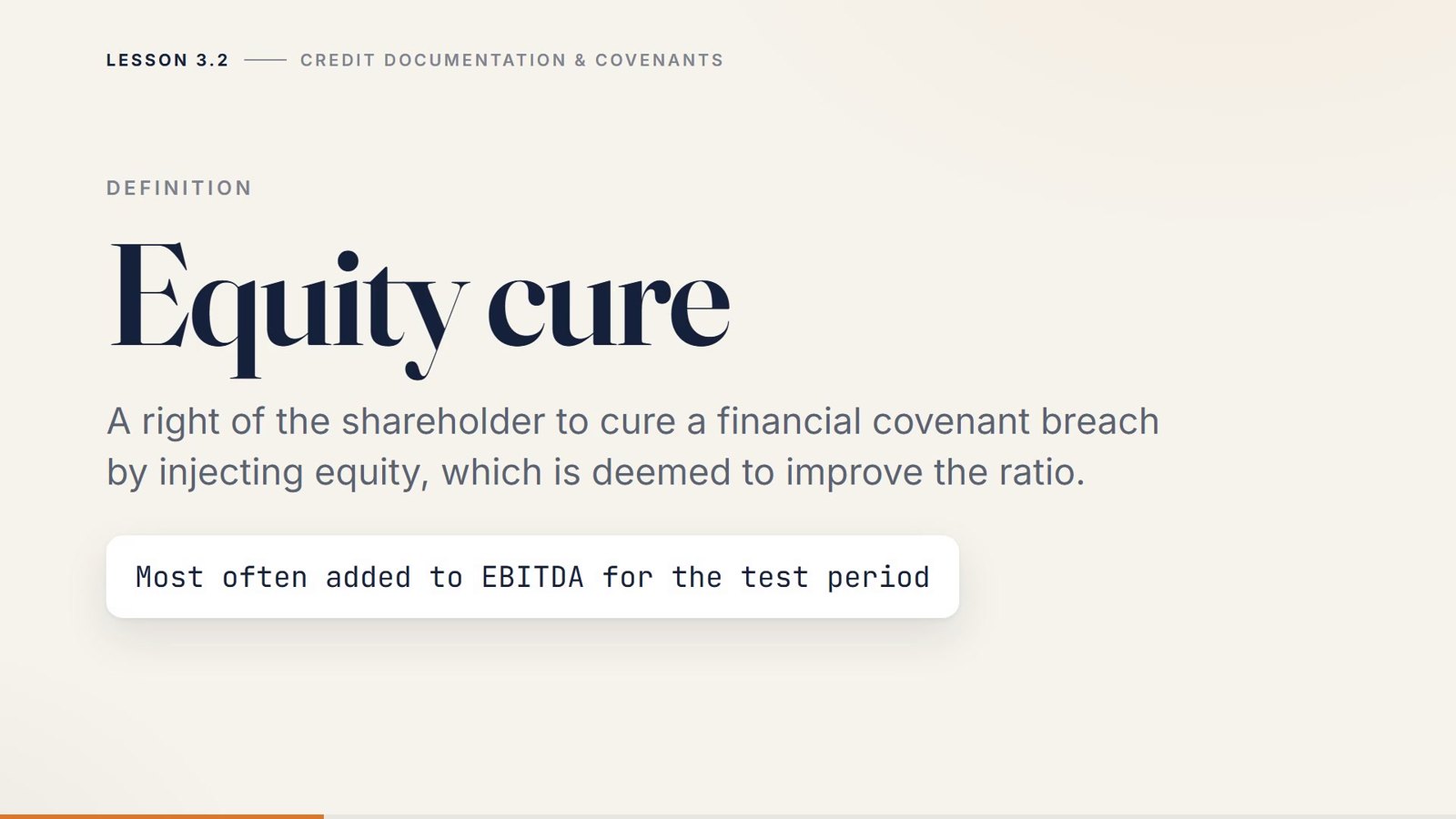
- Size an equity cure, counted as EBITDA or applied to debt, and know what a cure must not unlock.
- Measure the debt a borrower can add through stacked baskets, and the cash it can pay out through a builder basket.
- Compute an excess cash flow sweep and a margin ratchet, and read call protection, MFN and sacred rights.
- Build and check a compliance certificate, and review a term sheet with nine red flags and twelve questions.
The program
Six modules. Concept lessons explain on animated slides; build lessons fill the workbook on screen, cell by cell, with the formula shown, while you build the same cells in the start file.
- 1. The agreementWhat a credit agreement does, why the definitions come first, the case, and the covenant EBITDA with its add-backs and caps. Lessons: 1.1 What a credit agreement does. 1.2 Read the definitions first. 1.3 The case: a unitranche in a bad year. 1.4 Covenant EBITDA: add-backs and caps (build).
- 2. Financial covenantsMaintenance and incurrence tests, the net leverage ratio, headroom, the fixed charge cover ratio, and covenant-lite structures. Lessons: 2.1 Maintenance and incurrence covenants. 2.2 The net leverage test (build). 2.3 Headroom and cushion (build). 2.4 The fixed charge cover ratio (build). 2.5 Covenant-lite and springing covenants.
- 3. When a test failsDefault and event of default, the equity cure and its limits, and the difference between curing EBITDA and curing debt. Lessons: 3.1 Default, waiver, amendment. 3.2 Size an equity cure (build). 3.3 The limits of a cure right. 3.4 Cure as EBITDA or as debt reduction (build).
- 4. BasketsHow negative covenants and their baskets work, debt capacity, the builder basket for dividends, and value leakage. Lessons: 4.1 Negative covenants and baskets. 4.2 Debt capacity: free-and-clear and ratio baskets (build). 4.3 The builder basket and dividends (build). 4.4 Leakage: where value leaves the credit group.
- 5. Cash and pricingMandatory prepayments, the excess cash flow sweep, the margin ratchet, and the protections lenders keep. Lessons: 5.1 Mandatory prepayments. 5.2 The excess cash flow sweep (build). 5.3 The margin ratchet (build). 5.4 Call protection, MFN and sacred rights.
- 6. MonitoringThe compliance certificate, the checks behind it, the red flags of a covenant package, and a term sheet checklist. Lessons: 6.1 The compliance certificate. 6.2 Build the certificate and its checks (build). 6.3 Red flags in a covenant package. 6.4 A term sheet checklist. 6.5 From the document to the model.
Try it free
All of module 1 and one build lesson. The four lessons of module 1, and lesson 2.2, where you compute net debt and test the leverage covenant.
The summary of module 1. Download the free sample of the Course Summary (PDF).
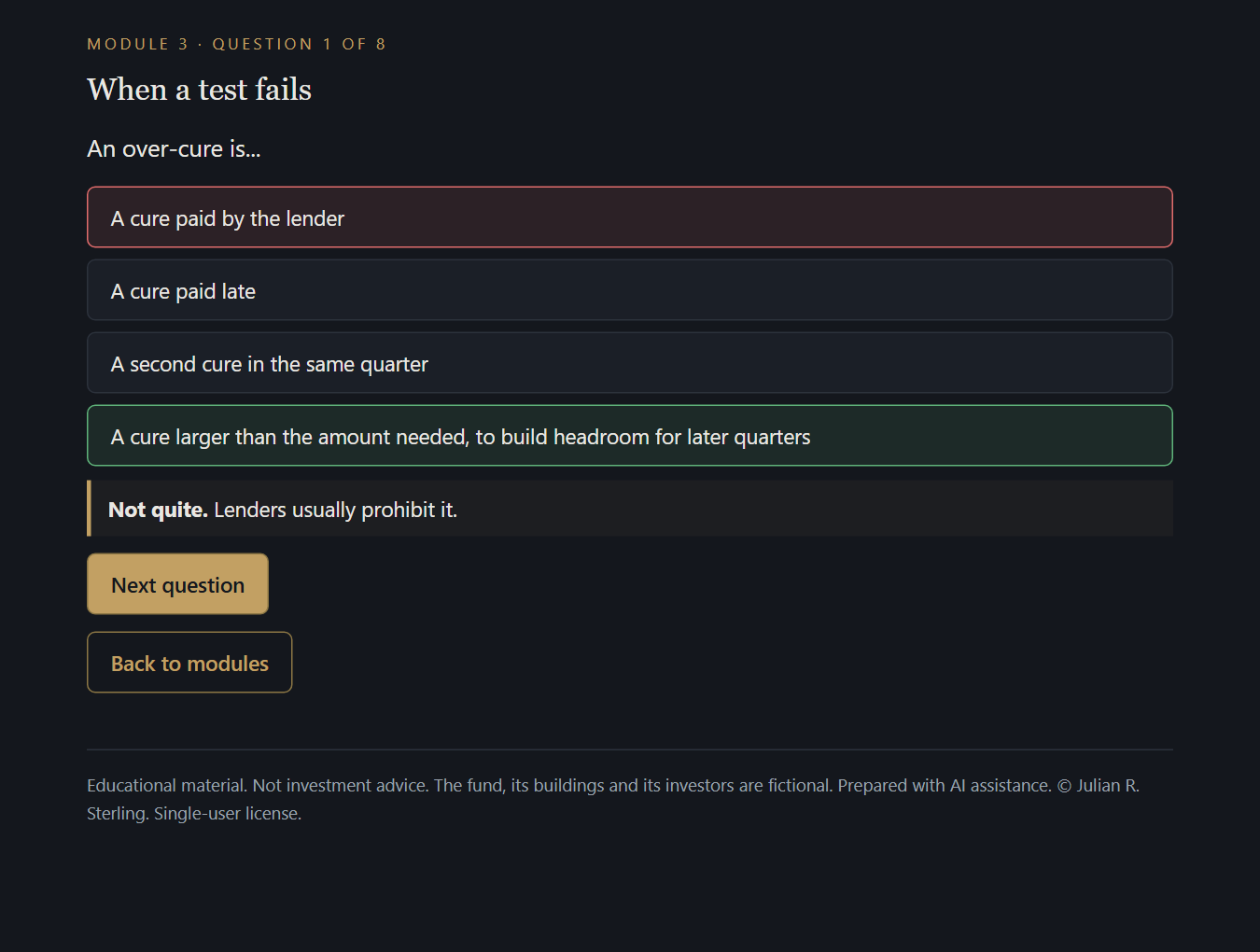
Ten quiz questions. Click an answer: it turns green or red and the explanation appears. The questions use the running case:
Marston Applied Controls (fictional): a US industrial company owned by a sponsor, with a unitranche term loan of $178.5m and a revolver. Covenant EBITDA of the last twelve months falls from $37.00m to $28.75m during 2027, while the maximum leverage steps down from 6.75x to 6.00x.
Module 1
1. Which part of a credit agreement decides how the covenant ratios are computed?
Answer: The definitions. EBITDA, debt and cash are defined terms.
Module 1
2. An add-back is...
Answer: An amount added to EBITDA under the definition, such as one-off costs or expected savings. Each add-back raises covenant EBITDA and lowers the tested leverage.
Module 1
3. A cap on an add-back is set as a percentage of EBITDA. When EBITDA falls, the cap...
Answer: Falls too: it tightens when the borrower needs the add-back most. A cap in dollars would not move.
Module 1
4. Which of these is a negative covenant?
Answer: A limit on paying dividends. Negative covenants prohibit, subject to baskets.
Module 1
5. Which EBITDA definition is a red flag?
Answer: One with an uncapped add-back for cost savings not yet achieved. Without a cap, the borrower largely writes the number itself.
Module 1
6. Q1 2027: reported EBITDA $32.00m, one-off costs $1.00m, savings claimed $4.00m, cap of 15% on savings. Covenant EBITDA?
Answer: $37.00m. 33.00 + min(4.00, 4.95).
Module 2
7. A maintenance covenant is tested...
Answer: At every test date, whether or not the borrower does anything. An incurrence test is tested only on an action.
Module 3
8. What is the difference between a default and an event of default?
Answer: An event of default is a breach whose grace and cure periods have passed: lenders may then act. Rights come with the event of default.
Module 4
9. A grower basket is...
Answer: The greater of a fixed amount and a share of EBITDA. It grows with the company and never falls below its floor.
Module 5
10. Which is NOT a usual mandatory prepayment trigger?
Answer: A fall in EBITDA. Asset sales, insurance, debt issuance, excess cash flow.
Inside the course
What you receive
| File | What it is |
|---|---|
| Videos, one zip per module | 26 lessons in 1080p, about 65 minutes of video, with English subtitles (.srt) and chapters. |
| Case_Workbook.xlsx | Marston Applied Controls over the four quarters of 2027: covenant EBITDA, leverage, cover, cure, baskets, cash sweep, margin ratchet, certificate and checks. |
| Step_Files | 22 workbooks: a start file and a solution file for each of the 11 build lessons. |
| Exercise_Workbook.xlsx | Six exercise tabs, 36 answers checked automatically, hidden solution tabs. |
| Quiz_App.html | 48 questions, eight per module, with explanations. |
| Course_Summary.pdf | Two pages per module: key ideas, the case in numbers, the mistakes to avoid; glossary and dated sources. |
| Certificate exam | Online from your order page or your account: 40 questions from a private bank, 60 minutes, 80% to pass, verifiable certificate. |
The running case
Marston Applied Controls, fictional, is the borrower of the Private Credit Modeling course. Here its credit agreement is tested at each quarter end of 2027, as its results weaken:
| Measure | Q1 2027 | Q4 2027 |
|---|---|---|
| Reported EBITDA / covenant EBITDA, last twelve months | $32.00m / $37.00m | $23.00m / $28.75m |
| Total net leverage / maximum permitted | 4.61x / 6.75x | 6.39x / 6.00x |
| Fixed charge cover ratio / minimum required | 1.47x / 1.05x | 1.10x / 1.05x |
| Capacity for additional debt under the baskets | $60.70m | $34.00m |
| Dividend capacity under the builder basket | $11.00m | $0.00m |
| Margin set by the ratchet | 5.25% | 5.50% |
At the end of the year the leverage test fails. The equity cure is $1.87m if it counts as EBITDA and $11.22m if it must repay debt, and the excess cash flow sweep repays $0.73m.
Part of the private credit track
This course follows Private Credit Modeling, which underwrites and models the same loan, and sits next to LBO Modeling, the sponsor's side of the deal, and Fund Finance. See certifications.
Questions people ask
Who is the course for?
Analysts and associates of private credit funds, leveraged finance, restructuring and portfolio monitoring teams, finance teams of sponsor-backed companies, and lawyers who want the numbers behind the clauses. You need basic Excel and to know what EBITDA and net debt are.
How long is it?
26 video lessons of two to four minutes, about 65 minutes of video, in six modules. With the build lessons, the exercises and the quizzes, most learners need five to seven hours.
Do I need the Private Credit course first?
No. The borrower is Marston Applied Controls, the company of Private Credit Modeling, but this course stands on its own: every figure it needs is given. The two courses complement each other: that one underwrites and models the loan, this one reads and tests its contract.
Is it about US or European documents?
Both, at the level of the mechanics. The case is a US dollar unitranche loan and the vocabulary is that of the US market; the lessons point out where European facilities differ. Definitions, tests, cures, baskets and prepayments work the same way.
What do I get exactly?
Right after payment: the course zip (Course Summary, Case Workbook with 252 live formulas, 22 step files, Exercise Workbook, Quiz App) and one video zip per module, with subtitles and chapters. The certificate exam opens from your order page or your learner account.
How does the certificate exam work?
40 questions drawn at random from a private bank, 60 minutes, graded on the server, 80% to pass, retake as often as you need. You receive a certificate with a public verification page. How certificates work.
Does it reproduce a real credit agreement?
No. Clauses are explained in plain words and turned into formulas. Levels, caps, baskets, grids and percentages are assumptions of the fictional case, chosen to be typical, not market data.
Who is the narrator?
Lessons use AI-generated narration. The scripts, the case and every figure on screen were written and computed for this course and checked by script against the workbook.
Can I get a refund?
Yes. Every course has a 14-day money-back guarantee: write to [email protected] within 14 days of your purchase and you get a full refund, no reason needed. Details in the terms of sale.
Is it legal or investment advice?
No. The borrower, its sponsor and its lenders are fictional. The course teaches how the terms of a credit agreement work and how to test them.
Credit Documentation & Covenants: $149
The videos, the Case Workbook, the step files, the exercises, the quiz app, the Course Summary and the certificate exam. Download right after payment.
Want every course? All Access opens all of them, with their certificate exams, for $299 a year.
Related
- Private Credit ModelingUnderwrite a direct loan: structure, returns, downside and recovery.
- LBO ModelingThe sponsor's model of a leveraged buyout, from sources and uses to returns.
- Fund FinanceSubscription lines and NAV facilities of private funds.
- All coursesReal estate, private credit, fund finance, project finance, data centers, LBO, property funds, fund reporting, infrastructure and credit documentation.