Courses · Project finance
Project Finance Modeling: size, sculpt and stress a renewable energy project
A complete course on the model behind a contracted solar plant, from the lender's chair: PPA and merchant revenue, P50 and P90 energy, construction funding, debt sculpting, reserves, cover ratios, the sponsor's return and the stress tests a credit committee reads.
$149 launch price until 31 December 2026 ($179 after), with the Project Finance Model, Pro Edition ($99 on its own)
Eight modules in a 31-page Course Book, an Excel workbook that checks your answers, a 160-question quiz app with a timed final exam and a certificate, and the full Pro model of the case. Download right after payment.
Secure checkout by Stripe. Not sure yet? Read module 4 and try ten quiz questions free below, or start with the free project finance model.
Most project finance courses are two-day classroom sessions at several thousand dollars. This one follows a single solar project from financial close to the value of its equity, and makes you compute every step: the energy and its P90, the interest during construction, the debt the cover ratios allow, the waterfall, the LLCR, the break-even that tells a lender how much room is left.
What you will be able to do
- Read a project's contracts and say which risk each one moves, and which stay with the lenders.
- Turn capacity, capacity factor and an energy uncertainty into P50, P90 and P99 revenue, then model the PPA and the merchant tail.
- Fund construction quarter by quarter with fees, interest during construction and pro rata drawdowns, and solve the funding loop without a circular reference.
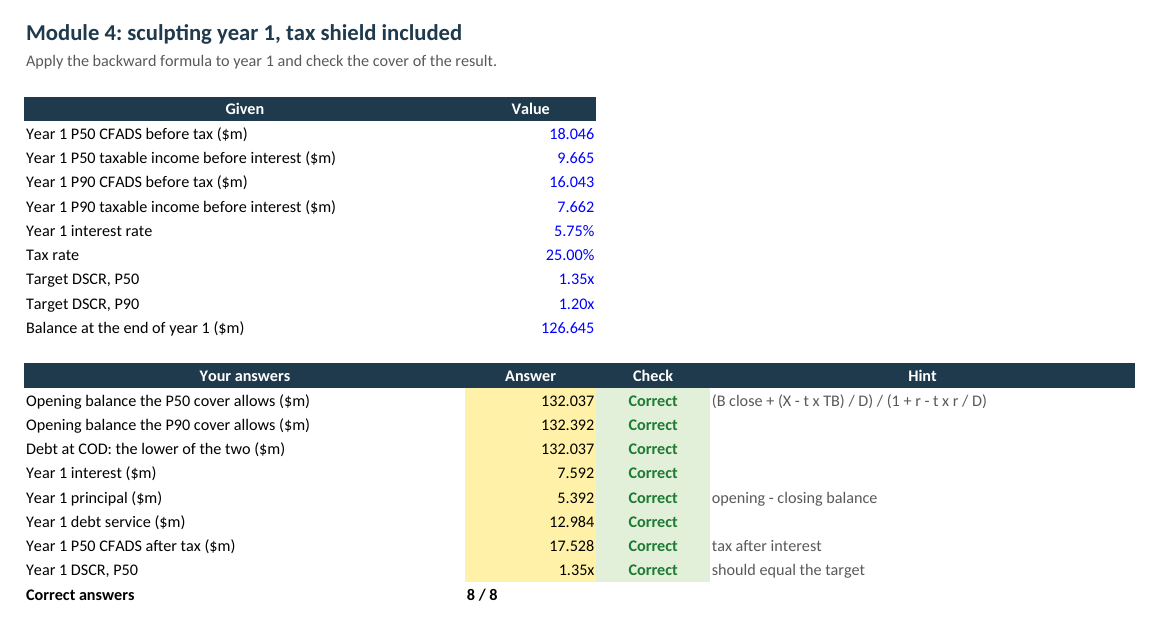
- Size a sculpted loan on P50 and P90 cover targets with the tax shield included, and know when gearing binds instead.
- Run the DSRA, the maintenance reserve, the lock-up and the cash sweep, and compute DSCR, LLCR and PLCR.
- Compute the sponsor's XIRR, stress the signed schedule to its break-evens and value the equity at COD.
The program
Each module has objectives, the lesson, a worked example step by step, the classic mistakes, a summary, three practice questions, one exercise tab and twenty quiz questions.
- 1. The structure and the contracts of a projectThe SPV and non-recourse lending, EPC, O&M, PPA, direct agreements, what each contract moves, and who checks what before financial close.
- 2. Revenue: PPA, merchant and the P50 / P90 energy yieldEnergy from capacity factor and degradation, P90 and P99 on one year and ten, PPA and merchant revenue, the captured price. In the case: a 20% revenue drop when the PPA ends.
- 3. Costs and construction: the budget, the drawdowns and the funding loopBudget and contingency, upfront and commitment fees, interest during construction, pro rata drawdowns, and the funding loop unrolled pass by pass.
- 4. Sizing the debt: CFADS, target cover and sculptingCFADS, target DSCR by period and by case, sculpting with the tax shield solved backwards, the gearing limit. In the case: $132.0m of debt, 72.5% gearing.
- 5. Reserves and the cash waterfallThe waterfall, the debt service reserve, the maintenance reserve, lock-up and trapped cash, the merchant cash sweep.
- 6. Cover ratios and covenants: DSCR, LLCR, PLCRDSCR, LLCR and PLCR, lock-up and default headroom, P50, P90 and P99 on the signed schedule. In the case: LLCR 1.37x at COD.
- 7. Tax and the sponsor's returnTax with losses carried forward, equity flows on real dates, XIRR, multiple and payback, what tax credits change. In the case: 9.1% equity IRR at P50.
- 8. Stress, banking case and valuationBreak-even energy, price and cost, banking case against sponsor case, equity value at COD. In the case: cover holds down to 79% of P50.
Try it free
A full module. Module 4, on debt sizing and sculpting, as it appears in the Course Book: download the free sample (PDF).
Ten quiz questions. Click an answer: it turns green or red and the explanation appears. The questions use the running case:
Saltbrush Solar (fictional): 150 MWac of solar at a 30% capacity factor, one-year uncertainty 6.5%, PPA 15 years at $61/MWh. Construction $167.6m before financing over six quarters; senior debt sculpted on P50 at 1.35x and P90 at 1.20x under the PPA, 1.70x and 1.55x in the merchant years, 18 years, gearing limit 80%.
Module 1
1. Saltbrush Solar's construction cost before financing is $167.6m and financing costs (fees, IDC, DSRA) are $14.6m. What is the total project cost?
Answer: $182.2m. $167.6m + $14.6m = $182.2m. Lenders apply the gearing limit to the total, financing costs included.
Module 1
2. What is the defining feature of project finance?
Answer: Lenders are repaid from the cash flows of one asset owned by an SPV, with limited or no recourse to the sponsor. Non-recourse or limited-recourse lending to a special purpose vehicle.
Module 2
3. The one-year uncertainty is 6.5%. What is the one-year P90 factor?
Answer: 0.9167. 1 - 1.2816 x 6.5% = 0.9167. 1.645 is the 95% one-sided z.
Module 2
4. Why is a solar plant's captured price below the average market price?
Answer: It produces at midday, when solar output depresses prices. The capture discount grows as more solar is built.
Module 3
5. What is the quarter 2 interest during construction?
Answer: $0.303m. 5.50% / 4 x opening $22.050m = $0.303m. Interest on the closing balance creates a loop.
Module 3
6. Why is IDC computed on the opening balance of the quarter?
Answer: It avoids a circular reference with little loss of accuracy. The closing balance depends on the draw, which depends on the IDC.
Module 4
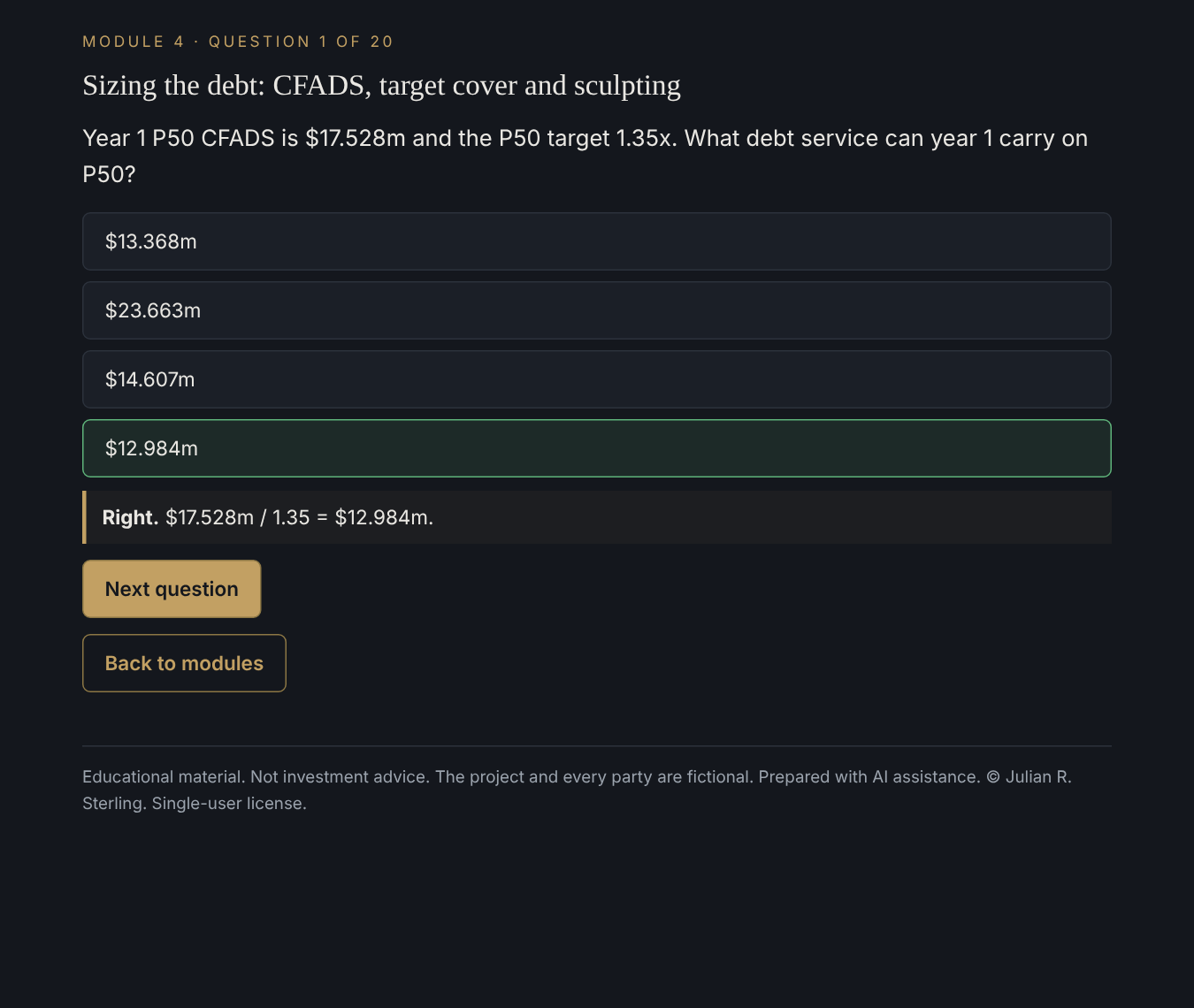
7. Year 1 P50 CFADS is $17.528m and the P50 target 1.35x. What debt service can year 1 carry on P50?
Answer: $12.984m. $17.528m / 1.35 = $12.984m.
Module 4
8. How is the sculpted loan amount found?
Answer: As the present value of the sculpted debt service at the loan's interest rate. With the tax shield included, solved backwards.
Module 6
9. What is the LLCR at COD at P50?
Answer: 1.37x. NPV of CFADS to maturity / debt = 1.37x.
Module 8
10. At which share of P50 energy does the minimum DSCR fall to 1.00x on the signed schedule?
Answer: 79.0%. 79.0% of P50, 3.23 standard deviations below it. 1 / 1.35 ignores that operating costs do not fall with energy.
Inside the course
What you receive
| File | What it is |
|---|---|
| Course_Book.pdf | Eight modules, 31 pages: lesson, worked example, pitfalls, summary, practice questions, glossary and dated sources. |
| Exercise_Workbook.xlsx | Eight exercise tabs, 63 answers checked automatically, eight hidden solution tabs. |
| Quiz_App.html | 160 questions, practice by module with explanations, timed final exam, score by module, certificate. |
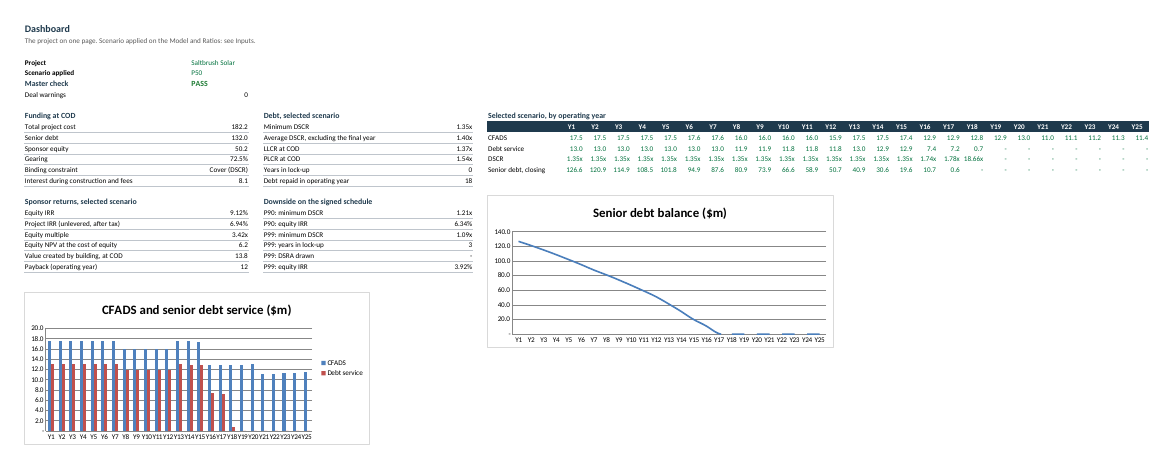
| Project_Finance_Model_Pro | The Pro model with the worked example, a blank copy and a 15-page user guide. |
| Start_Here.pdf | The order to use it all in, on one page. |
The running case
Saltbrush Solar, a fictional 150 MWac solar plant, reaches financial close on 31 December 2026 and commercial operation on 30 June 2028. The course follows it from the contracts to the value of its equity:
| Measure | Value |
|---|---|
| Total project cost / senior debt | $182.2m / $132.0m |
| Gearing / binding constraint | 72.5% / cover |
| Interest during construction and fees | $8.1m |
| Minimum DSCR: P50 / P90 / P99 | 1.35x / 1.21x / 1.09x |
| LLCR / PLCR at COD | 1.37x / 1.54x |
| Equity IRR: P50 / P90 / P99 | 9.1% / 6.3% / 3.9% |
| Energy break-even for 1.00x cover | 79% of P50 |
Questions people ask
Who is the course for?
Analysts and associates in project finance and infrastructure lending, renewable energy developers and investors, advisers and auditors who review project models, and students preparing for energy finance interviews. You need basic Excel and a first idea of what a cash flow is.
How is it different from a classroom course?
Classroom project finance modeling courses usually run for two days with a trainer and cost several thousand dollars. This one is self-paced and written: one complete solar case, an Excel workbook that checks every answer, a quiz app with a final exam, and a lender-grade model to keep.
How long does it take?
Most learners need five to eight hours: under an hour per module for the reading, the exercise tab and the practice quiz, then the final exam.
Is there video?
Not yet. This first edition is a written course with a live Excel workbook and a quiz app. Short video walkthroughs of each module will be added later and sent free to every buyer.
What do I get exactly?
One zip file: the Course Book (PDF), the Exercise Workbook (Excel), the Quiz App (a single HTML file that runs offline in any browser), the Project Finance Model, Pro Edition with a blank copy and its user guide, and a one-page Start Here guide.
Does it cover US tax credits and tax equity?
Module 7 explains how investment and production tax credits, tax equity and back-leverage change a US deal, but the case and the model leave them out so that the debt mechanics stay visible and work in any market.
Which software do I need?
A PDF reader, Excel (LibreOffice and Google Sheets also work) and a web browser. No macros, no add-ins, no account to create.
Is the certificate a professional qualification?
No. The Quiz App prints a certificate of completion when you score 70% or more on the final exam. It shows the work you did; it is not an accredited qualification.
Can I get a refund?
It is a digital download delivered immediately, so the right of withdrawal ends at delivery, as the checkout explains. If a file is faulty, write to [email protected] and it will be fixed or refunded. Details in the terms of sale.
Is it investment advice?
No. The project, the sponsor, the offtaker and every party are fictional. The course teaches the analysis and the modeling; it does not recommend any investment. It was prepared with AI assistance and every figure is computed and checked by script.
Project Finance Modeling: $149 until 31 December 2026
The course, the exercises, the quiz and the Project Finance Model, Pro Edition. Download right after payment. $179 after the launch period.
Only need the model? The Project Finance Model, Pro Edition is $99 on its own.
Related
- The Project Finance HandbookThe book behind the course, with its free companion workbooks.
- Free project finance modelSolar and storage with the investment tax credit, the funding loop and sculpting: a good first look.
- Free debt sculpting modelSculpting on a toll road concession, in six sheets.
- All coursesPrivate credit, project finance and more.