Courses · Private credit
Private Credit Modeling: underwrite, model and monitor a direct loan
A complete course on the work of a direct lending analyst, built around one sponsored borrower: lender EBITDA, debt sizing, pricing and yield, the loan model, covenants, stress and recovery, fair value and fund returns.
$149, with the Direct Lending Model, Pro Edition ($99 on its own)
Eight modules in a 32-page Course Book, an Excel workbook that checks your answers, a 160-question quiz app with a timed final exam and a certificate, and the full Pro model of the case. Download right after payment.
Secure checkout by Stripe. Not sure yet? Try a free module and ten quiz questions below, or start with the free direct lending model.
Most modeling courses teach the sponsor's side of a buyout. This one teaches the lender's: how much of the EBITDA is real, how much debt it carries, what the loan really yields, when the covenants bite, what you get back if it goes wrong, and what the loan is worth on the fund's books.
What you will be able to do
- Rebuild lender EBITDA from the sponsor's adjusted figure and defend each add-back you accept or refuse.
- Size a unitranche on leverage, interest cover, fixed charge cover and loan to value, and find the constraint that binds.
- Turn margin, SOFR floor, OID, fees, call protection and PIK into an exact yield, not just the market shortcut.
- Build an annual loan model with revolver, cash sweep and PIK toggle, with no circular reference.
- Test maintenance covenants, measure the EBITDA cushion, size an equity cure and follow a quarterly LTM test.
- Stress the credit, run the recovery waterfall and compute expected loss, then mark the loan at fair value under ASC 820 / IFRS 13.
The program
Each module has objectives, the lesson, a worked example step by step, the classic mistakes, a summary, three practice questions, one exercise tab and twenty quiz questions.
- 1. The market and the structure of a direct loanDirect lending, unitranche, senior, second lien and ABL, first out and last out, the super senior revolver, and what a credit committee asks.
- 2. Reading the financial statements of a sponsored borrowerReported, sponsor-adjusted and lender EBITDA: which add-backs to accept, add-back share, cash conversion, and why the same loan is 5.95x, 5.25x or 4.70x.
- 3. Sizing the debtLeverage, interest cover, FCCR and loan to value turned into debt limits; the binding constraint; repayment capacity.
- 4. The economics: margin, floor, OID, fees, call protection, PIK and the all-in yieldSOFR and the floor, OID and fees, the three-year convention against the exact IRR, call protection, PIK toggle. In the case: 10.35% to year 3.
- 5. The loan model: schedule, amortization, sweep, revolver, PIK and interest on cashThe cash waterfall from CFADS to closing balances, revolver draws and repayments, the sweep, PIK, interest on opening balances.
- 6. Covenants: maintenance and incurrence, definitions, headroom, EBITDA cures and quarterly testsMaintenance and incurrence covenants, definitions, EBITDA cushion, equity cures, quarterly tests on LTM EBITDA.
- 7. Stress tests and recovery: downside scenarios, enterprise value in default, waterfall, expected lossCoherent downside and stress cases, enterprise value in default, the waterfall, LGD and expected loss. In the case: 72.0% recovery.
- 8. Portfolio monitoring and valuation: quarterly reporting, internal ratings, fair value and fund returnsCompliance certificates, an internal rating grid, fair value by the yield method (Level 3), and the walk from loan yield to a levered fund's net return.
Try it free
A full module. Module 4, on loan economics, as it appears in the Course Book: download the free sample (PDF).
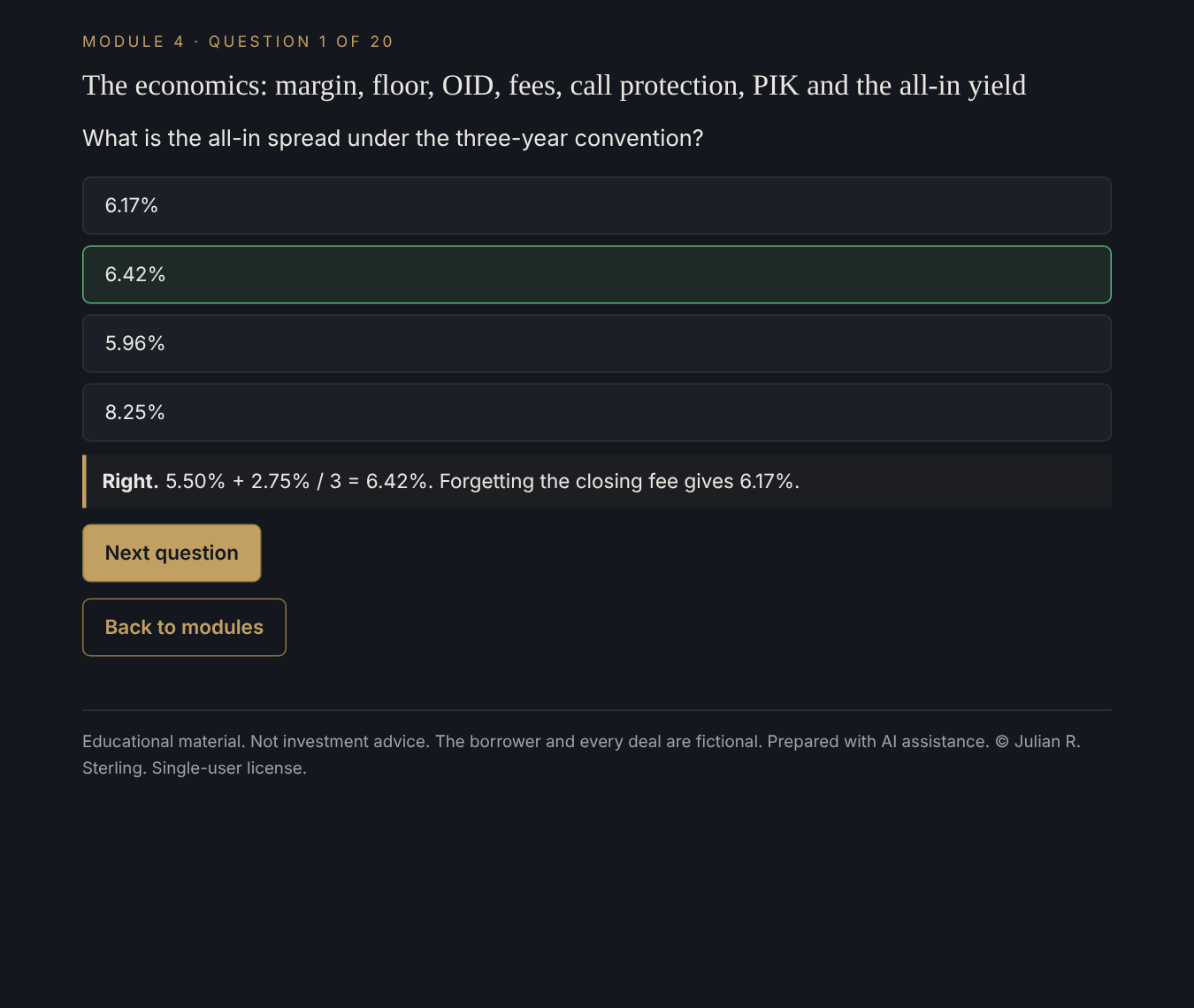
Ten quiz questions. Click an answer: it turns green or red and the explanation appears. The questions use the running case:
Marston Applied Controls, Inc. (fictional): lender EBITDA $34.0m, sponsor pays 11.0x, so $374.0m. Unitranche of $178.5m (5.25x), SOFR + 5.50% with a 1.00% floor, OID 2.00% and a 0.75% closing fee. Year 1 SOFR 3.90%. Net debt at closing $168.5m; first leverage covenant 6.75x.
Module 1
1. Marston's lender EBITDA is $34.0m and the sponsor pays 11.0x that EBITDA. What is the enterprise value?
Answer: $374.0m. 11.0 x $34.0m = $374.0m. Using the sponsor's adjusted EBITDA ($38.0m) or reported EBITDA gives a different value; total uses include costs and cash.
Module 1
2. What is the loan to value of the term loan at closing?
Answer: 47.7%. $178.5m / $374.0m = 47.7%. Loan to value divides by the enterprise value, not by total uses or equity.
Module 2
3. Two deals are quoted at 5.0x leverage. What must you check first?
Answer: Which EBITDA each multiple is on. The same $178.5m loan is 5.95x, 5.25x or 4.70x depending on the EBITDA.
Module 3
4. Which ratio guards against a capex-hungry business that looks fine on EBITDA?
Answer: Fixed charge cover. FCCR deducts capex and cash taxes before comparing with debt service.
Module 4
5. What is the year 1 cash coupon?
Answer: 9.40%. max(3.90%, 1.00%) + 5.50% = 9.40%.
Module 4
6. What is the all-in spread under the three-year convention?
Answer: 6.42%. 5.50% + 2.75% / 3 = 6.42%. Forgetting the closing fee gives 6.17%.
Module 6
7. What is the EBITDA cushion at closing against the year 1 leverage covenant?
Answer: 26.6%. 1 - 4.96x / 6.75x = 26.6%. Using gross debt instead of net debt gives a smaller figure.
Module 6
8. What is the best measure of covenant headroom?
Answer: The EBITDA cushion: how far EBITDA can fall before a breach. Cushion = 1 - leverage / covenant leverage.
Module 7
9. Expected loss is:
Answer: Probability of default x loss given default x exposure. The Basel framework uses PD, LGD and EAD.
Module 8
10. Why is a direct loan usually a Level 3 asset?
Answer: Its valuation relies on significant unobservable inputs. No quoted price exists for the loan or close equivalents.
Inside the course
What you receive
| File | What it is |
|---|---|
| Course_Book.pdf | Eight modules, 32 pages: lesson, worked example, pitfalls, summary, practice questions, glossary and dated sources. |
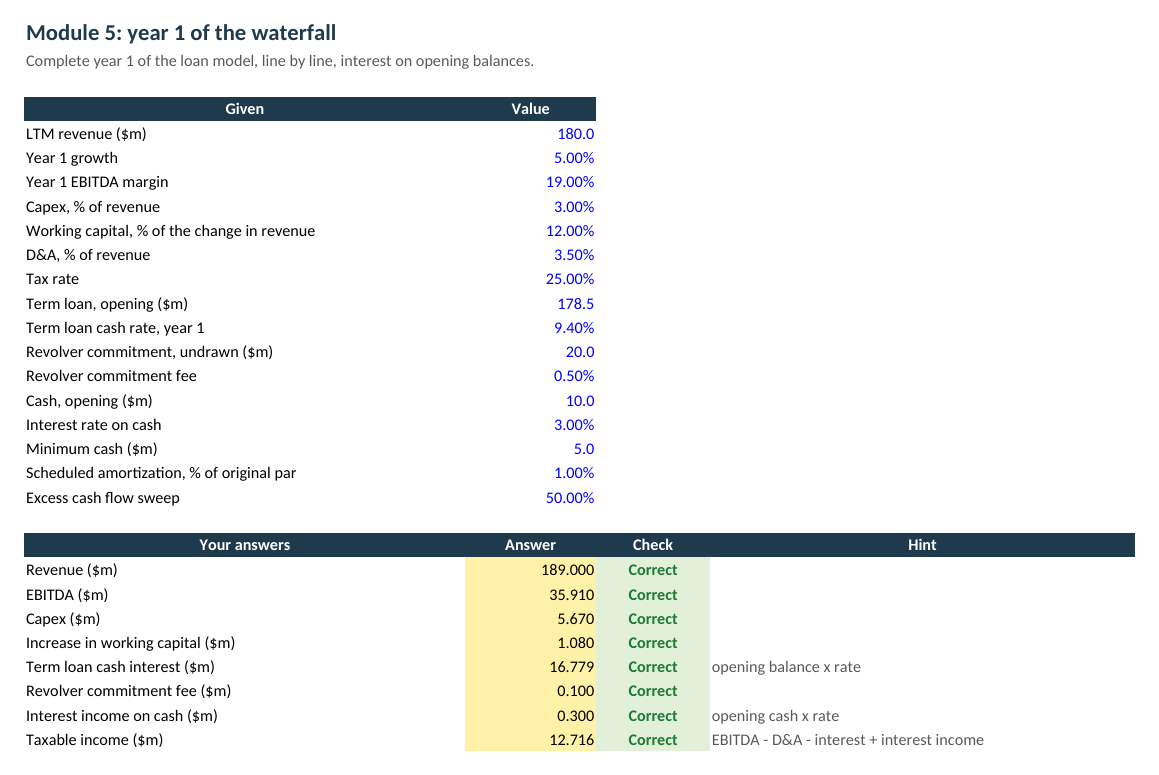
| Exercise_Workbook.xlsx | Eight exercise tabs, 72 answers checked automatically, eight hidden solution tabs. |
| Quiz_App.html | 160 questions, practice by module with explanations, timed final exam, score by module, certificate. |
| Direct_Lending_Model_Pro | The Pro model with the worked example, a blank copy and a 15-page user guide. |
| Start_Here.pdf | The order to use it all in, on one page. |
The running case
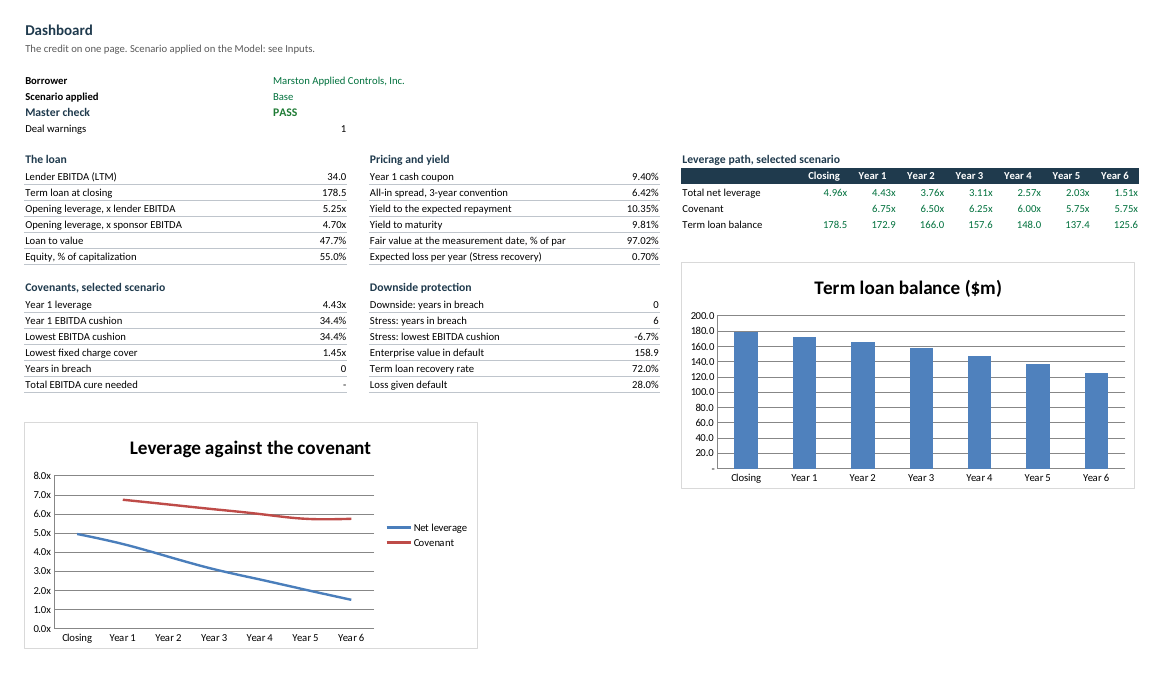
Marston Applied Controls, Inc., a fictional US maker of industrial controls, is bought by a sponsor for $374.0m. A direct lending fund provides a $178.5m unitranche. The course follows the loan from the first look at the numbers to its fair value one year later:
| Measure | Value |
|---|---|
| Sponsor adjusted EBITDA / lender EBITDA | $38.0m / $34.0m |
| Loan to value / equity share | 47.7% / 55.0% |
| Yield to year 3 / to maturity | 10.35% / 9.81% |
| Downside: lowest EBITDA cushion | 17.3% |
| Stress: equity cure needed in year 1 | $4.13m |
| Recovery in a stress default / expected loss a year | 72.0% / 0.70% |
| Fair value after a 50 bps widening | 97.02% of par |
Questions people ask
Who is the course for?
Analysts and associates joining a direct lending, private credit or leveraged finance team, credit analysts at banks moving to private markets, and students preparing for credit interviews. You need basic Excel and a first idea of what EBITDA is.
How long does it take?
Most learners need four to eight hours: about thirty minutes to an hour per module for the reading, the exercise tab and the practice quiz, then the final exam.
Is there video?
Not yet. This first edition is a written course with a live Excel workbook and a quiz app. Short video walkthroughs of each module will be added later and sent free to every buyer.
What do I get exactly?
One zip file: the Course Book (PDF), the Exercise Workbook (Excel), the Quiz App (a single HTML file that runs offline in any browser), the Direct Lending Model, Pro Edition with a blank copy and its user guide, and a one-page Start Here guide.
Which software do I need?
A PDF reader, Excel (LibreOffice and Google Sheets also work) and a web browser. No macros, no add-ins, no account to create.
Is the certificate a professional qualification?
No. The Quiz App prints a certificate of completion when you score 70% or more on the final exam. It shows the work you did, it is not a license or an accredited qualification.
Can I get a refund?
It is a digital download delivered immediately, so the right of withdrawal ends at delivery, as the checkout explains. If a file is faulty, write to [email protected] and it will be fixed or refunded. Details in the terms of sale.
Is it investment advice?
No. The borrower, the sponsor, the fund and every deal are fictional. The course teaches the analysis and the modeling; it does not recommend any investment. It was prepared with AI assistance and every figure is computed and checked by script.
Private Credit Modeling: $149
The course, the exercises, the quiz and the Direct Lending Model, Pro Edition. Download right after payment.
Only need the model? The Direct Lending Model, Pro Edition is $99 on its own.
Related
- The Private Credit InvestorThe book behind the course, with its free companion workbooks.
- Free direct lending credit modelThe one-sheet lender's model of the book: a good first look before the Pro edition.
- Private Fund Finance & ControllershipThe fund side: calls, waterfalls, NAV, fund financing.
- Real Estate ModelingRent roll to JV waterfall on one logistics park. With this course: $249 for both.
- Project Finance ModelingThe same method on a solar project: sculpting, reserves, cover ratios and stress.
- All coursesPrivate credit and data centers now, more modeling courses to follow.