Courses · Online course with Excel
M&A and Merger Modeling: deal structure, purchase accounting and accretion / dilution
The merger model a strategic acquirer, its bankers and its board use to decide on a public acquisition: the offer price and the diluted shares, sources and uses, the purchase price allocation and goodwill, pro forma EPS, the financing mix and breakeven tests, the pro forma balance sheet and the sensitivity tables. You build it in Excel, module by module, on one deal.
$149, or included in All Access
Six modules and 30 written lessons read online, an Excel build for each module with its start and solution files, the Case Workbook of the whole deal, an Exercise Workbook that checks 44 answers, a 96-question quiz app, a 40-page Course Book, and the certificate exam online. Read online in your learner account or download everything, right after payment.
Secure checkout by Stripe. 14-day money-back guarantee. Not sure yet? Read module 1 free and try ten questions below.
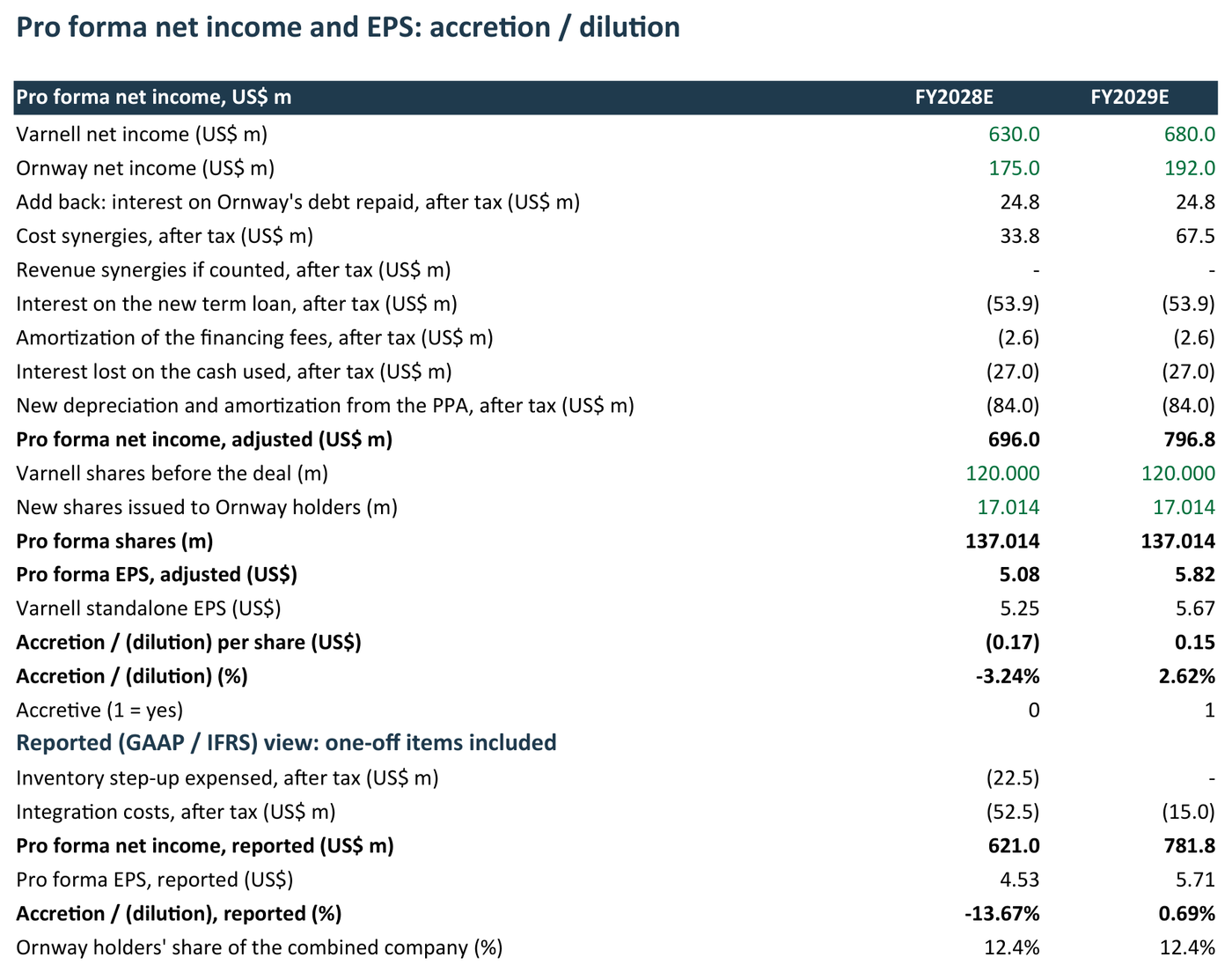
A deal can add to earnings per share and still destroy value, or dilute for a year and be the best decision of the decade. This course shows where each number comes from: an offer of $54.60 that is -3.2% in year 1 and +2.6% in year 2, a goodwill of $1,458m, synergies of $63m needed to break even, a maximum price of $61.12, and the leverage the board accepts to get there.
What you will be able to do
- Set an offer price from a premium and compute the target's diluted shares with the treasury stock method.
- Move from the equity value of the offer to its enterprise value, split cash and stock, and compute the exchange ratio and the new shares.
- Build the sources and uses with transaction and financing fees, and size the new debt without a circular reference.
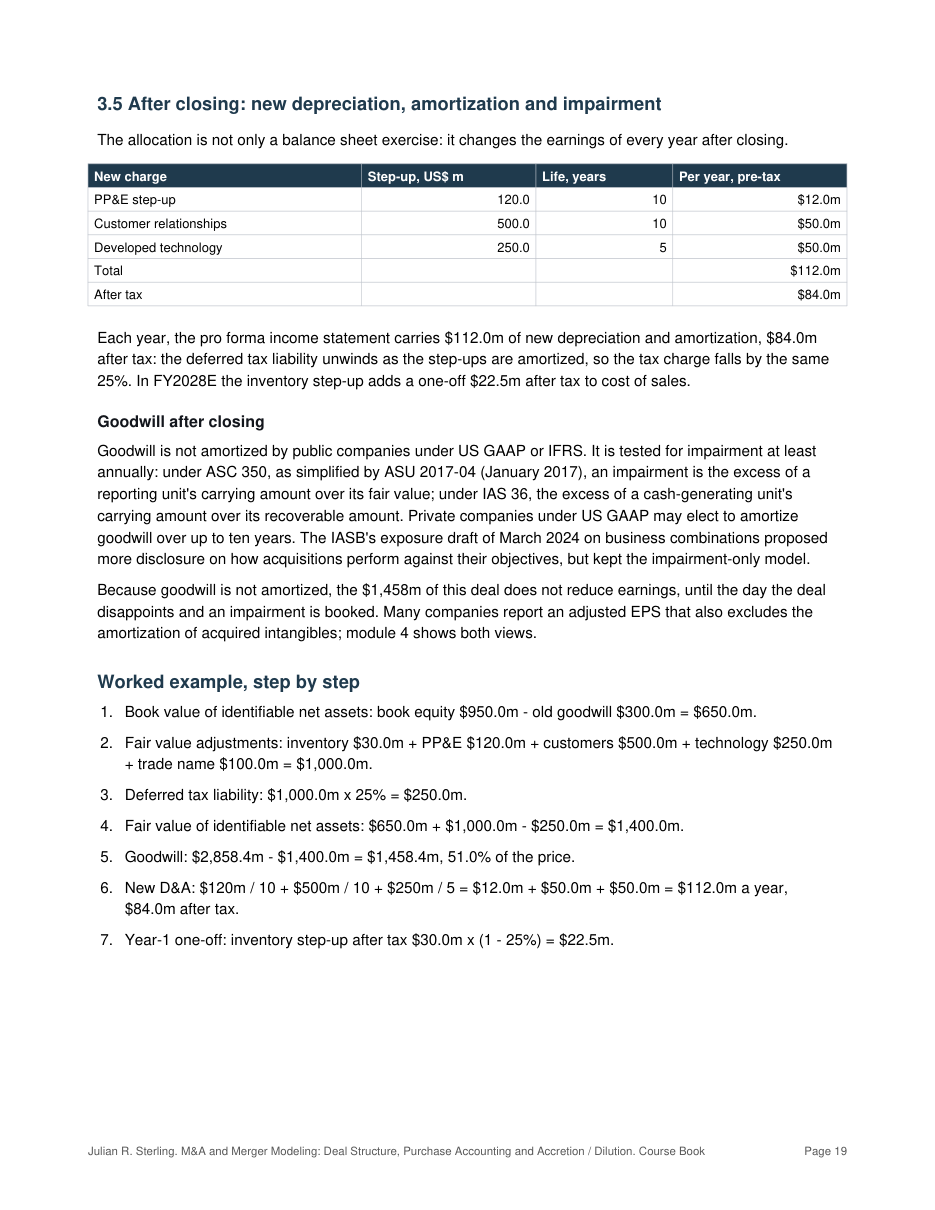
- Allocate the purchase price under ASC 805 and IFRS 3: step-ups, identified intangibles, deferred tax and goodwill, and the new depreciation and amortization.
- Compute pro forma net income and EPS, and accretion or dilution in dollars and percent, adjusted and reported.
- Compare cash, debt and stock, apply the relative P/E rule, and solve breakeven synergies and the maximum price at a neutral EPS.
- Build the pro forma balance sheet, leverage and interest cover, live sensitivity tables, and a one-page board summary.
The program
Six modules of five lessons. Each module has a worked example on the case, the classic mistakes, a summary, three practice questions and an Excel build: a start file with the cells to fill, the formula and the expected value of each, and the solution.
- 1. The M&A process and the deal rationaleWhy companies buy companies, who does what, the timeline of a public deal, cost and revenue synergies, and what a board looks at. Lessons: 1.1 Why companies buy companies (4 min). 1.2 Who does what in a public deal (3 min). 1.3 The timeline from first approach to closing (3 min). 1.4 Synergies: costs, revenues and the cost of getting them (3 min). 1.5 What the board looks at (6 min). Excel build: Synergies and their value (about 15 min).
- 2. Offer price and sources & usesPremium and offer price, diluted shares by the treasury stock method, equity and enterprise value of the offer, cash and stock consideration, sources and uses with fees. Lessons: 2.1 Premium and offer price per share (3 min). 2.2 Diluted shares by the treasury stock method (3 min). 2.3 Equity value and enterprise value of the offer (3 min). 2.4 Cash, stock and the exchange ratio (3 min). 2.5 Sources and uses, fees and the new debt (5 min). Excel build: Offer price, diluted shares and sources and uses (about 15 min).
- 3. Purchase price allocationThe acquisition method of ASC 805 and IFRS 3: identifiable net assets, fair value step-ups, identified intangibles, deferred tax, goodwill and the new depreciation and amortization. Lessons: 3.1 The acquisition method (3 min). 3.2 Identifiable net assets and fair value step-ups (3 min). 3.3 Identified intangible assets (3 min). 3.4 Deferred tax and goodwill (3 min). 3.5 After closing: new depreciation, amortization and impairment (5 min). Excel build: Purchase price allocation and goodwill (about 15 min).
- 4. Pro forma earnings and accretion / dilutionCombined net income, the cost of the new debt, the interest lost on cash, the shares issued, pro forma EPS and accretion or dilution in dollars and percent. Lessons: 4.1 The logic of accretion and dilution (3 min). 4.2 Combined net income and its adjustments (3 min). 4.3 The cost of the financing (3 min). 4.4 Shares issued and pro forma EPS (3 min). 4.5 Adjusted and reported EPS (4 min). Excel build: Pro forma EPS and accretion / dilution (about 15 min).
- 5. Financing mix and breakevenCash, debt or stock, the relative P/E rule, the synergies needed to break even, the maximum price at a neutral EPS and the contribution analysis. Lessons: 5.1 What each currency costs (3 min). 5.2 The relative P/E rule (3 min). 5.3 Breakeven synergies (3 min). 5.4 The maximum price at a neutral EPS (3 min). 5.5 Contribution analysis and ownership (5 min). Excel build: Financing mix, breakeven synergies and maximum price (about 15 min).
- 6. Pro forma balance sheet, credit and sensitivitiesThe balance sheet at closing, leverage and interest cover, sensitivity tables on premium, stock, synergies and price, the classic errors and the board summary. Lessons: 6.1 The pro forma balance sheet at closing (3 min). 6.2 Leverage, interest cover and the rating (3 min). 6.3 Sensitivity tables (3 min). 6.4 Classic errors in merger models (3 min). 6.5 The one-page board summary (4 min). Excel build: Pro forma balance sheet, credit, sensitivities and checks (about 15 min).
Try it free
All of module 1. Download module 1 of the Course Book (PDF): why companies buy companies, who does what in a public deal, the timeline, synergies and what the board looks at, with the worked example.
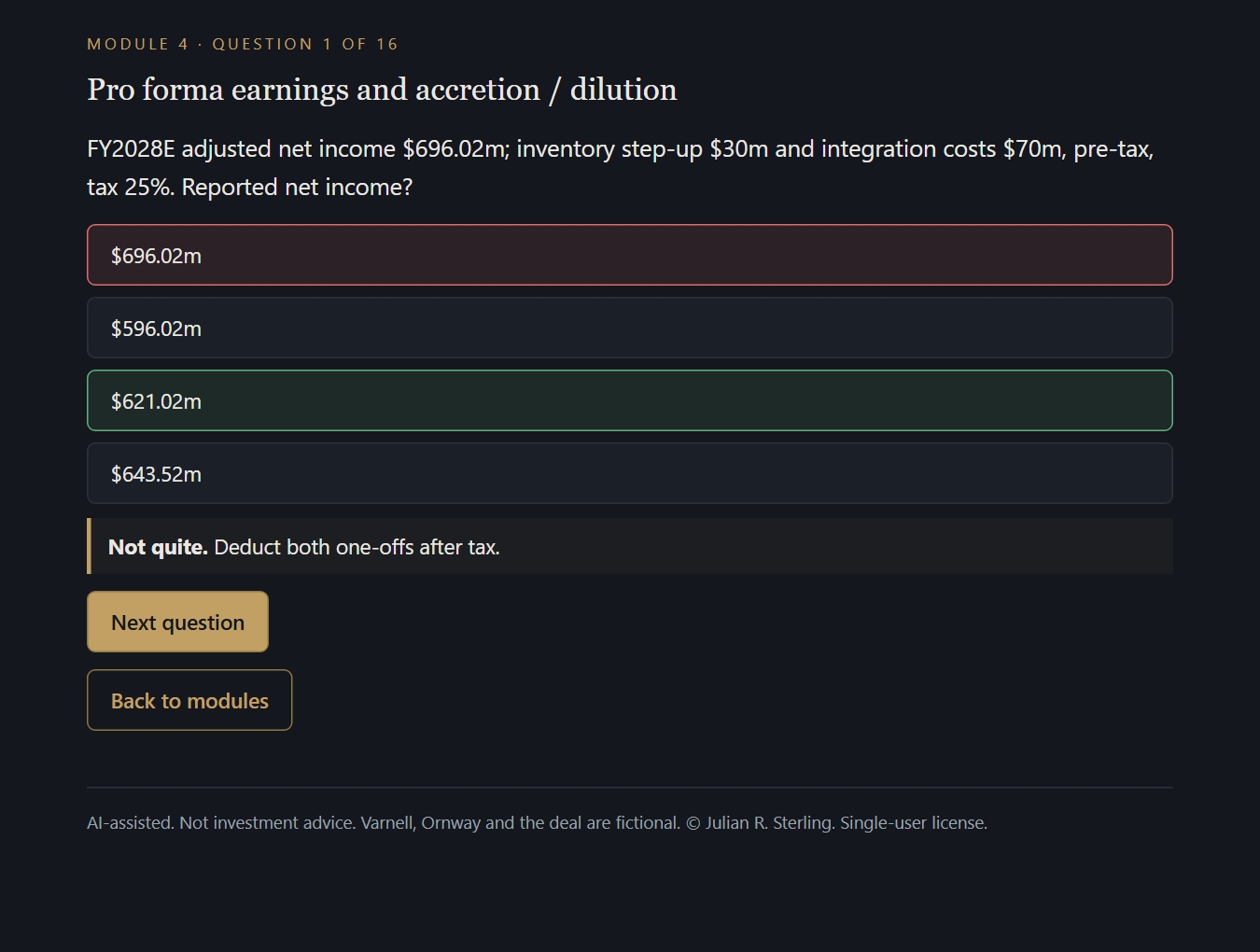
Ten quiz questions. Click an answer: it turns green or red and the explanation appears. The questions use the running case:
Varnell Flow Technologies, Inc. (fictional), a listed maker of valves, pumps and flow-control systems, offers $54.60 per share, half in cash and half in shares, for Ornway Sensing Corporation (fictional), a listed maker of process sensors and monitoring software whose shares traded at $42.00.
Module 1
1. When does an acquisition create value for the buyer's shareholders?
Answer: When the synergies, net of the cost of achieving them, exceed the premium paid. The buyer pays the market value plus a premium; it gains only what the synergies add beyond that premium.
Module 1
2. Why can a strategic buyer usually outbid a financial buyer?
Answer: It can pay for synergies it will capture. A fund pays for standalone cash flows and debt capacity.
Module 1
3. Which synergies do most boards give little or no weight in the base case?
Answer: Revenue synergies. Revenue synergies depend on customers and competitors and fail more often.
Module 1
4. Run-rate cost synergies of $90m pre-tax, 50% achieved in FY2028E. Cost synergies in FY2028E?
Answer: $45.0m. Run-rate x phasing; tax comes later.
Module 1
5. Varnell: FY2028E net income $630m, 120m shares, share price $84.00. Its P/E?
Answer: 16.0x. Price / EPS = 84.00 / 5.25.
Module 2
6. Undisturbed price $42.00, premium 30%. Offer price?
Answer: $54.60. 42.00 x 1.30.
Module 3
7. Book equity $950m, of which goodwill $300m. Book value of identifiable net assets?
Answer: $650m. Equity less the old goodwill.
Module 4
8. Ornway's debt of $600m at 5.5% is repaid; tax 25%. After-tax add-back?
Answer: $24.75m. 600 x 5.5% x 75%.
Module 5
9. Ornway earns $175m in FY2028E; the equity value of the offer is $2,858.4m. Earnings yield bought?
Answer: 6.12%. Net income / equity value.
Module 6
10. Cash: Varnell $1,400m, Ornway $150m, cash used $900m. Pro forma cash?
Answer: $650m. Both less the cash used.
Try the module 1 exercises
The 8 results that close module 1, from the data of the case. Type your answers: they are checked at once. No sign-up.
Inside the course
Your certificate
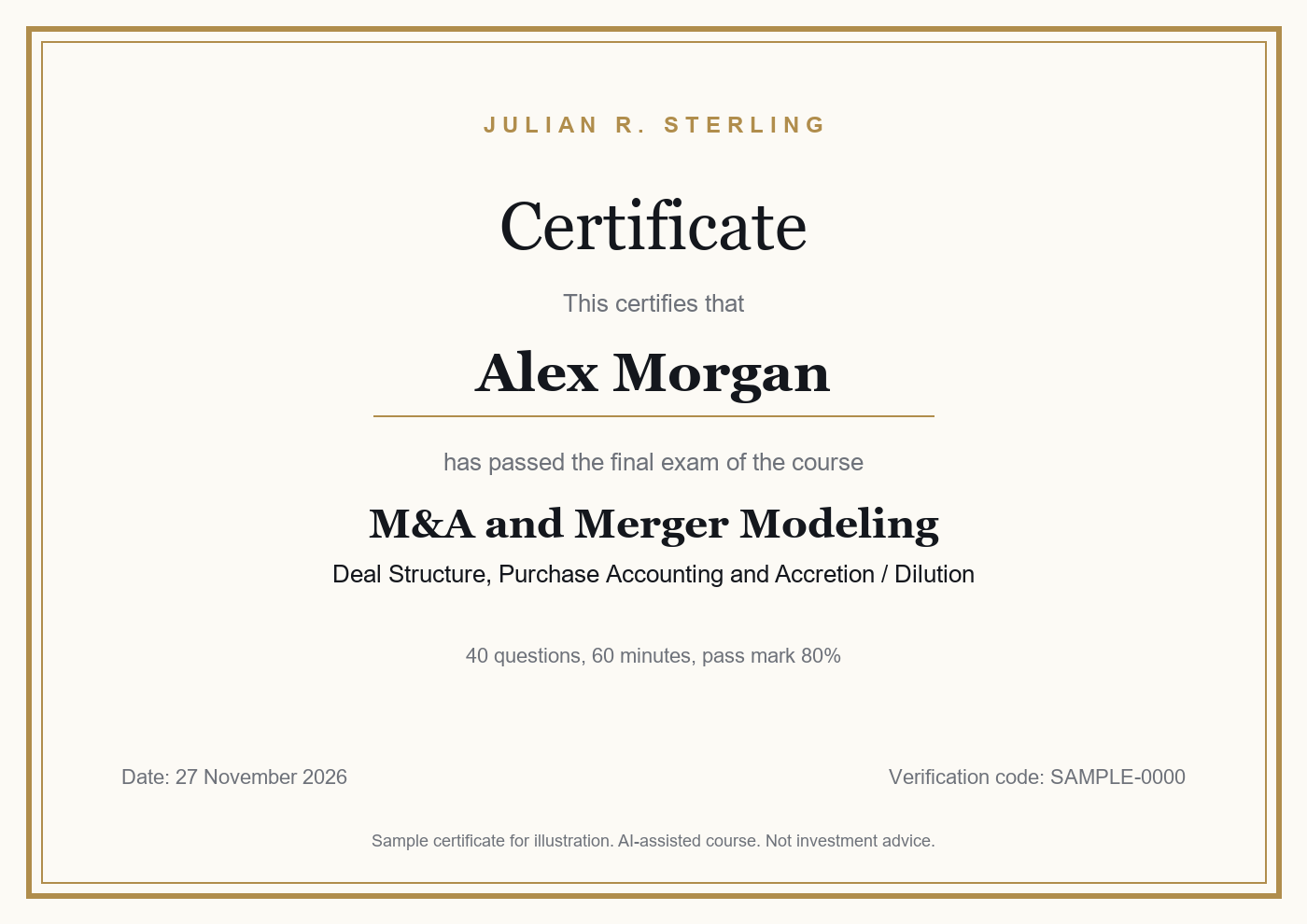
Pass the online exam (40 questions, 60 minutes, 80%) and you receive a certificate of completion with a public verification page, to add to your profile or your CV.
How you learn
What you receive
| File | What it is |
|---|---|
| Online reader | The six modules read in your learner account, with the Excel build of each module and its files. |
| Course_Book.pdf | The same six modules in 40 pages: lessons, worked examples, pitfalls, summaries, builds, practice questions, glossary and dated sources. |
| Case_Workbook.xlsx | Varnell acquires Ornway: offer, sources and uses, purchase price allocation, pro forma EPS, financing, balance sheet, sensitivities, checks. |
| Step_Files | 12 workbooks: a start file and a solution file for each module's build. |
| Exercise_Workbook.xlsx | Six exercise tabs, 44 answers checked automatically, hidden solution tabs. |
| Quiz_App.html | 96 questions, 16 per module, with explanations. |
| Certificate exam | Online from your order page or your account: 40 questions from a private bank, 60 minutes, 80% to pass, verifiable certificate. |
The running case
Varnell Flow Technologies, Inc. buys Ornway Sensing Corporation, both fictional. The offer is announced on 14 Jun 2027 and closes on 31 Dec 2027:
| Measure | Value |
|---|---|
| Offer price / premium to the undisturbed price | $54.60 / 30% |
| Equity value / enterprise value of the offer | $2,858.4m / $3,308.4m |
| EV / EBITDA paid, FY2028E | 10.0x |
| Consideration: cash / new Varnell shares | $1,429.2m / 17.01m |
| New term loan / goodwill | $1,198.2m / $1,458.4m |
| EPS accretion / (dilution), FY2028E / FY2029E | -3.2% / +2.6% |
| Net leverage at closing / board limit | 1.57x / 2.50x |
Not ready yet?
Join the reader list: one short email when a new course, case or correction goes up. No spam, unsubscribe in one click.
Join the reader list Run by MailerLite. How your address is used.
Questions people ask
Who is the course for?
Analysts and associates in investment banking, corporate development, private equity and transaction services, FP&A teams that model an acquisition, and anyone preparing for M&A modeling tests. You need basic Excel and to know what EPS, EBITDA and a balance sheet are.
How long is it?
Six modules and 30 written lessons, about 1 h 42 of reading, plus an Excel build for each module (about 15 minutes each), the exercises and the quizzes. Most learners need four to six hours in all.
Is there video?
The course is read online module by module with an Excel build for each module; video lessons are being added and come at no extra cost.
What do I get exactly?
Right after payment: online access to every module in your learner account, and the course zip: the Course Book (PDF), the Case Workbook with live formulas and a master check, 12 step files, the Exercise Workbook (44 answers checked automatically) and the Quiz App (96 questions). The certificate exam opens from your order page or your learner account.
Which accounting does it follow?
Both US GAAP and IFRS, where they agree: ASC 805 and IFRS 3 for the purchase price allocation, ASC 350 and IAS 36 for goodwill, ASC 740 and IAS 12 for deferred tax. Where they differ, the lesson says so. Standards are paraphrased with their dates.
How does the certificate exam work?
40 questions drawn at random from a private bank, 60 minutes, graded on the server, 80% to pass, retake as often as you need. You receive a certificate with a public verification page. How certificates work.
Does the model use macros or circular references?
No. The new loan and its fees are sized in closed form, the maximum price is solved algebraically, and the sensitivity tables use live formulas instead of data tables. Nothing needs iterative calculation or macros.
Can I get a refund?
Yes. Every course has a 14-day money-back guarantee: write to [email protected] within 14 days of your purchase and you get a full refund, no reason needed. Details in the terms of sale.
Is it investment advice?
No. Both companies and the deal are fictional. The course teaches modeling and accounting mechanics. It was prepared with AI assistance and every figure is computed and checked by script.
M&A and Merger Modeling: $149
The online modules, the Course Book, the Case Workbook, the step files, the exercises, the quiz app and the certificate exam. Read online in your learner account or download everything, right after payment.
Want every course? All Access opens all of them, with their certificate exams. 14-day money-back guarantee.
AI-assisted. Not investment advice. Both companies and the deal are fictional.
Related
- LBO ModelingThe financial buyer's model: sources and uses, debt schedule, returns.
- Credit Documentation & CovenantsWhat the loan that funds a deal really allows.
- Infrastructure ValuationValuing an operating asset with cash flows and multiples.
- All coursesModeling, valuation, credit and fund courses.