Courses · Text course with Excel
Debt Sizing: size a commercial real estate loan with LTV, DSCR and debt yield
How a lender turns a property's income into a loan amount, and proves it: the underwritten NOI, the lendable value, LTV and LTC, DSCR and the mortgage constant, the debt yield and the binding test; then the break-evens, the sensitivities, the maturity test, a refinancing, a construction takeout and the cash trap covenants. You size one loan in Excel along the way.
$49, or included in All Access
A Course Book in 6 short modules, the Case Workbook of a $45.5m warehouse loan (477 live formulas, 11 checks), a start file and a solution file for every module, an Exercise Workbook that checks your 42 answers, a 54-question quiz app, and the certificate exam online. Everything downloads right after payment.
Secure checkout by Stripe. 14-day money-back guarantee. Not sure yet? Read module 1 free and try ten questions below.
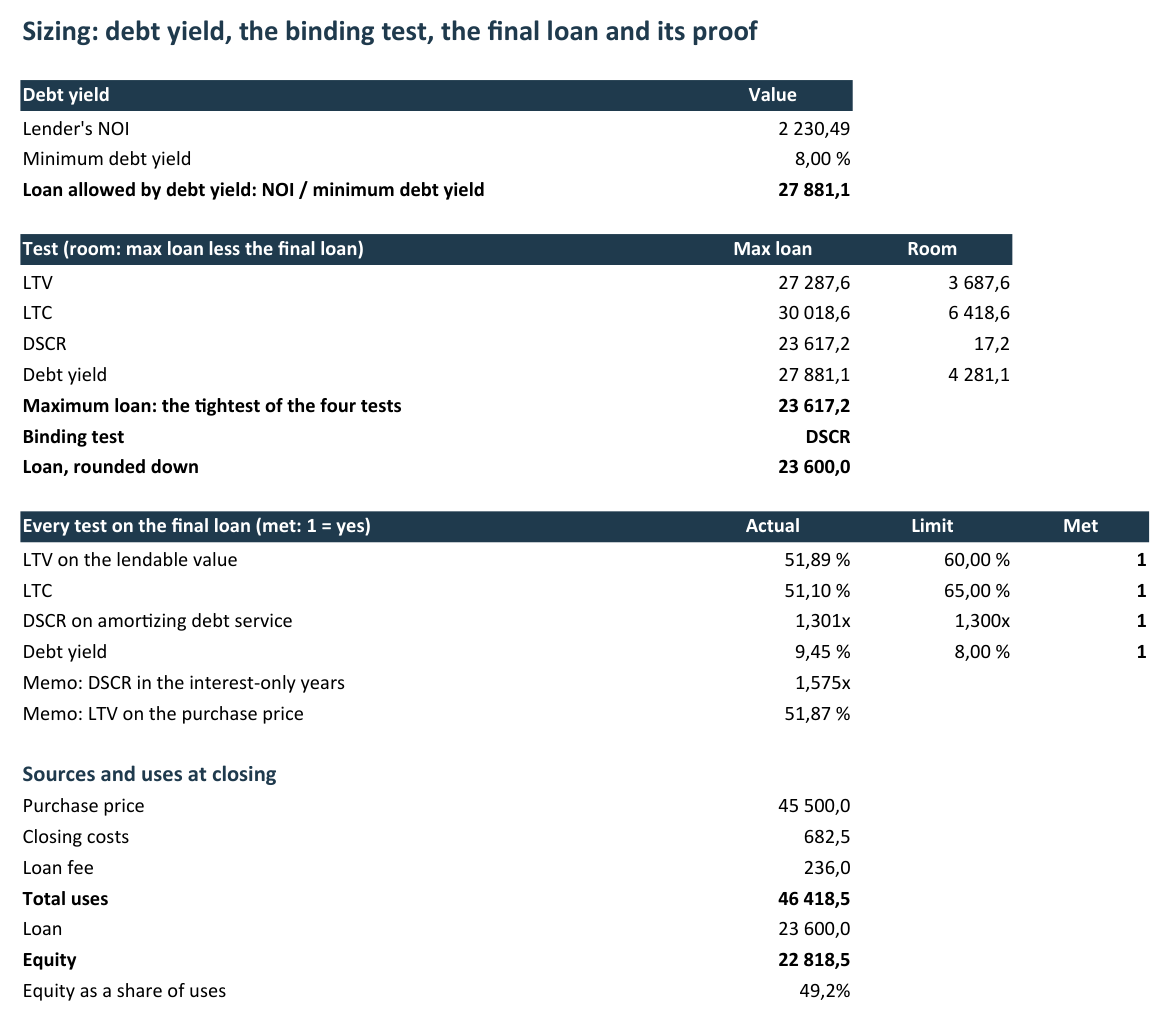
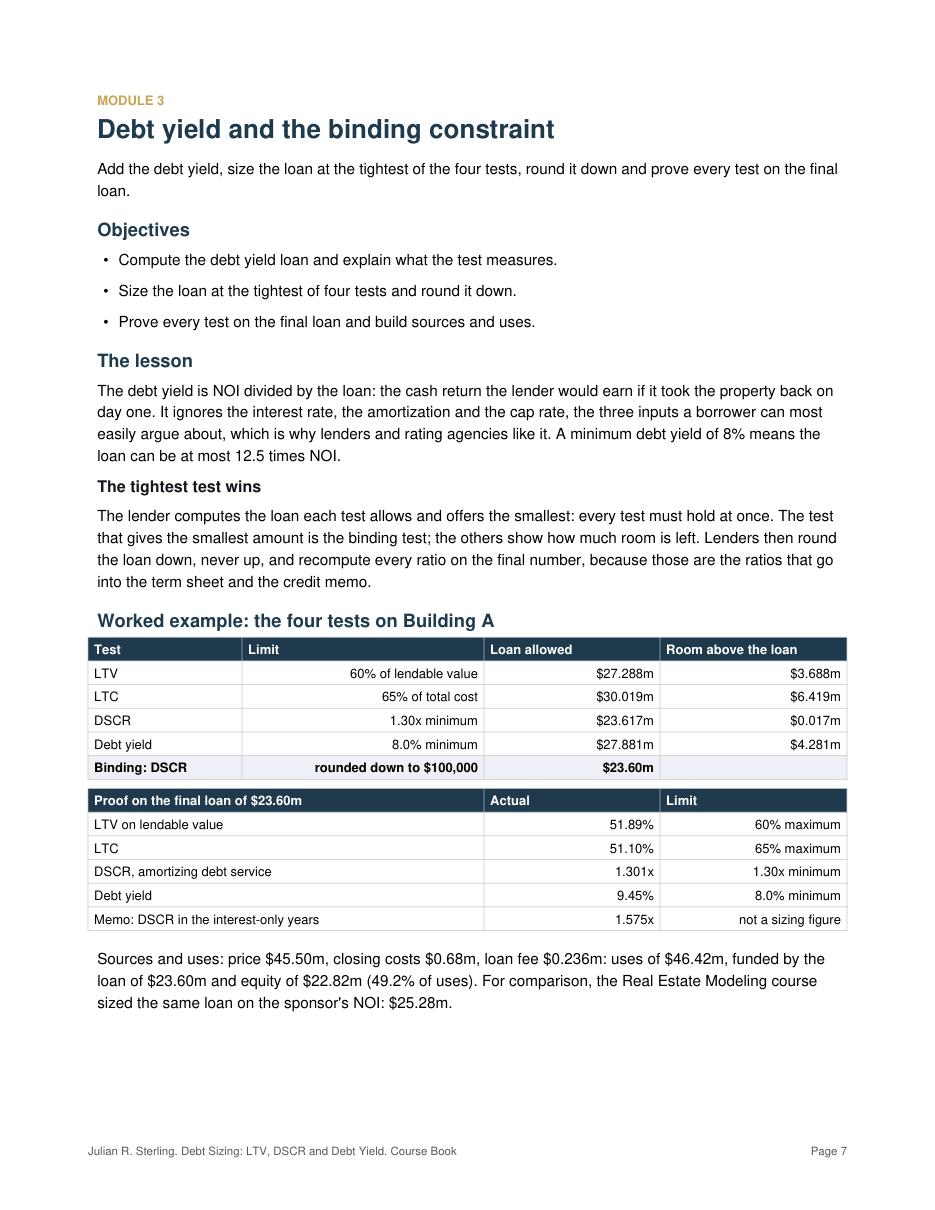
Four tests, four different loans. On Building A the LTV test allows $27.29m, LTC $30.02m, the debt yield $27.88m, and DSCR only $23.62m: the lender offers $23.60m. Size it on the sponsor's NOI or on an interest-only constant and you promise $25.28m or $27.29m. This course shows where each number comes from and which one wins.
What you will be able to do
- Rebuild the NOI a lender underwrites and the value and cost it lends against.
- Compute a mortgage constant and the largest loan a minimum DSCR allows, with or without an interest-only period.
- Size a loan at the tightest of LTV, LTC, DSCR and debt yield, round it and prove every test on the final number.
- Find the value, rate, NOI and occupancy at which the answer changes, and read sensitivity tables with their binding test.
- Test a balloon at maturity, size a cash-out refinancing and a construction-to-permanent takeout.
- Test DSCR and debt yield covenants every year, measure a cash trap and size the paydown that cures it.
- Avoid the classic errors: DSCR on interest only, debt yield on value, sizing on the sponsor's NOI.
The program
Six modules. For each: read the module in the Course Book, build the module in the workbook, then check yourself with the exercise tab and the quiz.
- 1. NOI and lendable valueRebuild the NOI the lender will underwrite, the value it will lend against and the cost it will finance; then the LTV and LTC limits. Read the module in the Course Book; build the module exercise in the workbook.
- 2. DSCR and the mortgage constantTurn a rate and an amortization period into a mortgage constant, and the NOI into the largest loan a 1.30x DSCR allows. Read the module in the Course Book; build the module exercise in the workbook.
- 3. Debt yield and the binding constraintAdd the debt yield, size the loan at the tightest of the four tests, round it down and prove every test on the final loan. Read the module in the Course Book; build the module exercise in the workbook.
- 4. Break-evens and sensitivitiesFind the value, rate, NOI and occupancy at which the answer changes, and run the loan through rate, cap rate and NOI tables. Read the module in the Course Book; build the module exercise in the workbook.
- 5. Refinancing and the maturity testFollow the loan to its balloon, test the refinancing at maturity, size a cash-out refinancing and a construction-to-permanent takeout. Read the module in the Course Book; build the module exercise in the workbook.
- 6. Covenants and the cash trapTest the loan every year against its cash management triggers, stress the NOI, measure the cash trapped and the paydown that cures it. Read the module in the Course Book; build the module exercise in the workbook.
Try it free
Module 1 in full. Download module 1 of the Course Book (PDF): the lender's NOI, the lendable value, LTV and LTC on Building A.
Ten quiz questions. Click an answer: it turns green or red and the explanation appears. The questions use the running case:
Harbor Point Logistics Park, Building A (fictional): a 450,000 sq ft multi-tenant warehouse bought for $45.5m. The lender underwrites an NOI of $2.230m against the sponsor's $2.388m and offers a senior loan at 6.00%, interest only for 3 years, then amortizing over 30 years.
Module 1
1. Why does a lender underwrite its own NOI instead of taking the sponsor's?
Answer: It sizes the loan on what the property can earn through a cycle: market vacancy, market fees, no optimism. The lender's NOI is lower and more durable.
Module 1
2. Building A: gross revenue $3,592.5k, expenses of $1,080.0k, lender vacancy 5% and a 3% management fee on effective gross revenue. The lender's NOI is...
Answer: $2,230.5k. Gross revenue less vacancy, then less expenses and the management fee.
Module 1
3. The lendable value of a property bought today is usually...
Answer: The lower of the purchase price and the appraised value. The loan rests on no more value than both the buyer and the appraiser support.
Module 1
4. The appraiser capitalizes the in-place NOI of $2,387.7k at 5.25%. Appraised value?
Answer: $45.48m. Value = NOI / cap rate.
Module 1
5. Lendable value $45.48m, maximum LTV 60%. Loan allowed by LTV?
Answer: $27.29m. LTV x the lower of price and value.
Module 2
6. The mortgage constant is...
Answer: The annual debt service per dollar of loan. Rate plus the principal of a level payment: rate / (1 - (1 + rate)^-years).
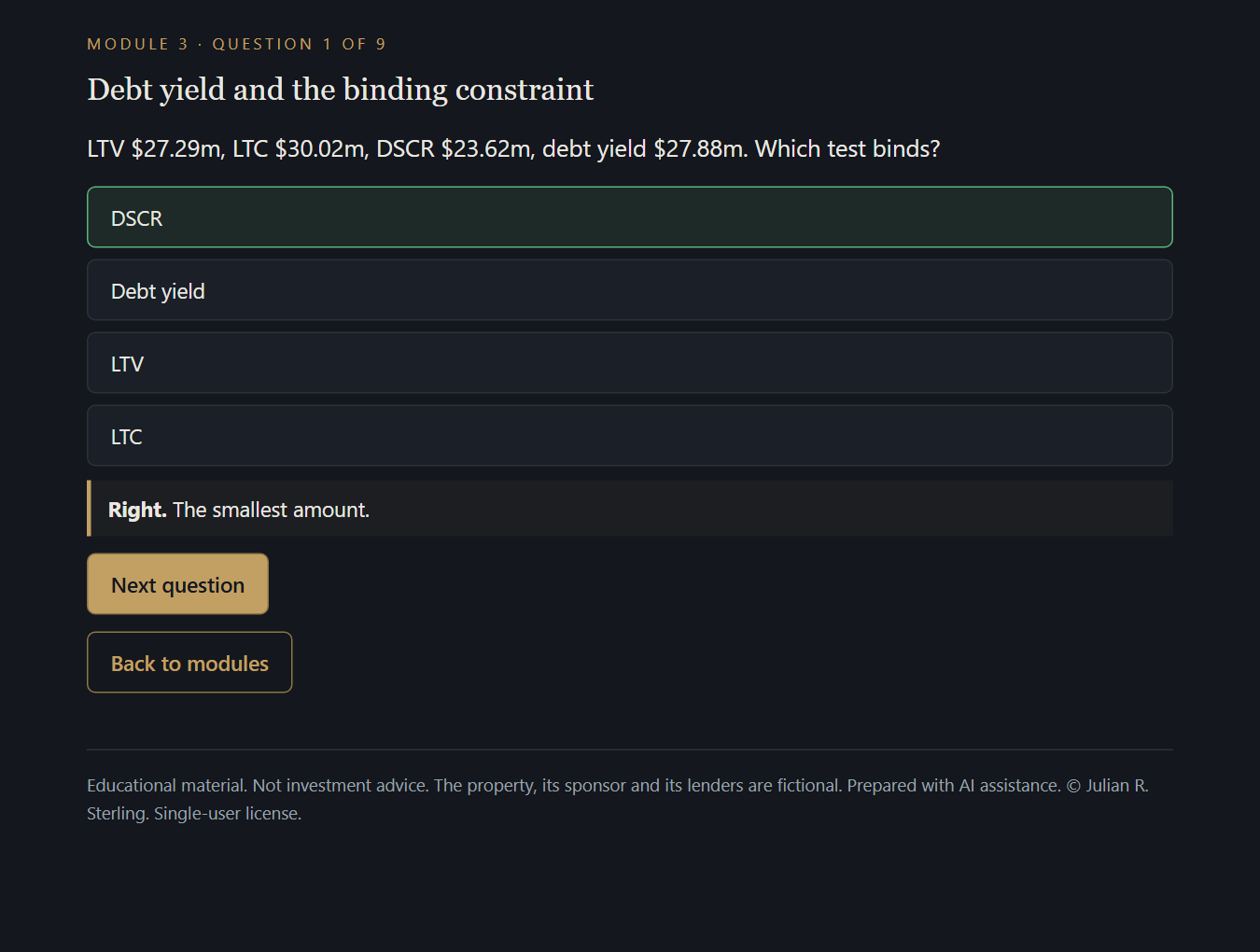
Module 3
7. Debt yield is...
Answer: NOI divided by the loan amount. The lender's cash return if it owned the property.
Module 4
8. The DSCR loan is $23.62m and the maximum LTV 60%. Below which lendable value would LTV bind instead?
Answer: $39.36m. DSCR loan / LTV.
Module 5
9. Loan $23.60m, interest only for 3 years, then a level payment of $1,714.5k a year. Balloon at the end of year 10?
Answer: $21.09m. Seven years of amortization, front-loaded with interest.
Module 6
10. A cash trap is...
Answer: A clause that keeps the property's excess cash in a lender-controlled account while a ratio is below its trigger. It protects the lender before a default.
Try the module 1 exercises
The 7 results that close module 1, from the data of the case. Type your answers: they are checked at once. No sign-up.
Inside the course
Your certificate
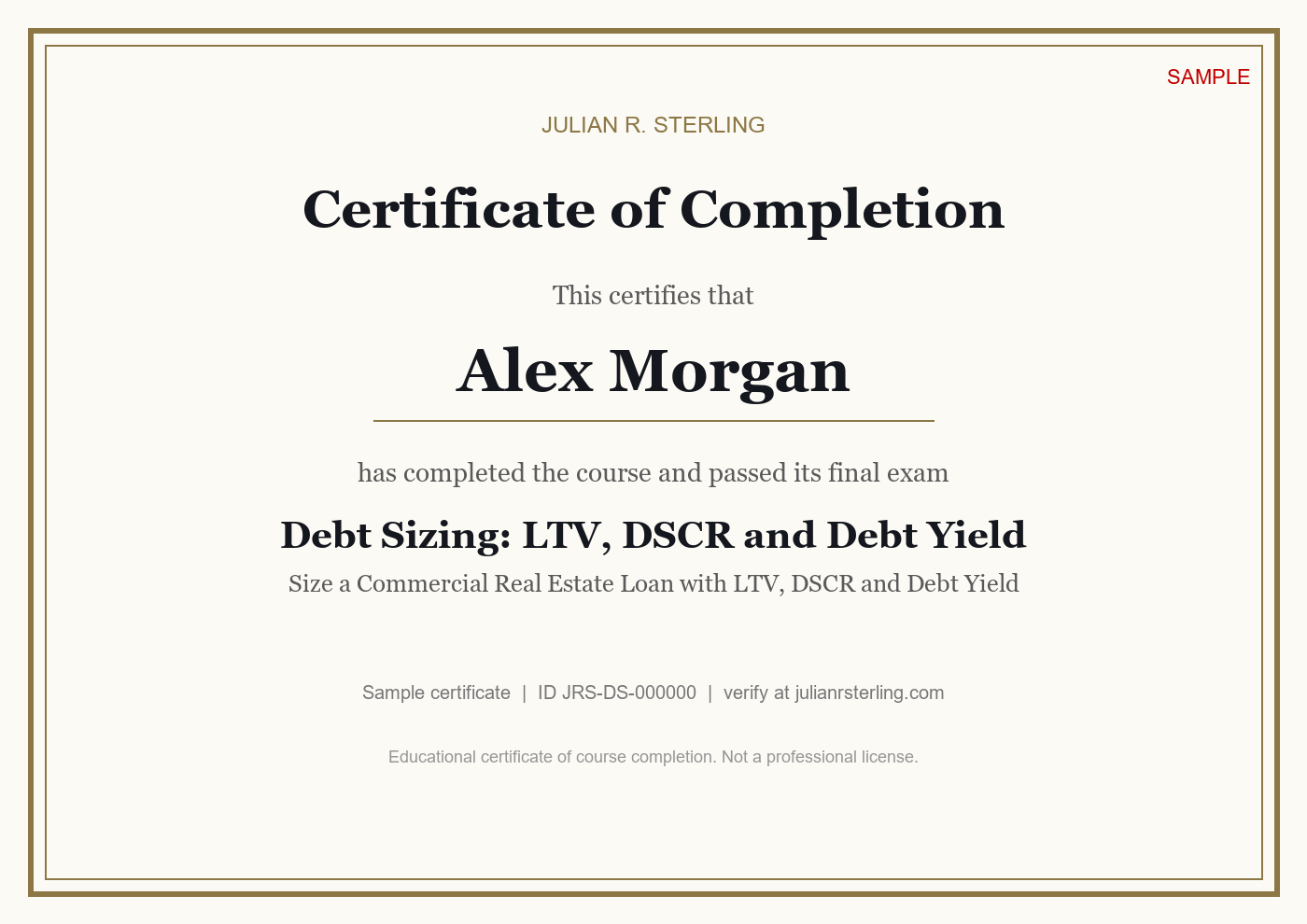
Pass the online exam (40 questions, 60 minutes, 80%) and you receive a certificate of completion with a public verification page, to add to your profile or your CV.
How you learn
What you receive
| File | What it is |
|---|---|
| Course_Book.pdf | Six modules: objectives, lesson, worked example, pitfalls, summary and practice questions; glossary, answers and dated sources. |
| Case_Workbook.xlsx | Building A's loan: lender's NOI, LTV, LTC, DSCR, debt yield, binding test, break-evens, sensitivities, schedule, maturity test, refinancing, takeout, covenants and checks. |
| Step_Files | 12 workbooks: a start file and a solution file for each module. |
| Exercise_Workbook.xlsx | Six exercise tabs, 42 answers checked automatically, hidden solution tabs. |
| Quiz_App.html | 54 questions, nine per module, with explanations. |
| Certificate exam | Online from your order page or your account: 40 questions from a private bank, 60 minutes, 80% to pass, verifiable certificate. |
The running case
Harbor Point Logistics Park, fictional, is the property of the Real Estate Modeling course. Here the senior loan on Building A is sized again from first principles:
| Measure | Building A |
|---|---|
| Sponsor's NOI / lender's NOI, year 1 | $2.388m / $2.230m |
| Loan allowed by LTV / LTC / DSCR / debt yield | $27.29m / $30.02m / $23.62m / $27.88m |
| Loan offered (DSCR binds, rounded down) | $23.60m |
| DSCR / debt yield / LTV on the final loan | 1.301x / 9.45% / 51.9% |
| Interest rate at which LTV would bind instead | 4.70% |
| Balloon at maturity / refinancing capacity | $21.09m / $39.84m |
| Lowest DSCR over the term / cash trap trigger | 1.299x / 1.25x |
In a downside where NOI falls 10% from year 4, the DSCR drops to 1.169x in the first amortizing year, the lender traps $0.240m of cash, and a paydown of $1.54m would cure the trap.
Part of the real estate track
This course follows Real Estate Modeling, which underwrites the same property, and sits next to Private Credit Modeling and Credit Documentation & Covenants on the lender's side. See certifications.
Not ready yet?
Join the reader list: one short email when a new course, case or correction goes up. No spam, unsubscribe in one click.
Join the reader list Run by MailerLite. How your address is used.
Questions people ask
Who is the course for?
Analysts and associates in commercial real estate lending, debt funds, CMBS and bank credit teams; acquisition analysts who must anticipate what a lender will offer; anyone writing a credit memo. You need basic Excel and to know what NOI and a cap rate are.
Is it a video course?
It is a text course with Excel. Each module is read in the Course Book and built in the workbook, with a start file and a solution file, an exercise tab and a quiz. Video lessons are being added and are included at no extra cost.
How long is it?
Six short modules. Most learners need three to five hours to read the 6 modules, build them in the workbook, do the 42 exercises and the quizzes.
Do I need the Real Estate Modeling course first?
No. The property is Harbor Point Logistics Park, Building A, the acquisition of Real Estate Modeling, but this course stands on its own: every figure it needs is given. That course underwrites the property; this one sizes, tests and follows its loan.
What do I get exactly?
Right after payment, one zip: the Course Book (PDF), the Case Workbook with 477 live formulas and 11 checks, 12 step files, the Exercise Workbook (42 answers checked automatically) and the Quiz App (54 questions). The certificate exam opens from your order page or your learner account.
How does the certificate exam work?
40 questions drawn at random from a private bank, 60 minutes, graded on the server, 80% to pass, retake as often as you need. You receive a certificate with a public verification page. How certificates work.
Are these real lender terms?
No. The limits, rates and triggers are assumptions of the fictional case, chosen to be typical of a senior loan on a stabilized warehouse, not quotes. The course teaches the mechanics so that you can apply any lender's terms.
Can I get a refund?
Yes. Every course has a 14-day money-back guarantee: write to [email protected] within 14 days of your purchase and you get a full refund, no reason needed. Details in the terms of sale.
Is it investment advice?
No. The property, its sponsor and its lenders are fictional. The course was prepared with AI assistance, and every figure is computed by the same code as the workbooks and checked by script.
Debt Sizing: LTV, DSCR and Debt Yield: $49
The Course Book, the Case Workbook, the step files, the exercises, the quiz app and the certificate exam. Everything downloads right after payment. 14-day money-back guarantee.
Want every course? All Access opens all of them, with their certificate exams.
Related
- Real Estate ModelingUnderwrite, develop and share the profits of a commercial property: the same Harbor Point case.
- Private Credit ModelingUnderwrite a direct loan: structure, returns, downside and recovery.
- Credit Documentation & CovenantsRead and test the covenants of a credit agreement.
- All coursesEvery course, with its free sample and its certificate exam.