Book · Julian R. Sterling
The Bar Owner
Starting, Buying and Running a Neighborhood Bar: Pour Cost and Drink Prices, Happy Hour, Inventory and Variance, Labor and Tips, Rent and Insurance, the Liquor License, Food and Events, Break-Even, Cash Flow, a Patio and Valuation
About the book
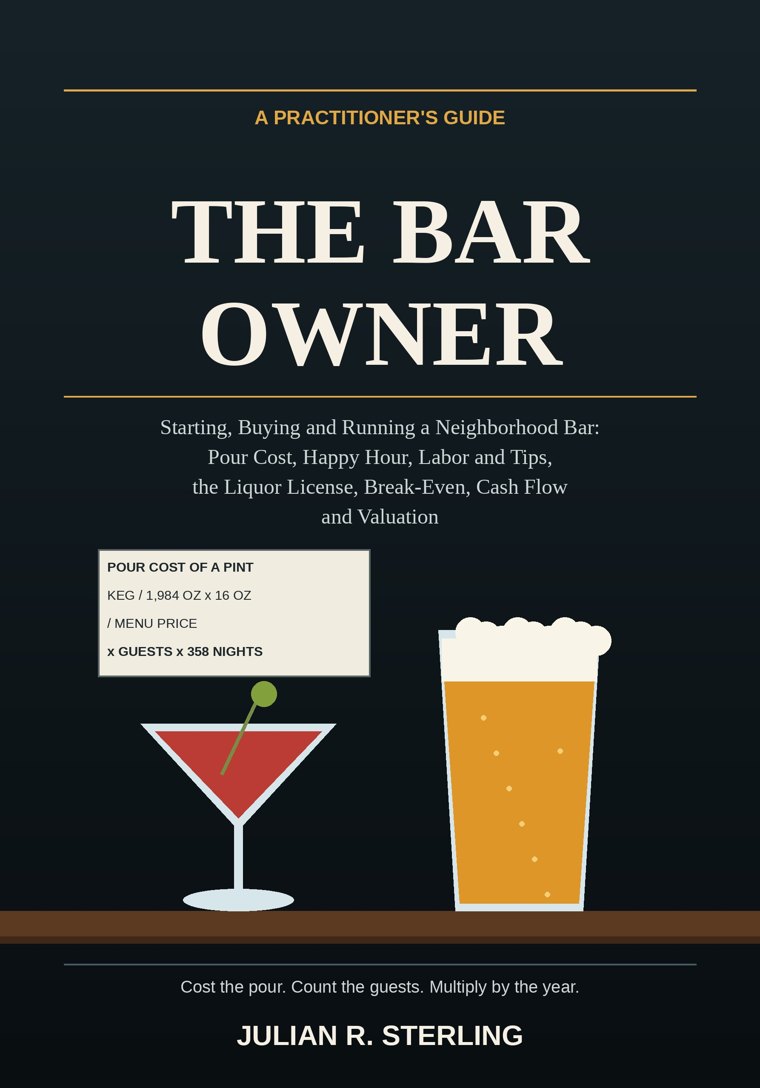
A pint costs a little over a dollar to pour and sells for seven, and the margin on the whole bar is still ordinary. Between the keg and the bank account stand the staff, the rent, the insurance, the license, the spills, the free rounds and the slow Tuesdays. This guide works through those numbers, from the cost of one pour to the sale of the bar.
One fictional bar runs through every chapter: the Haverline, a corner tavern of 2,600 square feet with 64 seats and a small kitchen, bought in 2022 by an owner who works as its general manager. In 2026 it served 140 guests a day at an average spend of $25.08, took in $1,257,010 and earned adjusted EBITDA of $227,462 (18.1%) after a market salary for the manager’s job. The book follows its pour costs, its weekly count, its schedule and tips, its license and insurance, its quiet January, a seasonal patio and two offers for the bar.
What is inside:
- 16 chapters in five parts: the bar and its numbers, control, people and place, beyond the bar, profit and cash, starting, buying and selling
- Pour costs to the cent: a pint at $1.49 against a price of $7.00, a mixed drink at $1.20, a house cocktail at $3.06; why the cocktail’s higher pour cost still leaves the most dollars
- Happy hour and a price rise tested in guests; a quarter ounce over-poured on every spirit drink that costs $10,254 a year
- Labor, wages and tips as read in the federal rules: tip pools, managers and owners, Form 8027, the deduction for qualified tips and the employer’s credit
- The federal registration of an alcohol retailer, the state license as a question to ask, its market price in the case and the floor it puts under the bar’s value
- Break-even at 103 guests a day, four stress tests, cash through the year, a patio, a start-up budget of $813,977 and two offers for the bar; check-lists and a glossary
Free: the bar model in Excel
The Haverline model from the book, simplified, with live formulas: the pour cost of every item, the mix and the average check, happy hour, variance, labor and tips, occupancy, insurance and other costs, the P&L with adjusted EBITDA and SDE, the break-even in guests per day, three stress factors and two offers for the bar. No macros, nothing locked.
What is inside
- Chapter 1: The Bar on One Page
- Chapter 2: The Cost of a Pour
- Chapter 3: Prices, Happy Hour and the Average Check
- Chapter 4: Guests, Nights and the Weekend
- Chapter 5: Inventory, Variance and Shrinkage
- Chapter 6: Labor, Wages and Tips
- Chapter 7: Rent, the Lease and Insurance
- Chapter 8: The Liquor License and the Rules
- Chapter 9: Food, Private Parties and Entertainment
- Chapter 10: The P&L, Prime Cost, Adjusted EBITDA and SDE
- Chapter 11: Break-Even and Four Stress Tests
- Chapter 12: Cash Through the Year
- Chapter 13: A Patio and the 2027-2029 Plan
- Chapter 14: Opening a Bar from Scratch
- Chapter 15: Buying a Bar
- Chapter 16: Value and Sale
- Conclusion
- Appendix A: The Bar Model, Tab by Tab
- Appendix B: Check-Lists
- Appendix C: Glossary
Read first
To read: How much does a bar make?
To read: How much does it cost to open a bar?
To read: How to calculate pour cost
Updates
Liquor licensing, dram shop rules, drink promotion rules, minimum wages, tip rules and tip reporting, food safety codes, tax rules on equipment and build-outs, and SBA lending rules change, and most differ by state, county and city. This page will note material changes that affect the book.
Also by Julian R. Sterling
Related titles. The full list is on the author page.