Book · Julian R. Sterling
The Syndicated Loan Handbook
Arranging and Investing in Leveraged Loans: Mandates and Flex, Term Loan B and Revolvers, Pricing, OID and Margin Ratchets, Agency and Secondary Trading, Amendments and Covenant-Lite Terms, and the Return Math of Banks and Institutional Lenders
Google Play Paperback, $32.99 PDF edition, $19.99
Buying for your firm? Add your company name and VAT number at checkout and they go on the invoice. For a team: team license, up to 10 people, $59.99 · firm-wide license, $139.99.
About the book
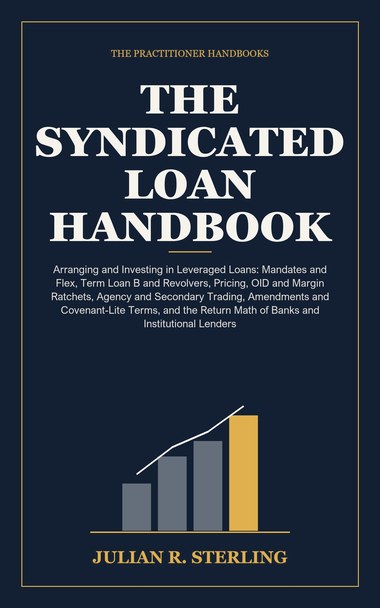
Arranging or investing in leveraged loans means operating across two distinct ecosystems that share one first-lien collateral pool: regulated commercial banks holding revolvers under Basel III capital charges, and CLOs, loan funds, and hedge funds underwriting 7-year Term Loan Bs on Term SOFR, OID, secondary Discount Margin, and covenant-lite recovery math.
Every calculation is worked on one fictional $815,000,000 U.S. LBO, Meridian Industrial Packaging, Inc. ($715M TLB + $100M RCF): upward market flex (+25 bps margin, +50 bps OID to 98.50, 9.00 percent 3-year yield), Actual/360 uplift (+12 bps) and 0.50 percent SOFR floors, IRC 1273(a)(3) OID de minimis cliffs (98.32 on 6.74-year WAM) and 2026 OBBBA IRC 163(j) EBITDA caps ($39M), LSTA T+12 delayed compensation ($8,106 net credit over 7 calendar days), ASC 470-50 lender-by-lender amendment testing (1.73 percent), Serta/J.Crew/Chewy LMT blockers, a 9-cell PD x LGD stress matrix, and 12 CFR 217.33 bank RAROC (10.11 percent standalone vs. 19.29 percent relationship wallet).
Paperback, $32.99, shipping included to the United States, the United Kingdom, Europe, and Australia.
PDF edition, $19.99, DRM-free, delivered at once by email.
What is inside
- Introduction: Why Syndicated Loans Are the Engine of Corporate Leverage
- Chapter 1: The Syndicated Loan Market, Participants, and Regulatory Perimeter
- Chapter 2: Mandate Letters, Commitment Papers, and Market Flex Mechanics
- Chapter 3: Capital Structure, Facility Architecture, and Sources and Uses
- Chapter 4: Term Loan B vs. Revolving Credit Facilities
- Chapter 5: Benchmark Mechanics: Term SOFR, Floors, Day Count, and Margin Ratchets
- Chapter 6: Original Issue Discount, Upfront Fees, Soft Call, and Tax Rules
- Chapter 7: Syndication Execution, Bookbuilding, Allocations, and Closing
- Chapter 8: The Administrative Agent, Collateral Agent, and Operational Mechanics
- Chapter 9: Secondary Loan Trading, LSTA Settlement, and Delayed Compensation
- Chapter 10: Covenant-Lite Architecture: Baskets, Builders, and Incremental Debt
- Chapter 11: Amendments, Waivers, Repricings, and Liability Management Defense
- Chapter 12: Institutional Lender Return Math: Yield, Discount Margin, and Prepayments
- Chapter 13: Default, Recovery, and Credit Loss Stress Testing
- Chapter 14: Relationship Bank Return Math: RWA, RAROC, and Ancillary Wallets
- Chapter 15: Practitioner Playbook: 90-Day Deal Execution and Portfolio Monitoring
- Conclusion: Structuring for the Cycle, Not Just the Launch Day
- Appendix A: Glossary of Syndicated and Leveraged Loan Terms
- Appendix B: Worked Formulas and Quantitative Reference
- Appendix C: Practitioner Checklists
- Appendix D: Guide to the Companion Excel Workbooks
Free companion files
Unlocked Excel workbooks, blue inputs, black formulas, zero macros, and a Controls tab that reads 0.
Complete case model
Meridian Syndicated Loan Case Workbook
8 tabs reproducing every flex walk, amortization schedule, quarterly IRR, LSTA delayed comp, ASC 470-50 test, default stress matrix, and bank RAROC calculation in the book.
Download Syndicated_Loan_Case_Workbook.xlsx27 KBStandalone practitioner tool
Syndicated Loan Pricing Model
Facility sizing, lender allocations, Term SOFR floor, OID and market flex, 28-quarter amortization/prepayment IRR, secondary Discount Margin, and 9-cell default stress matrix.
Download Syndicated_Loan_Pricing_Model.xlsx19 KB
Want the standalone pricing template first? Open the free Syndicated Loan Pricing Model (Excel) page.
Worked articles from the book
- How Syndicated Loans WorkPro-rata banks, CLO institutional tranches, SunGard commitments, Shared National Credit rules, and Kirschner v. JPMorgan worked on an $815M LBO.
- Leveraged Loan Pricing, OID, and Market FlexTerm SOFR, Actual/360 uplift, 0.50 percent floors, fee-cushion flex sharing, 3-year convention yield vs. exact IRR, and the IRC 1273(a)(3) de minimis cliff.
- Term Loan B vs. Revolving Credit FacilityComparing 7-year cov-lite TLBs against 5-year springing-covenant revolvers, 12 CFR 217.33 50 percent CCF capital charges, and standalone vs. relationship RAROC.
Questions practitioners ask
Who is this handbook written for?
Leveraged finance bankers, loan syndicators, CLO analysts, secondary loan traders, private equity deal teams, debt advisors, and corporate treasurers.
Which legal, tax, and accounting rules are covered?
Shared National Credit (SNC) thresholds, 12 CFR 217.33 CCF rules, Kirschner v. JPMorgan (2d Cir. 2023; cert. denied 2024), In re Serta Simmons Bedding (5th Cir. Dec 2024 & July 2026 remand), LSTA T+7 delayed compensation, IRC Sections 163(j) (2026 OBBBA EBITDA restoration) and 1273(a)(3), and FASB ASC 310-20 and ASC 470-50.
Are the Excel workbooks included free?
Yes. Both Syndicated_Loan_Case_Workbook.xlsx and the standalone Syndicated_Loan_Pricing_Model.xlsx are free on this page, unlocked, and macro-free.