Book · Julian R. Sterling
The Section 708 Partnership Mergers and Divisions Handbook
Partnership Continuations, Mergers, and Divisions Under US Tax Law: The 50% Capital and Profits Test, Assets-Over vs Assets-Up Forms, Exiting Partner Buy-Outs, Section 704(c) Layering, Section 752 Liability Netting, and Post-TCJA Termination Rules
About the book
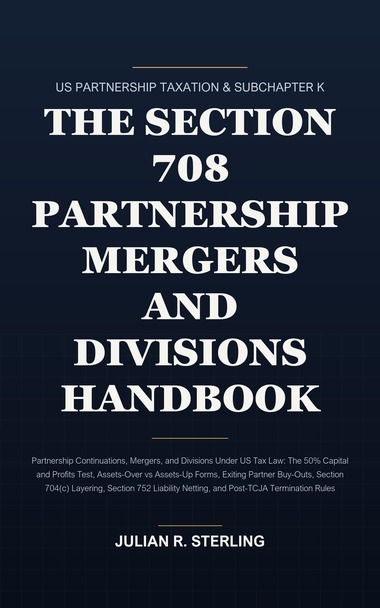
IRC Section 708 governs the federal tax survival, termination, consolidation, and split-up of every US tax partnership. One overlooked consent clause, an unmodeled liability shift, or an untracked 7-year anti-mixing-bowl clock can turn a tax-free fund consolidation or portfolio division into millions of dollars of immediate phantom gain.
One complete institutional case study, Meridian Real Estate & Operating Partnerships, carries every calculation from pre-merger trial balances through post-division Form 1065 compliance. In the June 30, 2026 three-way consolidation of Alpha ($28,000,000 net FMV), Beta ($24,000,000 net FMV), and Gamma ($8,000,000 net FMV) into Meridian Consolidated Partners, LP ($54,000,000 post-buyout net equity), both Alpha (81.48%) and Beta (64.44%) clear the 50% capital and profits test, triggering the Treas. Reg. § 1.708-1(c)(1) Net FMV tie-breaker in Alpha's favor. Electing Treas. Reg. § 1.708-1(c)(4) on Cedar Realty Trust's $6,000,000 cash exit eliminates $4,437,500 of phantom Section 707(a)(2)(B) disguised-sale gain on continuing partners (including qualified liabilities under Treas. Reg. § 1.707-5(a)(5)(i)) while creating a $3,250,000 common-basis step-up. Assets-Up ($409,002 PV tax shield vs. $360,000 single-layer transfer tax at 1.00%), Treas. Reg. § 1.752-1(f) liability netting (avoiding $2,000,000 phantom gain for Epsilon), Rev. Rul. 2004-43 dual-clock Section 704(c) layering ($20,750,000 new layers), and the December 31, 2028 partnership division (saving $1,904,000 in anti-mixing-bowl tax by waiting six months) are reconciled cell by cell.
What is inside:
- 15 chapters in four parts covering IRC § 708(a)/(b)(1)/(b)(2)(A)/(B), Treas. Reg. § 1.708-1, Rev. Rul. 99-5 and 99-6, Rev. Rul. 2001-61, Rev. Rul. 2004-43, and the TCJA repeal of technical terminations
- Complete worked mechanics of the >50% capital and profits continuation test, Net FMV tie-breaker, and none-continuing restructurings
- Assets-Over default rules contrasted against Assets-Up state-law conveyances, Section 732(b)/(c) basis step-ups, and transfer-tax breakeven modeling
- Exiting partner buy-out drafting under Treas. Reg. § 1.708-1(c)(4) versus Section 707(a)(2)(B) and Treas. Reg. § 1.707-5(a)(5)(i) disguised-sale allocation traps
- Three-tier Reg. § 1.752-3 nonrecourse waterfalls, Treas. Reg. § 1.752-1(f) simultaneous liability netting, and Rev. Rul. 2004-43 dual-clock Section 704(c) ledgers
- Partnership divisions with multiple continuations, Divided vs. Recipient EIN rules, anti-mixing-bowl split-off exposure, Form 1065 compliance statements, and a 30/60/90-day deal playbook
Free: the Section 708 Merger & Division Calculator in Excel
Computes the 3-partnership >50% continuation test and Net FMV tie-breaker, Reg. § 1.708-1(c)(4) buy-out vs. disguised sale, Assets-Up vs. Assets-Over NPV and transfer-tax breakeven, 3-tier Section 752 waterfall and netting test, Rev. Rul. 2004-43 Section 704(c) layers, partnership divisions, Rev. Rul. 99-6, and post-TCJA repeal savings. Pre-loaded with Meridian Consolidated Partners, LP, 100% live formulas, no macros, nothing locked.
Contents
- Chapter 1: The Statutory Framework of IRC Section 708 and the Continuation Doctrine
- Chapter 2: Partnership Terminations Under Section 708(b)(1) and the TCJA Repeal of Technical Terminations
- Chapter 3: Single-Member Conversions and Asymmetrical Buy-Outs Under Rev. Rul. 99-6 and Rev. Rul. 99-5
- Chapter 4: The 50% Capital and Profits Continuation Test and the Net FMV Tie-Breaker
- Chapter 5: Assets-Over Mergers: The Default Federal Tax Construct
- Chapter 6: Assets-Up Mergers: State-Law Conveyance, Section 732(b) Step-Ups, and Transfer-Tax Trade-Offs
- Chapter 7: Exiting Partner Buy-Outs Under Treas. Reg. § 1.708-1(c)(4) vs. Section 707(a)(2)(B) Disguised Sales
- Chapter 8: Section 752 Liability Netting in Mergers and the Three-Tier Nonrecourse Waterfall
- Chapter 9: Section 704(c) Layering and the 7-Year Anti-Mixing-Bowl Clock Under Rev. Rul. 2004-43
- Chapter 10: Inside Basis, Section 754 Elections, Mandatory $250,000 Loss Adjustments, and Section 168(i)(7) Depreciation
- Chapter 11: Partnership Divisions Under Section 708(b)(2)(B): Multiple Continuations and the Divided Partnership
- Chapter 12: Assets-Over vs. Assets-Up Divisions and Anti-Mixing-Bowl Exposure in Split-Offs
- Chapter 13: Form 1065 Compliance, Short-Year Returns, EIN Retention, and Schedule K-1 Reporting
- Chapter 14: State-Law Merger Statutes, Real Estate Transfer Taxes, and Anti-Abuse Recasts
- Chapter 15: End-to-End Meridian Restructuring Case Study and Transaction Execution Playbook
- Conclusion & Appendices A, B, and C (Reconciled Schedules, Structuring Checklists, Glossary)
Read first
To read: Section 708(b)(2)(A) Partnership Mergers: The 50% Continuing Entity Test and Net FMV Tie-Breaker
To read: Assets-Over vs. Assets-Up Partnership Mergers: Tax Rules, Basis Step-Ups, and Transfer-Tax Breakeven
Updates
Federal tax authorities are stated as of November 2026, reflecting IRC § 708, Treas. Reg. § 1.708-1, Treas. Reg. § 1.752-1(f), Treas. Reg. § 1.707-5(a)(5)(i), Rev. Rul. 99-5, Rev. Rul. 99-6, Rev. Rul. 2001-61, Rev. Rul. 2004-43, Notice 2005-15, and the TCJA repeal of technical terminations. Any future Treasury or IRS guidance will be posted here.
Also by Julian R. Sterling
Related US federal tax and international tax handbooks. The full list is on the author page.