Book · Julian R. Sterling
The Section 704(b) and 704(c) Handbook
Partnership Capital Accounts, Special Allocations, and Built-In Gain Rules in Practice: Substantial Economic Effect, QIO and DRO, Minimum Gain Chargeback, Traditional vs Curative vs Remedial 704(c) Methods, Reverse 704(c) Book-Ups, and Section 752 Debt Sharing
About the book
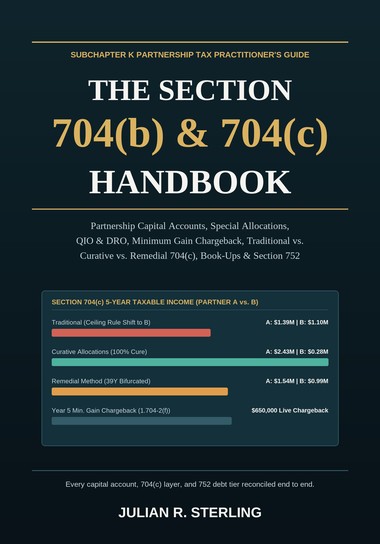
Every dollar of taxable income, depreciation, and cash flow inside a partnership passes through two interlocking engines: IRC Section 704(b) governs the economic split and capital account maintenance, while IRC Section 704(c) prevents partners from shifting precontribution built-in gain or loss onto one another. Layered underneath both is IRC Section 752, which allocates recourse and nonrecourse debt across partners and determines whether a negative tax capital account triggers immediate gain under Section 731(a).
One complete five-year partnership case study carries every computation from Day-1 formation to Year 5 Schedule K-1 reconciliation. In Oakridge Industrial Partners, LP (OIP), Partner A contributes Building A ($5,000,000 FMV, $710,000 tax basis, $4,290,000 built-in gain) subject to a $2,000,000 qualified nonrecourse mortgage, while Partner B contributes $3,000,000 cash. Under the Traditional Method, the ceiling rule shifts $179,000 per year of depreciation shortfall onto Partner B in Years 1-3, driving Partner B's five-year cumulative taxable income to $1,095,897.22 versus $281,597.22 under Curative Allocations and $993,823.18 under the Remedial Method. The exact same partnership then executes a Year 3 $2,200,000 nonrecourse cash-out refinancing, admits Partner C for $2,000,000 in Year 4 with a $3,340,000 Reverse Section 704(c) book-up, triggers a live $650,000 Minimum Gain Chargeback in Year 5, and tests the seven-year anti-mixing bowl rules under Sections 704(c)(1)(B) and 737.
What is inside:
- 15 chapters in four parts covering IRC Sections 704(b), 704(c), 704(d), 706(d), 707(a)(2)(B), 737, and 752 and Treasury Regulations 1.704-1(b)(2), 1.704-2, 1.704-3, 1.704-4, 1.737-1 through -5, and 1.752-1 through -3
- Complete capital-account architecture: Big Three Basic Test, unconditional DRO, Alternate Test with QIO, shifting/transitory substantiality, PIP, and modern target/forced waterfall allocations
- Nonrecourse deductions, Partnership Minimum Gain, the four-part safe harbor, Minimum Gain Chargeback (and its (f)(2)/(f)(3) exceptions), Partner Nonrecourse Debt, and the three-tier Section 752 debt waterfall
- Side-by-side five-year comparison of Traditional, Curative, and Remedial Section 704(c) methods, ceiling-rule economics, NPV tax differentials, and LPA negotiation clauses
- Reverse Section 704(c) book-ups, multi-layer tracking, anti-mixing bowl triggers under Sections 704(c)(1)(B) and 737, disguised sales, loss stacking (704(d)/465/469/461(l)), and Schedule K-1 Item L reconciliation
Free: the Section 704(b) & 704(c) Allocation Calculator in Excel
Six-tab dynamic workbook tracking five-year Section 704(b) Book Capital, Schedule K-1 Item L Tax Basis Capital, Outside Basis, side-by-side Traditional vs. Curative vs. Remedial Section 704(c) allocations, three-tier Section 752 debt sharing, PMG/MGC, QIO stress, and Sections 704(c)(1)(B)/737/707 calculators. Pre-loaded with Oakridge Industrial Partners, LP, 100% live formulas, 21 dynamic integrity controls, no macros, nothing locked.
Contents
- Introduction: Why Section 704(b) and Section 704(c) Govern Every Partnership Dollar
- Chapter 1: Statutory Architecture of Subchapter K Allocations and the Dual-Ledger System
- Chapter 2: Maintaining Section 704(b) Capital Accounts Under Treas. Reg. 1.704-1(b)(2)(iv)
- Chapter 3: Economic Effect: The Big Three, DROs, and the Alternate Test with QIO
- Chapter 4: Substantiality, Shifting Allocations, Transitory Allocations, and PIP
- Chapter 5: Nonrecourse Deductions and the Four-Part Safe Harbor Under Treas. Reg. 1.704-2
- Chapter 6: Minimum Gain Chargeback, Nonrecourse Distributions, and Partner Nonrecourse Debt
- Chapter 7: Section 752 Debt Allocation: Recourse EROL and the Three-Tier Nonrecourse Waterfall
- Chapter 8: Forward Section 704(c) Mechanics and the Ceiling Rule Distortion
- Chapter 9: Traditional Method with Curative Allocations Under Treas. Reg. 1.704-3(c)
- Chapter 10: The Remedial Allocation Method Under Treas. Reg. 1.704-3(d) and Method Selection Strategy
- Chapter 11: Reverse Section 704(c) Revaluations (Book-Ups) and Multi-Layer Tracking
- Chapter 12: The Anti-Mixing Bowl Rules: IRC Sections 704(c)(1)(B) and 737
- Chapter 13: Disguised Sales Under Section 707(a)(2)(B) and Debt-Financed Distributions
- Chapter 14: Outside Basis Loss Limitations (Section 704(d)), Varying Interests (Section 706(d)), and Loss Stacking
- Chapter 15: Schedule K-1 (Form 1065) Reporting, Audit Defense, and LPA Drafting Playbook
- Conclusion & Appendices A, B, and C (Five-Year Master Schedules, LPA & Tax-Close Checklists, Glossary)
Read first
To read: Section 704(b) Substantial Economic Effect, QIO, and DRO: Practitioner Guide
To read: Section 704(c) Traditional, Curative, and Remedial Methods Compared With Numbers
To read: Reverse Section 704(c) Book-Ups and Section 752 Three-Tier Debt Allocation
Updates
Federal income tax authorities and Form 1065 / Schedule K-1 Item L, Item K1, and Item N reporting instructions are stated as of November 2026. For Section 754 elections and Section 743(b)/734(b) inside basis adjustments, see the companion volume The Section 754 Handbook.
Also by Julian R. Sterling
Related Subchapter K and federal corporate tax handbooks. The full list is on the author page.