Book · Julian R. Sterling
Pass the HKSI LE Paper 1 Exam
400 exam-style questions with answers and explanations, including five full 60-question mock exams. Hong Kong Licensing Examination for Securities and Futures Intermediaries, Paper 1: Fundamentals of Securities and Futures Regulation
Apple Books Google Play Paperback PDF edition
About the book
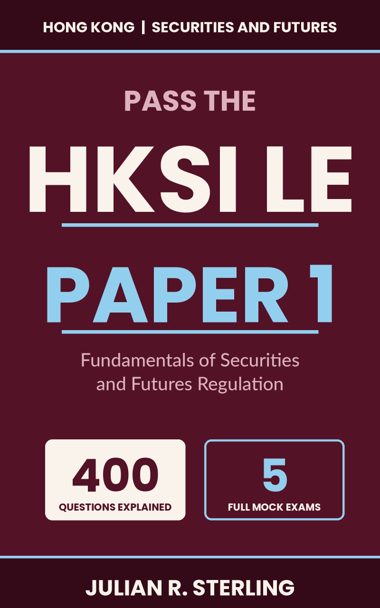
Preparing for Paper 1 of the Hong Kong Licensing Examination for Securities and Futures Intermediaries (HKSI LE), Fundamentals of Securities and Futures Regulation? This guide explains what the paper tests in short chapters you can read on a phone, then lets you practise until the right answer comes without hesitation.
It covers the exam format and a method for the questions, Hong Kong's financial regulators and the Securities and Futures Commission, the powers of the Securities and Futures Ordinance, discipline, appeals and investor compensation, the regulated activities and their exemptions, getting licensed and staying licensed, minimum capital worked in figures, fit and proper criteria, competence and continuous training, the Code of Conduct (knowing your client, suitability, disclosure, conflicts, staff dealing and professional investors), internal control and anti-money laundering, trading on the exchange, disclosure of interests and takeovers, and market misconduct and unsolicited calls.
What is inside:
- 12 short chapters, with 37 worked calculations that show every step
- 3 appendices: a glossary, the figures, dates and time limits to remember, and a 7-day revision plan
- 400 original four-option questions, every one with the correct answer and a short explanation, including questions in the combined-statement style (statements I to IV)
- 5 full mock exams of 60 questions each, the length of the real paper
Written from the Securities and Futures Commission's codes and guidelines and the HKSI Institute's handbook and syllabus as read in October 2026. Where a point could not be confirmed, the book says so and tells you to check the current official text.
All questions are original. This is an independent study guide: it is not produced, endorsed or approved by the Securities and Futures Commission, the HKSI Institute or any exam body, and it does not contain real exam questions. It is general information, not advice, and it does not promise a pass.
What is inside
- Chapter 1. How HKSI LE Paper 1 works and how to pass it
- Chapter 2. Hong Kong's financial regulators and the SFC
- Chapter 3. The SFO: powers, discipline, appeals and investor compensation
- Chapter 4. Do you need a licence? Regulated activities and exemptions
- Chapter 5. Getting licensed and staying licensed
- Chapter 6. Capital requirements in figures
- Chapter 7. Fit and proper, competence and continuous training
- Chapter 8. The Code of Conduct (1): principles, knowing your client and suitability
- Chapter 9. The Code of Conduct (2): disclosure, conflicts, staff dealing and professional investors
- Chapter 10. Internal control and anti-money laundering
- Chapter 11. Trading on the exchange, disclosure of interests and takeovers
- Part XV: who must disclose
- Part XV deadlines and offences
- Chapter 12. Market misconduct and unsolicited calls
- Appendix 1. Glossary of terms and abbreviations
- Appendix 2. Figures, dates and time limits to remember
- Appendix 3. A 7-day revision plan and how to read your mock exam scores
Also by Julian R. Sterling
Related titles. The full list is on the author page.
- Pass the HKSI LE Papers 6 and 12
- Pass the HKSI LE Papers 7 and 8
- Pass the IIQE Paper II Exam 2027
- Pass the IIQE Paper V Exam 2027
- Pass the ASIC Financial Adviser Exam
Read next: HKSI papers: how many questions, how long, and what score do you need?