Book · Julian R. Sterling
The Garage Door Company Owner
Running a Garage Door Repair and Installation Company by the Numbers: Service Calls and Average Ticket, Door and Opener Installs, Lead Costs, Technician Pay and Commissions, Trucks, Warranties, Cash Flow, Break-Even and What Your Company Is Worth
About the book
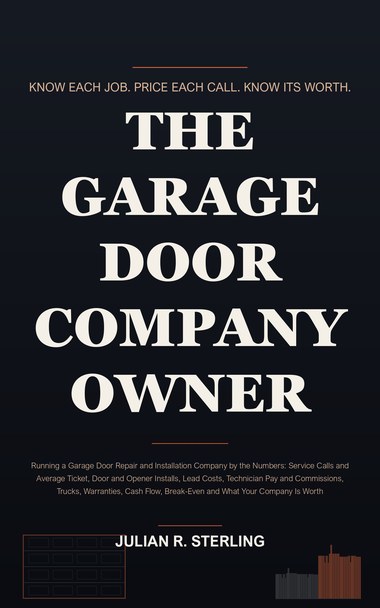
November 2026. The owner of an independent garage door repair and installation company reviews two fiscal years: revenue up from $1,366,658 to $2,875,836, EBITDA up from $130,084 to $346,609. In one week the company added three technicians and three service vans, moved every technician from an hourly wage to a commission with a weekly guarantee, started an install crew, a maintenance plan, door installs for a home builder and financing on new doors. On the desk sits a letter of intent from an individual buyer backed by an SBA lender, not answered.
The Garage Door Company Owner is a practitioner's guide to the economics of a garage door company in the United States: licenses, contracts and the three-day notice on sales at the customer's home, calls, hours and utilization, the margin of each job type, prices, options and the diagnostic fee, doors, deposits, a builder and financing, the cost of a call by lead channel, warranties, callbacks and the maintenance plan, technician pay by the hour or by commission and the minimum wage, hiring and the install crew, vans and their payback, cash and break-even, the statements and the owner's pay, and how a buyer reads the company. One fictional company, two fiscal years, week by week, every number from one model.
Some of what the arithmetic shows: why fixed costs of $75.27 a billable hour leave a spring job $101.77 and an opener job $40.21; why a paid advertising job sold costs $115.52 when the average across all channels is $68.47; why the company needed 362.3 calls a month to break even in FY2026 and ran 549.5; why a new technician's first week on commission needed a top-up of $77.45 to reach the minimum wage; how a new service van pays back the cash put in within 3.0 months; and how a letter of intent at 3.0 times adjusted EBITDA becomes a price of $914,553 and $634,803 of cash at closing.
The model is not described, it is supplied. Seven companion workbooks hold the margin per job, calls and break-even, technician pay, lead cost by channel, service van payback, deposits, receivables and stock, and the offer, by live formula, each with a Checks tab, and the check-lists come as an editable document. The closing pages say where to find them.
What you will be able to do:
- Read each job type by what it leaves after parts, pay and its share of fixed costs
- Price a call from what it costs to get one, channel by channel
- Pay technicians by commission and check every week against the minimum wage and overtime
- Read break-even in calls a month and the cash held in receivables, stock and deposits
- Test a van purchase by its own payback, and read a letter of intent line by line
Sixteen chapters in four parts and four appendices: a guide to the workbooks with seven exercises, eight working check-lists, sixty-eight questions for the licensing office, a customer, a technician candidate, the distributor, the insurance agent, the outside CPA, counsel, the lead vendors, the bank and the SBA lender, and a buyer, and a glossary of fifty terms.
Written for owners of garage door companies, for technicians who plan to own one, and for buyers. It is about the business, and it leaves repair methods, state law, taxes and full valuation methods to trained technicians, counsel, the outside CPA and other books. The case, its company, its town, its bank, its landlord, the builder and their figures are fictional teaching assumptions, not market norms and not the rule of any state; real-world rules are dated as of November 2026. This book is for education only. It is not legal, tax, insurance, accounting or safety advice. Part of The Private Markets Career Guides.
How this book was made: written with the help of artificial intelligence tools, under the author's direction; every figure was computed by a model and every rule was checked against its source.
Free: the Garage Door Job Profit and Break-Even Calculator (Excel)
Type your tickets, parts and hours by job type, your commission, burden and card fees, your fixed costs and billable hours, a closed year's totals and one technician's week: the margin of each job before and after fixed costs, break-even in calls a month, and a check of the week's pay against the minimum wage and the overtime premium. Live formulas, a Checks tab, no macros.
The companion files
The book prints this address for its readers. The seven workbooks reproduce the figures of the case, Corlanby Overhead Door, with live formulas and a Checks tab, and open pre-filled with the exercises of Appendix A; type your own company over the blue cells. No sign-up, no email address.
Chapter 4
GarageDoor_1_Margin_per_Job.xlsx
What each job type leaves after parts, commission, burden and card fee, then after its share of fixed costs by the technician hour. Case, FY2026: $75.27 of fixed costs a billable hour; a spring job leaves $214.67, then $101.77.
Download11 KBChapter 14
GarageDoor_2_Calls_and_Break_Even.xlsx
A closed year's contribution per call and break-even in calls a month. Case, FY2026: 362.3 calls a month against 549.5, a margin of safety of 34.1 percent.
Download10 KBChapter 9
GarageDoor_3_Technician_Pay.xlsx
One technician's commission week with the weekly guarantee at the minimum wage, the regular rate and the overtime premium, against the FY2025 hourly wage. Case, week 102: $28.70 an hour, a $71.76 premium, $1,364 for the week against $1,283.
Download10 KBChapter 7
GarageDoor_4_Lead_Cost_by_Channel.xlsx
Every source of calls on three measures: share booked, cost a call dispatched, cost a job sold. Case, FY2026: $115.52 a paid advertising job sold, $68.47 across all channels.
Download10 KBChapter 13
GarageDoor_5_Service_Van_Payback.xlsx
What one more service van leaves in a quarter and the months that pay back the cash put in. Case: $70,884 of run-rate, 3.0 and 10.9 months.
Download11 KBChapter 14
GarageDoor_6_Deposits_Receivables_and_Stock.xlsx
Receivables and stock, less the deposits customers advance. Case: $37,968 of receivables, $19,725 of deposits, $74,243 of cash tied up.
Download10 KBChapter 16
GarageDoor_7_Value_and_Offer.xlsx
The letter of intent from EBITDA to the cash at closing. Case: a price of $914,553, $634,803 at closing.
Download10 KBAppendix B
Garage_Door_Company_Owner_Check_Lists.docx
The eight check-lists of the book, editable.
Download42 KBRead first
00_START_HERE.md
What each file holds and how to use the workbooks.
Download5 KB
The seven workbooks, the check-lists and the guide, 00_START_HERE.md.
The case and its figures are fictional teaching assumptions, not market norms, not a price list and not the rule of any state. Nothing here is repair, installation or safety advice: spring, cable and opener work belongs to trained technicians working from the makers' instructions. Federal rules are dated November 2026; licenses, contract and warranty rules are set by each state.
Read first
To read: How is a garage door business valued in a sale?
To read: Garage door repair pricing: what each job really leaves
To read: Garage door technician pay: hourly or commission?
What is inside
- Introduction
- Part I: The Company You Run
- Chapter 1: What a Garage Door Company Owner Actually Runs
- Chapter 2: The Rules at the Customer's Door: Licenses, Contracts and the Three-Day Rule
- Chapter 3: Calls, Jobs and Technician Hours
- Chapter 4: The Average Ticket and the Margin on Each Job
- Part II: Prices, Doors and Leads
- Chapter 5: Pricing Repairs: Flat Prices, Options and the Diagnostic Fee
- Chapter 6: Selling and Installing New Doors and Openers
- Chapter 7: Where Calls Come From: Lead Costs by Channel
- Chapter 8: Warranties, Callbacks and the Maintenance Plan
- Part III: Technicians, Pay and Safety
- Chapter 9: Technician Pay: Hourly, Commission and the Weekly Guarantee
- Chapter 10: Hiring Technicians and Installers, and Who Is an Employee
- Chapter 11: Dispatch, the Office and the Customer
- Chapter 12: Safety, Insurance and the Opener Standard
- Part IV: Vans, Cash, Tax and Value
- Chapter 13: Vans, the Install Truck, Stock and Payback
- Chapter 14: Cash, Deposits, Receivables and Break-Even in Calls
- Chapter 15: Statements, Taxes and the Owner's Pay
- Chapter 16: What Your Garage Door Company Is Worth, and Selling It
- Conclusion
- Appendix A: The Workbooks
- Appendix B: The Owner's Check-Lists
- Appendix C: Questions to Ask
- Appendix D: Glossary
Updates
Federal rules in the book are given as in force in November 2026, including the FTC rule on sales made at the buyer's home (16 CFR part 429) and its Holder Rule on consumer credit (16 CFR 433.2), the FTC rule on consumer reviews (16 CFR part 465), the safety standard for residential garage door operators (16 CFR part 1211), the minimum wage and overtime rules of 29 U.S.C. 206 and 207, the regular rate of commissioned employees and the section 7(i) exemption (29 CFR parts 778 and 779), travel time (29 CFR part 785), the 2025 law on section 179, bonus depreciation and section 199A, the Form 1099-NEC threshold, and the SBA's procedures for 7(a) loans. This page will note material changes.
Also by Julian R. Sterling
Related titles. The full list is on the author page.