Courses · Online course with Excel
Three-Statement Modeling: build and link the income statement, balance sheet and cash flow statement
The model every finance job assumes you can build, line by line: historicals and drivers, the income statement forecast, the working capital, PP&E, debt and equity schedules, a cash flow statement with a revolver and no circular reference, checks that find any error, and three scenarios.
$149, or included in All Access
Six modules read online in your learner account, each with an Excel build, the Case Workbook of the running case (1017 live formulas), a start and a solution file for every module, an Exercise Workbook that checks your 55 answers, a 100-question quiz app, the Course Book in PDF, and the certificate exam online.
Secure checkout by Stripe. 14-day money-back guarantee. Not sure yet? Read module 1 free and try ten questions below.
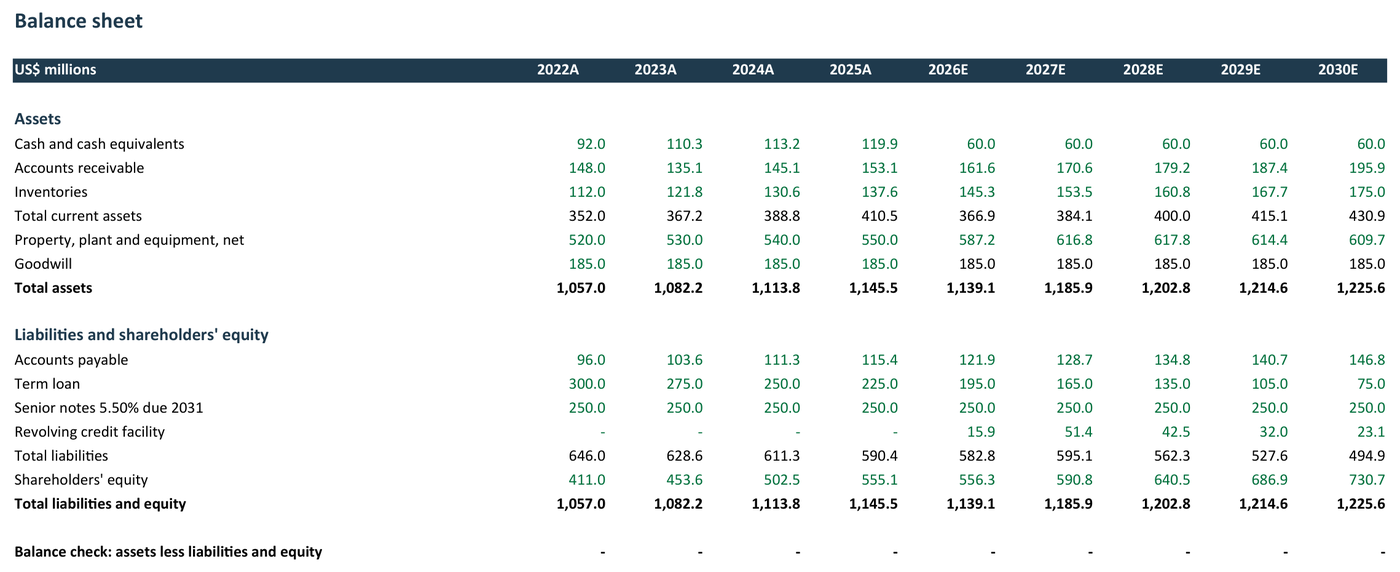
A profit forecast cannot tell you whether a company can pay for its plans. Larkfield Packaging, the fictional company of this course, earns $118.0m in 2025, plans a new production line and keeps buying back shares. Only the three statements together show that its revolver peaks at $51.4m in the base case and climbs to $165.5m of a $200m line if volumes fall.
What you will be able to do
- Explain how the three statements link, and follow any transaction through all three.
- Lay out reported statements and turn them into drivers: volume and price, margins, working capital days, capex, tax and payout.
- Forecast an income statement from volume, price and a variable and fixed cost base, down to diluted EPS after buybacks.
- Build working capital, PP&E by vintage, debt and equity schedules that roll from opening to closing.
- Link a cash flow statement by the indirect method (ASC 230, IAS 7) with a revolver that protects a minimum cash balance, without a circular reference.
- Build checks and a master check, find why a balance sheet does not balance, and run base, low and high scenarios with one switch.
The program
Six modules of five written lessons. Each module has objectives, a worked example on the case, the classic pitfalls, a summary, practice questions, an Excel build in a start file, an exercise tab and a quiz.
- 1. How the three statements fit together (20 min)The income statement, the balance sheet and the cash flow statement as one system: the identities that hold every period, accrual against cash, one transaction followed through the three statements, and the map of the model. Lessons: 1.1 Three statements, one company. 1.2 The identities that hold every period. 1.3 Accrual and cash: why net income is not cash. 1.4 One transaction through the three statements. 1.5 The case and the map of the model. Build: How the three statements fit together in the start file.
- 2. Historicals and drivers (20 min)Laying out three years of reported statements, then turning them into drivers: growth split into volume and price, margins, working capital in days, capex and D&A as a share of revenue, tax rate and payout. Lessons: 2.1 Laying out the historicals. 2.2 Growth: volume and price. 2.3 Margins and cost structure. 2.4 Working capital in days. 2.5 Capex, D&A, tax and payout. Build: Historicals and drivers in the start file.
- 3. Forecasting the income statement (25 min)Revenue as volume times price, cost of goods sold with a variable and a fixed part, SG&A, D&A from the fixed asset schedule, interest, taxes, shares and earnings per share. Lessons: 3.1 Revenue as volume times price. 3.2 Cost of goods sold: variable and fixed. 3.3 SG&A, EBITDA and D&A. 3.4 Interest and taxes. 3.5 Net income, shares and EPS. Build: Forecasting the income statement in the start file.
- 4. Balance sheet schedules (25 min)The working capital schedule from DSO, DIO and DPO, PP&E with capex and depreciation by vintage, debt with a repayment schedule, and the equity roll-forward with earnings, dividends and buybacks. Lessons: 4.1 The working capital schedule. 4.2 PP&E: capex and depreciation. 4.3 Debt with a repayment schedule. 4.4 Shareholders' equity: earnings, dividends, buybacks. 4.5 Goodwill and the lines that stay flat. Build: Balance sheet schedules in the start file.
- 5. Cash flow statement and linking (25 min)The indirect method under IAS 7 and ASC 230, cash before the revolver, a revolver that draws to keep a minimum cash balance, interest on opening balances with no circular reference, and the balance sheet that closes. Lessons: 5.1 The indirect method under IAS 7 and ASC 230. 5.2 Cash before the revolver. 5.3 The revolver and the minimum cash balance. 5.4 Interest on opening balances: no circularity. 5.5 Closing the balance sheet. Build: Cash flow statement and linking in the start file.
- 6. Checks, debugging and scenarios (20 min)A checks sheet with a master check, the classic causes of an unbalanced balance sheet and a routine to find them, and a base, low and high scenario switch without macros or data tables. Lessons: 6.1 The checks sheet and the master check. 6.2 Why a balance sheet does not balance. 6.3 A debugging routine. 6.4 A scenario switch without macros. 6.5 Reading the three scenarios. Build: Checks, debugging and scenarios in the start file.
Try it free
All of module 1. How the three statements fit together, as it appears in the Course Book: download module 1 free (PDF).
Ten quiz questions. Click an answer: it turns green or red and the explanation appears. The numeric questions use the running case:
Larkfield Packaging Corp. (fictional): rigid plastic and fiber containers, listed in the United States. 2025 revenue $1,164.0m, EBITDA $235.3m, net income $118.0m, net debt 1.51x EBITDA. Forecast 2026 to 2030 in three scenarios.
Module 1
1. Which statement shows a company's position at a single date?
Answer: The balance sheet. Assets, liabilities and equity are measured at the balance sheet date; the other two cover a period.
Module 1
2. Which identity holds at every balance sheet date?
Answer: Assets = liabilities + shareholders' equity. The balance sheet balances by construction.
Module 1
3. Closing cash on the cash flow statement must equal...
Answer: Cash on the balance sheet at the same date. The cash flow statement explains the change in the balance sheet cash.
Module 1
4. Without share issuance or other comprehensive income, closing equity equals...
Answer: Opening equity + net income - dividends - buybacks. Equity rolls forward with earnings and distributions.
Module 1
5. Under ASC 606 and IFRS 15, revenue is recognized when...
Answer: Control of the goods passes to the customer. Accrual accounting: recognition does not wait for cash.
Module 1
6. Why does depreciation lower net income but not operating cash flow?
Answer: It spreads a cost paid when the asset was bought; no cash leaves in the year. D&A is added back in the indirect method.
Module 2
7. Where do the historical statements of a US-listed company come from?
Answer: Item 8 of the Form 10-K, with volumes and prices from Item 7. Statements in Item 8; management's discussion in Item 7.
Module 3
8. In the course model, which row of the Inputs sheet does the income statement read?
Answer: The live row, chosen by the scenario switch. One switch drives every forecast formula.
Module 4
9. A schedule in a three-statement model...
Answer: Rolls one balance sheet item from opening to closing and feeds the statements. Opening + flows = closing.
Module 5
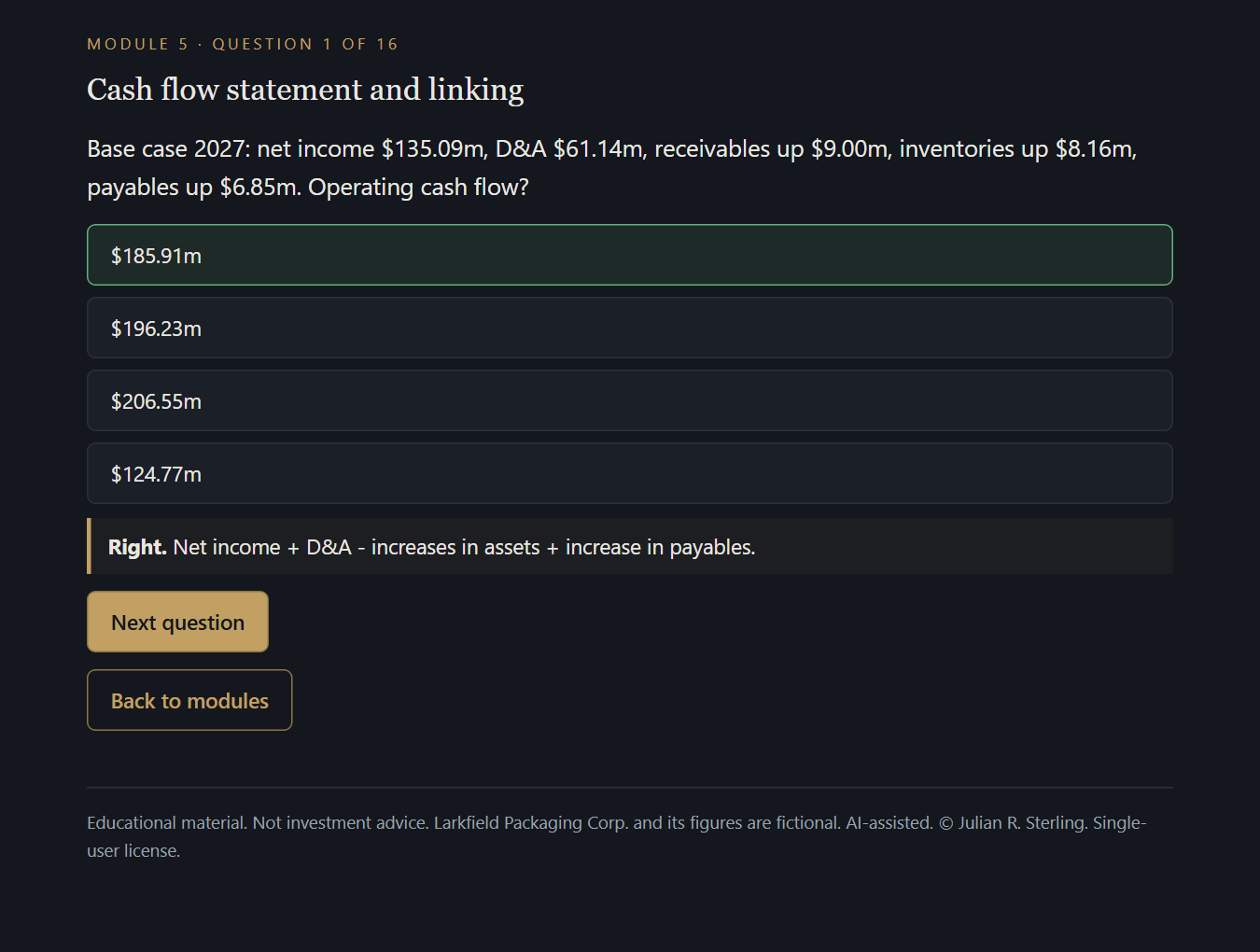
10. The indirect method starts from...
Answer: Net income. Then adjusts for non-cash items and working capital.
Inside the course
Your certificate
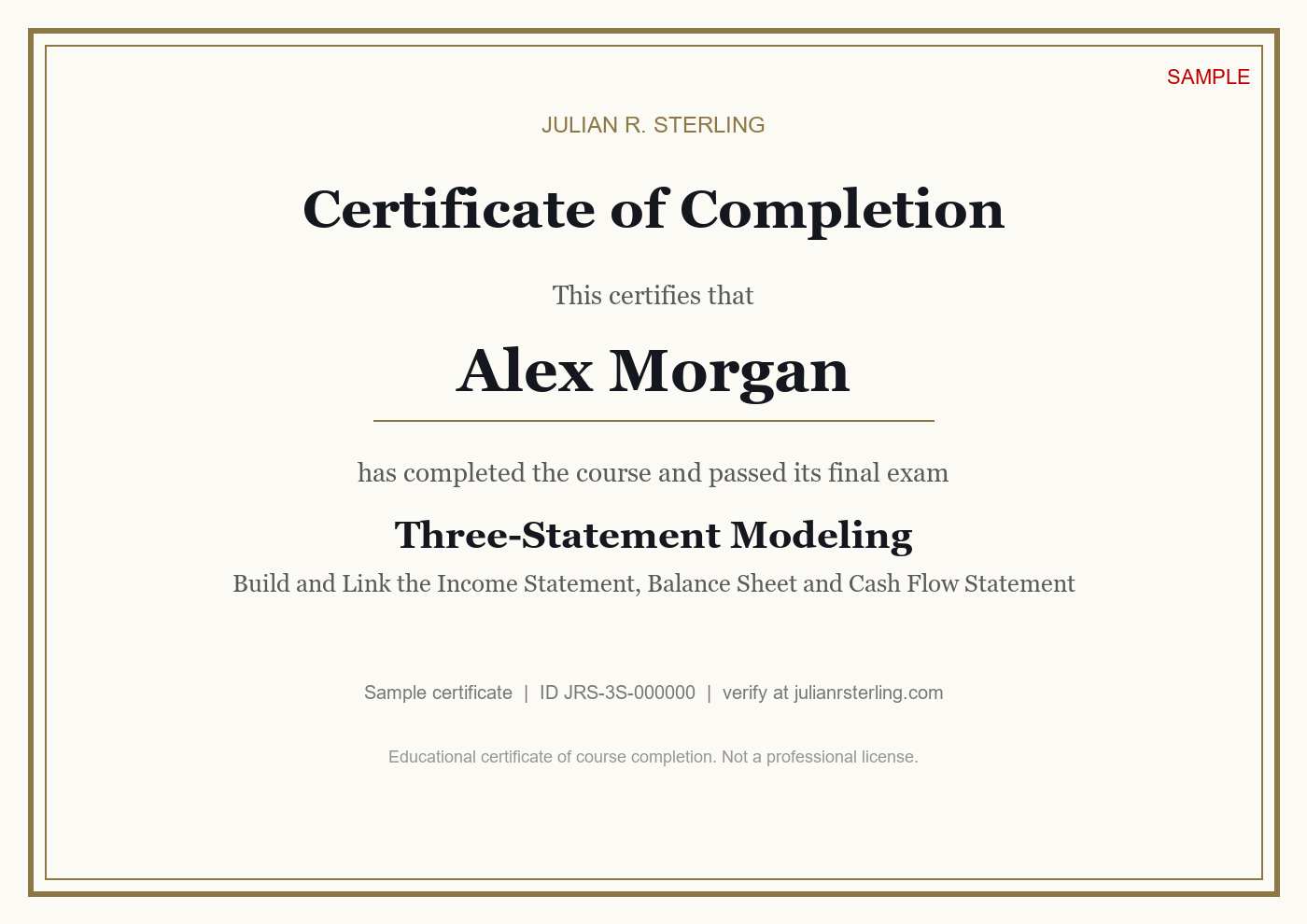
Pass the online exam (40 questions, 60 minutes, 80%) and you receive a certificate of completion with a public verification page, to add to your profile or your CV. It shows the work you did; it is not a license or an accredited qualification.
What you receive
| File | What it is |
|---|---|
| Online reader | Every module in your learner account, on a computer or a phone, with the Build lesson and its files one click away. |
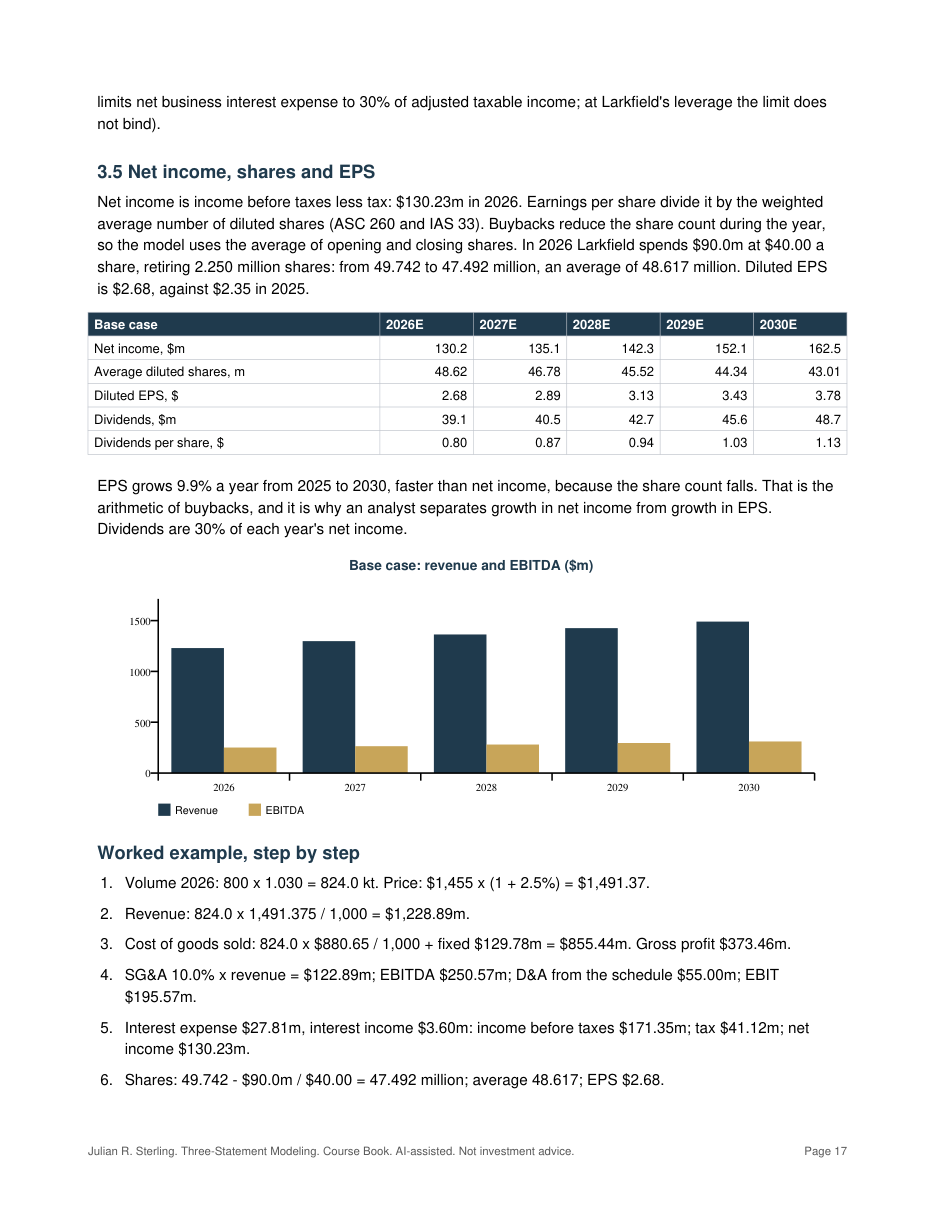
| Course_Book.pdf | Six modules, 39 pages: lessons, worked examples, pitfalls, summaries, the cells to build, practice questions, glossary and dated sources. |
| Case_Workbook.xlsx | The finished model: Inputs with a scenario switch, Historicals, IS, WC, PPE, Debt, Equity, CF, BS, Checks and Scenarios. |
| Step_Files | Twelve workbooks: a start file and a solution file for each module. |
| Exercise_Workbook.xlsx | Six exercise tabs, 55 answers checked automatically, hidden solution tabs. |
| Quiz_App.html | 100 questions with explanations, offline. |
| Certificate exam | Online from your order page or your account: 40 questions from a private bank, 60 minutes, 80% to pass, verifiable certificate. |
The running case
Larkfield Packaging Corp., fictional, is forecast from 2026 to 2030 in a base, a low and a high scenario:
| Measure | 2025A | 2030E, base |
|---|---|---|
| Revenue | $1,164.0m | $1,489.8m |
| EBITDA margin | 20.2% | 20.9% |
| Diluted EPS | $2.35 | $3.78 |
| Net debt / EBITDA | 1.51x | 0.93x |
| Revolver (peak over 2026 to 2030: base / low / high) | $0.0m | $51.4m / $165.5m / $38.9m |
Questions people ask
Who is the course for?
Analysts and associates in investment banking, private equity, credit and equity research, transaction services and corporate FP&A, and students preparing for modeling tests. You need basic Excel and to know what an income statement and a balance sheet are.
Is there video?
The course is read online module by module with an Excel build for each module; video lessons are being added and come at no extra cost.
How long is it?
Six modules of five written lessons, about 2 hours 15 minutes of reading and building, plus the exercises and the quizzes. At about an hour a day, that is a week of evenings.
What do I get exactly?
Right after payment: the online reader in your learner account and the course zip with the Course Book (PDF), the Case Workbook (1017 live formulas), twelve step files, the Exercise Workbook (55 answers checked automatically) and the Quiz App (100 questions). The certificate exam opens from your order page or your learner account.
Does the model use circular references or macros?
No. Interest is charged on opening balances, so the revolver, the cash flow statement and the balance sheet link without a circular reference, an iterative calculation or a macro. Module 5 explains why and what it costs.
US GAAP or IFRS?
The case is a US company under US GAAP (ASC 230 for the cash flow statement). The lessons point out where IFRS differs, including the IFRS 18 changes to the income statement and to the classification of interest and dividends from 2027. The links are the same under both.
How does the certificate exam work?
40 questions drawn at random from a private bank, 60 minutes, graded on the server, 80% to pass, retake as often as you need. You receive a certificate with a public verification page. How certificates work.
Can I get a refund?
Yes. Every course has a 14-day money-back guarantee: write to [email protected] within 14 days of your purchase and you get a full refund, no reason needed. Details in the terms of sale.
Is it investment advice?
No. Larkfield Packaging Corp., its figures and its plans are fictional. The course teaches modeling mechanics. It is AI-assisted: written with AI assistance, and every figure is computed and checked by script.
Three-Statement Modeling: $149
The online course, the Course Book, the Case Workbook, the step files, the exercises, the quiz app and the certificate exam. 14-day money-back guarantee.
Want every course? All Access opens all of them, with their certificate exams.
Related
- LBO ModelingThe next step: a leveraged buyout model built on the same three-statement logic.
- Free three-statement model templateA blank structure to start your own.
- All coursesFinancial modeling, private credit, real estate, fund reporting and more.