Courses · Video course
Infrastructure Valuation: valuing an operating asset for a fund
How the fair value of an infrastructure asset is really built and defended: the operating cash flow, debt service and tax, the distributions to the shareholder, the discount rate, contracted and merchant cash flows, multiples and comparables, sensitivities, and the bridge from one valuation date to the next. You value a solar plant in Excel along the way.
$149, or included in All Access
26 short video lessons (about 65 minutes of video), 11 of them built live in Excel, the Case Workbook of a 150 MW solar plant, a start file and a solution file for every build lesson, an Exercise Workbook that checks your answers, a 48-question quiz app, a Course Summary, and the certificate exam online. Download right after payment.
Secure checkout by Stripe. 14-day money-back guarantee. Not sure yet? Watch module 1 and a build lesson free, read the summary of module 1 and try ten questions below.
Project finance courses stop at financial close. Valuation courses value companies with a perpetuity. This one starts where the plant is running and has an owner who must report its value every quarter: $70.04m of equity at the first date, $70.83m a year later, and an explanation for every dollar in between.
What you will be able to do
- Project the operating cash flow of an asset to the end of its life, with a contracted period and a merchant period.
- Run the cash flow waterfall of a project company: debt service, tax with its shields, and the distributions that reach the shareholder.
- Build a cost of equity, discount the distributions, and split the value between contracted and merchant years.
- Value with two discount rates, find the blended rate, and read the return implied by a bid or a transaction price.
- Cross-check with enterprise value multiples, value per MW and transaction comparables, and explain why there is no terminal value.
- Build a sensitivity table and see why volume risk can matter more than the discount rate in a leveraged asset.
- Roll a valuation forward: unwind of the discount, cash received, changes of assumption, and a checks sheet with a master check.
The program
Six modules. Concept lessons explain on animated slides; build lessons fill the workbook on screen, cell by cell, with the formula shown, while you build the same cells in the start file.
- 1. What is being valuedWhy infrastructure is valued on its cash flows, equity value and enterprise value, the case, and the operating cash flow of the asset. Lessons: 1.1 Why infrastructure is valued on cash flows. 1.2 Equity value, enterprise value, fair value. 1.3 The case: a solar plant in operation. 1.4 Project the operating cash flow (build).
- 2. From EBITDA to distributionsThe cash flow waterfall of a project company: debt service, tax, and what is left for the shareholder each year. Lessons: 2.1 The cash flow waterfall of a project company. 2.2 The debt schedule (build). 2.3 Tax and depreciation (build). 2.4 Distributions to the shareholder (build). 2.5 What delays a distribution.
- 3. The discount rateThe cost of equity of an infrastructure asset, the equity value, contracted and merchant cash flows, and the return implied by a price. Lessons: 3.1 The cost of equity of an infrastructure asset. 3.2 The equity value (build). 3.3 Contracted and merchant cash flows. 3.4 Two discount rates and the blended rate (build). 3.5 The return implied by a price (build).
- 4. Cross-checksEnterprise value, multiples and value per megawatt, transaction comparables, and why a finite life means no terminal value. Lessons: 4.1 Enterprise value and multiples. 4.2 From equity value to multiples (build). 4.3 Reading transaction comparables. 4.4 A finite life: no terminal value.
- 5. Sensitivities and the roll-forwardWhat moves the value, a sensitivity table, and the bridge from one valuation date to the next. Lessons: 5.1 What moves the value. 5.2 The sensitivity table (build). 5.3 The roll-forward: unwind, cash, assumptions. 5.4 The valuation bridge (build).
- 6. Reporting the valueValuation governance, the checks sheet, the mistakes reviewers find, and the path from the asset to the fund's NAV. Lessons: 6.1 Who values, who approves. 6.2 Build the checks sheet (build). 6.3 The mistakes reviewers find. 6.4 From the asset to the fund's NAV.
Try it free
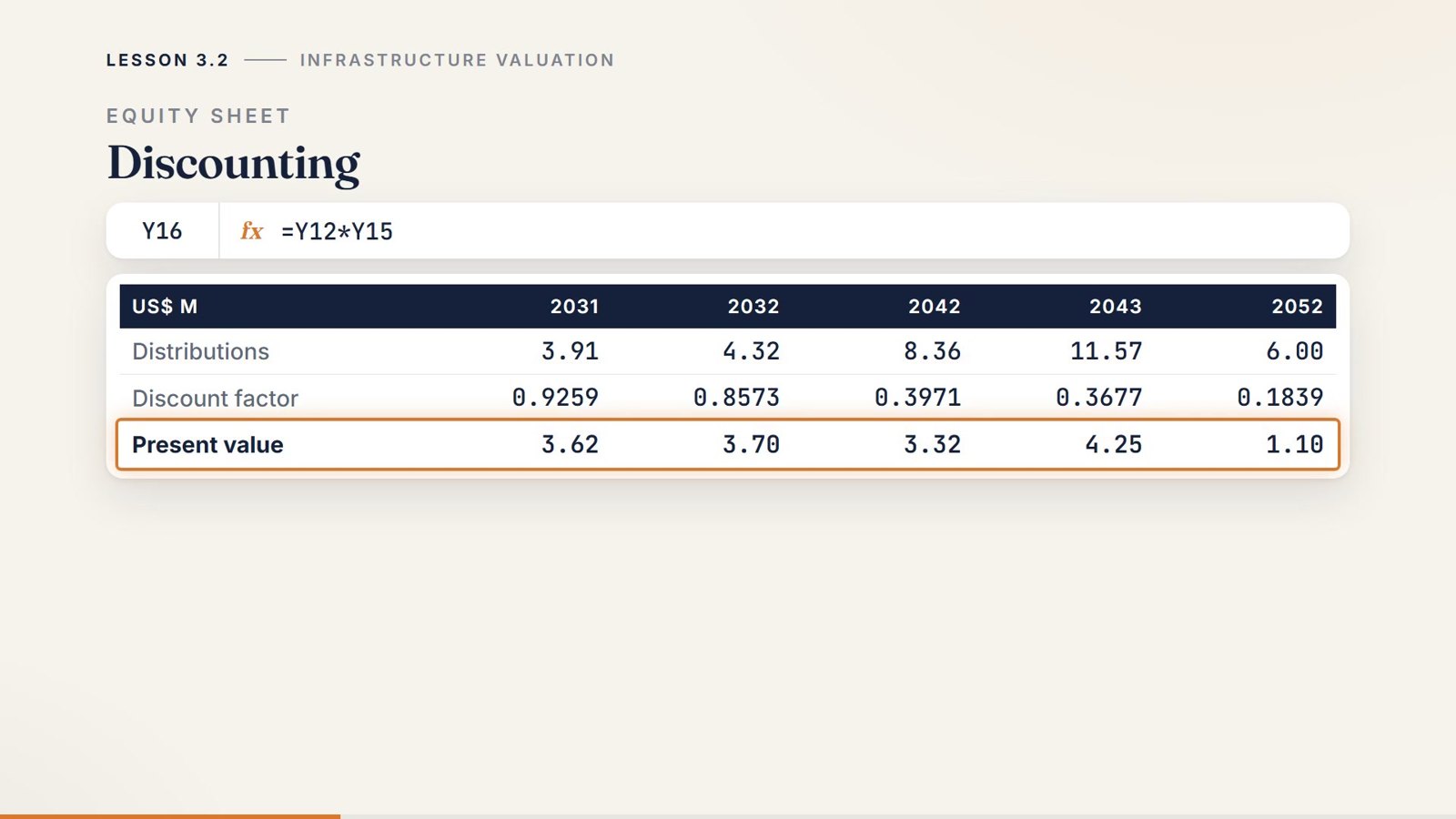
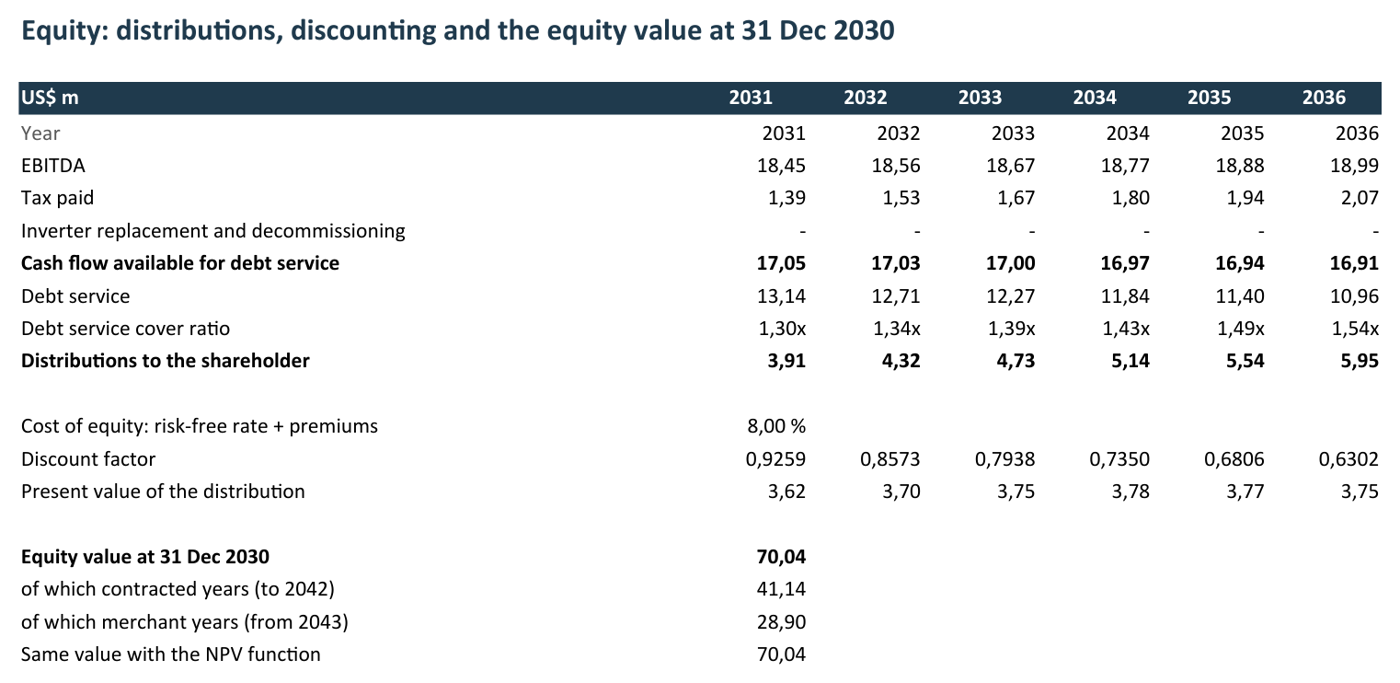
All of module 1 and one build lesson. The four lessons of module 1, and lesson 3.2, where you discount the distributions and compute the equity value.
The summary of module 1. Download the free sample of the Course Summary (PDF).
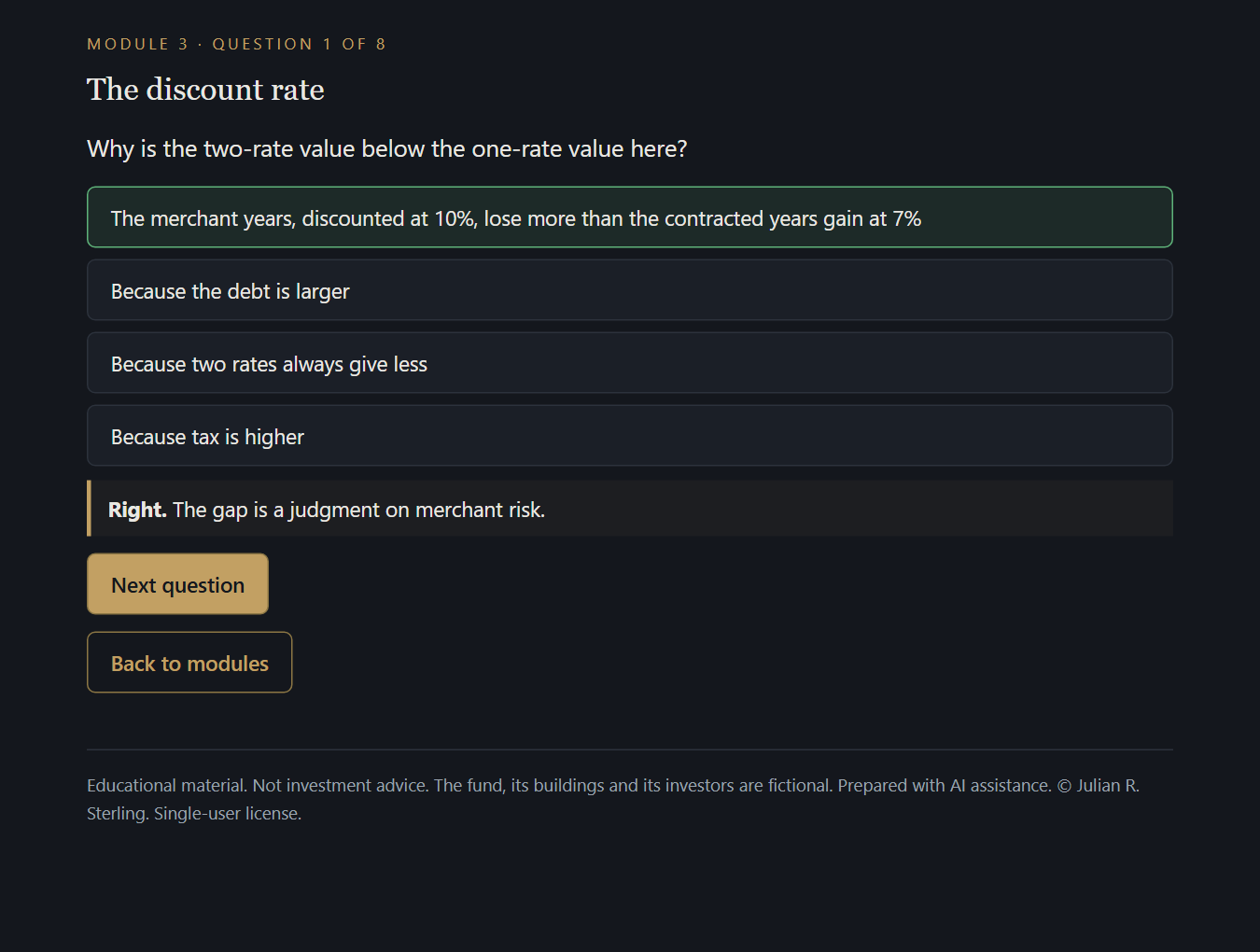
Ten quiz questions. Click an answer: it turns green or red and the explanation appears. The questions use the running case:
Saltbrush Solar (fictional): a 150 MW solar plant with 22 years of life left at 31 Dec 2030, a contract at $63.80 per MWh until 2042 and merchant prices after, senior debt of $95.00m repaid by 2042, a tax rate of 25%. One fund owns 100% of the equity.
Module 1
1. Why is infrastructure valued first on discounted cash flows?
Answer: Its cash flows are visible for decades and its life is finite, so each year can be modelled. Multiples serve as a cross-check.
Module 1
2. Fair value is...
Answer: The price that would be received to sell the asset in an orderly transaction between market participants at the measurement date. IFRS 13 and ASC 820.
Module 1
3. Prices and costs in the model include inflation. The discount rate must be...
Answer: Nominal. Nominal cash flows go with a nominal rate.
Module 1
4. The model distributes the cash held by the project next year. Adding that cash to the present value of distributions...
Answer: Counts it twice. Add only cash that is outside the forecast.
Module 1
5. The equity of Saltbrush is worth $70.04m and its net debt is $95.00m. Enterprise value?
Answer: $165.04m. Equity value plus net debt.
Module 1
6. In 2031 the plant generates 391 GWh sold at $63.80 per MWh. Revenue?
Answer: $24.95m. 391 x 63.80 / 1,000.
Module 2
7. In a project company's waterfall, who is paid last?
Answer: The shareholder. Costs, tax and works, lenders, then the shareholder.
Module 3
8. How do you find the single rate equivalent to a two-rate valuation?
Answer: With the IRR function, on minus the value followed by the distributions. The blend depends on how much value sits in each period.
Module 4
9. Why are multiples computed on enterprise value?
Answer: So that assets with different amounts of debt can be compared. EBITDA serves debt and equity.
Module 5
10. A sensitivity is...
Answer: The change in value when one assumption moves by a stated amount, the others being held. One assumption at a time, plausible size.
Inside the course
What you receive
| File | What it is |
|---|---|
| Videos, one zip per module | 26 lessons in 1080p, about 65 minutes of video, with English subtitles (.srt) and chapters. |
| Case_Workbook.xlsx | Saltbrush Solar from 2031 to 2052: operations, debt, tax, equity value, multiples, sensitivities, valuation bridge and checks. |
| Step_Files | 22 workbooks: a start file and a solution file for each of the 11 build lessons. |
| Exercise_Workbook.xlsx | Six exercise tabs, 36 answers checked automatically, hidden solution tabs. |
| Quiz_App.html | 48 questions, eight per module, with explanations. |
| Course_Summary.pdf | Two pages per module: key ideas, the case in numbers, the mistakes to avoid; glossary and dated sources. |
| Certificate exam | Online from your order page or your account: 40 questions from a private bank, 60 minutes, 80% to pass, verifiable certificate. |
The running case
Saltbrush Solar, fictional, is the 150 MW plant built and financed in the Project Finance Modeling course. Here it is in operation, and its owner values it at 31 December 2030 and again a year later:
| Measure | Value |
|---|---|
| EBITDA: 2031 / 2043, after the contract ends | $18.45m / $12.87m |
| Distributions to the shareholder: 2031 / 2043 | $3.91m / $11.57m |
| Equity value at 8.0% / with two rates | $70.04m / $64.92m |
| Enterprise value: multiple of EBITDA / per MW | 8.95x / $1.10m |
| Value if generation falls 8% / if the rate rises one point | -22.2% / -9.0% |
| Value at 31 Dec 2031 / total return of the year | $70.83m / 6.72% |
Part of the infrastructure and energy track
This course follows Project Finance Modeling, which structures and finances the same plant, and sits next to Data Center Investment Modeling. For the fund side of a valuation, see NAV & Investor Reporting. See certifications.
Questions people ask
Who is the course for?
Analysts and associates of infrastructure and energy funds, valuation and fund finance teams, lenders, auditors and advisers who prepare, review or challenge the fair value of an infrastructure asset. You need basic Excel and the idea of a present value.
How long is it?
26 video lessons of two to four minutes, about 65 minutes of video, in six modules. With the build lessons, the exercises and the quizzes, most learners need five to seven hours.
Do I need the Project Finance course first?
No. The asset is Saltbrush Solar, the project of Project Finance Modeling, a few years into operation, but this course stands on its own: the operating case is given and rebuilt in a simple annual model. The two courses complement each other: that one structures and finances the project, this one values it for its owner.
Does it apply beyond solar?
Yes. The method is the one used for contracted and regulated assets in general: wind, networks, roads, social infrastructure, data centers. Volume, price and costs change name; the waterfall, the discount rate, the cross-checks and the bridge do not.
What do I get exactly?
Right after payment: the course zip (Course Summary, Case Workbook with 1,039 live formulas, 22 step files, Exercise Workbook, Quiz App) and one video zip per module, with subtitles and chapters. The certificate exam opens from your order page or your learner account.
How does the certificate exam work?
40 questions drawn at random from a private bank, 60 minutes, graded on the server, 80% to pass, retake as often as you need. You receive a certificate with a public verification page. How certificates work.
Which standards does it follow?
Fair value as defined by IFRS 13 and ASC 820, and the IPEV valuation guidelines (December 2022 edition) for discounted cash flows, calibration and backtesting. Prices, yields, costs, discount rates and comparables are assumptions of the fictional case, not market data.
Who is the narrator?
Lessons use AI-generated narration. The scripts, the case and every figure on screen were written and computed for this course and checked by script against the workbook.
Can I get a refund?
Yes. Every course has a 14-day money-back guarantee: write to [email protected] within 14 days of your purchase and you get a full refund, no reason needed. Details in the terms of sale.
Is it investment or valuation advice?
No. The asset, its owner and its counterparties are fictional. The course teaches how a valuation works and how to model it.
Infrastructure Valuation: $149
The videos, the Case Workbook, the step files, the exercises, the quiz app, the Course Summary and the certificate exam. Download right after payment.
Want every course? All Access opens all of them, with their certificate exams, for $299 a year.
Related
- Project Finance ModelingStructure, size the debt and model a solar project from construction to the end of its life.
- Data Center Investment ModelingDevelopment, leasing and returns of a data center.
- NAV & Investor ReportingFrom asset values to the NAV, capital accounts and investor reports of a fund.
- All coursesReal estate, private credit, fund finance, project finance, data centers, LBO, property funds, fund reporting and infrastructure.