Courses · Online course with Excel
DCF Valuation: free cash flow, WACC and terminal value, from forecast to value per share
The discounted cash flow valuation an analyst builds and defends in front of a committee: unlevered free cash flow, the cost of capital with relevered betas, the terminal value and its cross-checks, the bridge to equity, diluted shares, the stub period and the mid-year convention, then the sensitivities. You value one listed company, step by step, in Excel.
$149, or included in All Access
6 modules and 30 written lessons, the Case Workbook with 340 live formulas and a master check, a start file and a solution file for every module, an Exercise Workbook that checks your 43 answers, a 96-question quiz app, the Course Book in PDF, and the certificate exam online. Read every module online in your learner account or download everything, right after payment.
Secure checkout by Stripe. 14-day money-back guarantee. Not sure yet? Read module 1 free and try ten questions below.
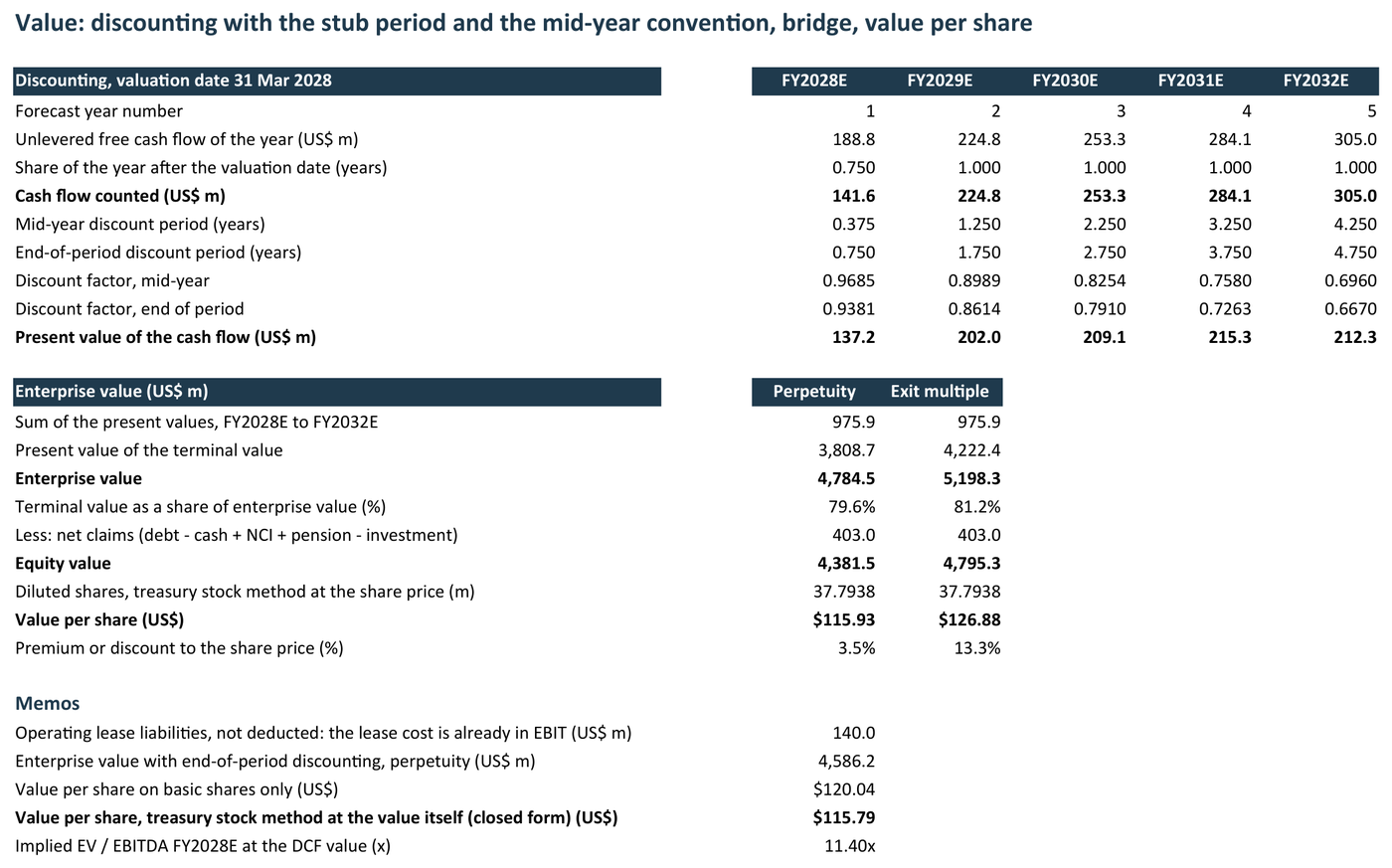
A DCF gives one number, and a committee wants to know what you had to believe to get it. Here the number is $115.93 a share for a company trading at $112.00, and the course shows where it comes from: a WACC of 8.90% built from four peers, a terminal value that carries 80% of the value and implies 9.9x EBITDA, and a stub period that is worth $1.21 a share if you get it wrong.
What you will be able to do
- Build unlevered free cash flow from EBIT with a normalized tax, and treat stock-based compensation, one-off items and leases (ASC 842 and IFRS 16) consistently.
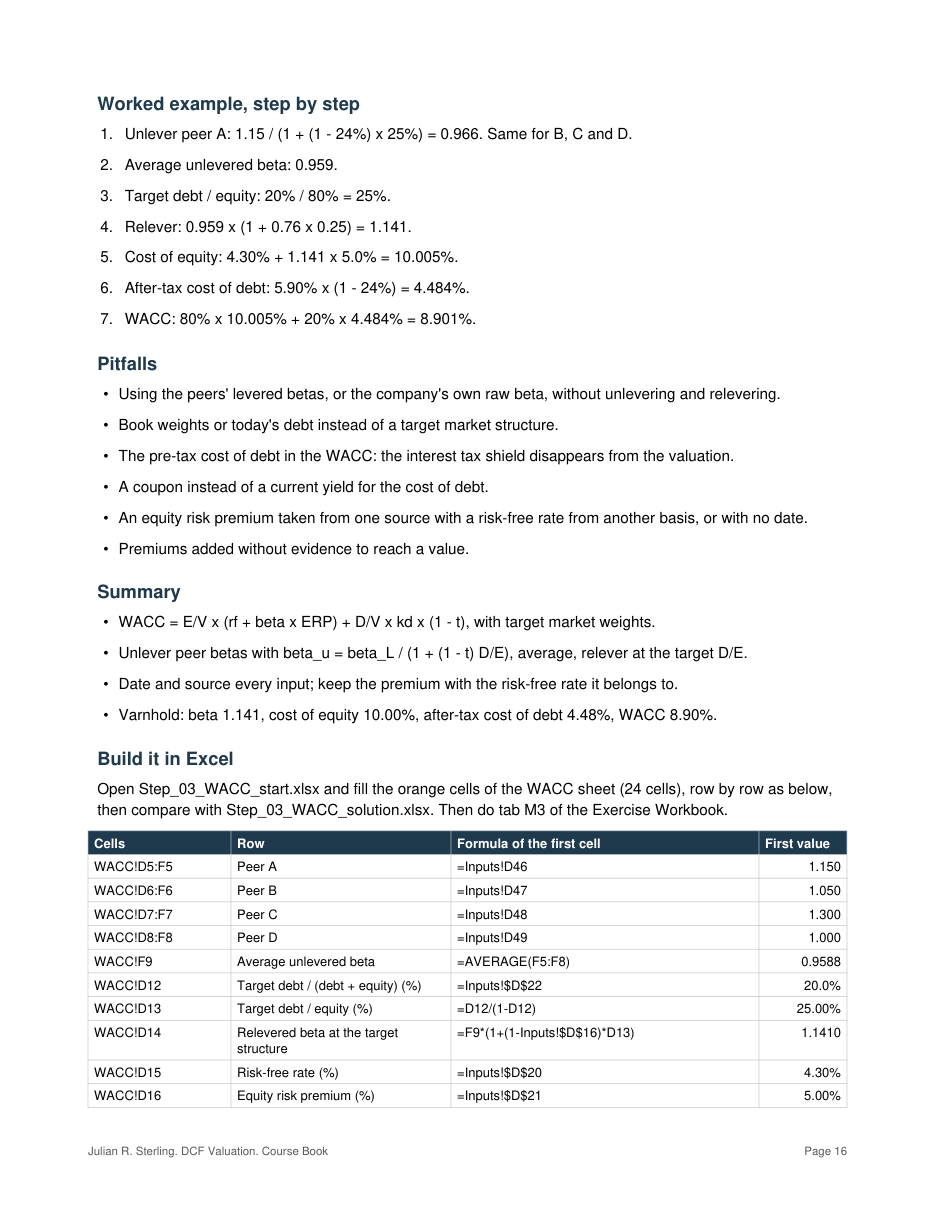
- Compute a WACC: risk-free rate and a dated equity risk premium, peer betas unlevered and relevered with Hamada, after-tax cost of debt, target weights.
- Set a terminal value by perpetuity growth and by exit multiple, and cross-check them with the implied multiple, the implied growth and the return on new capital.
- Discount with the mid-year convention and a stub period without double counting the cash.
- Bridge enterprise value to equity value and count diluted shares with the treasury stock method, without a circular reference.
- Present WACC x growth and WACC x multiple tables and a football field, and spot the classic errors by the direction they move the value.
The program
6 modules. Each one is read online (or in the Course Book), then built in Excel in its start file, then checked in the Exercise Workbook and the module quiz.
- 1. Intrinsic value and the DCF logic What a DCF measures, enterprise value against equity value, when a DCF is the right tool, the case, and what an investment committee looks at. Lessons: 1.1 What a DCF measures (4 min). 1.2 Enterprise value and equity value (4 min). 1.3 When a DCF is the right tool (3 min). 1.4 The case: Varnhold Medical Systems (4 min). 1.5 What an investment committee looks at (3 min). Excel build: Market (15 min). About 33 minutes in all.
- 2. Unlevered free cash flow From EBIT to NOPAT with a normalized tax, D&A, capex and working capital, stock-based compensation, one-off items, and leases under ASC 842 and IFRS 16. Lessons: 2.1 From EBIT to NOPAT: the normalized tax (4 min). 2.2 D&A, capex and working capital (5 min). 2.3 Stock-based compensation and one-off items (4 min). 2.4 Leases under ASC 842 and IFRS 16 (4 min). 2.5 Build the five-year forecast (4 min). Excel build: FCF (25 min). About 46 minutes in all.
- 3. WACC CAPM, the risk-free rate, a dated equity risk premium, beta unlevered and relevered (Hamada), the after-tax cost of debt and the target structure. Lessons: 3.1 The weighted average cost of capital (3 min). 3.2 Risk-free rate and equity risk premium (4 min). 3.3 Beta: unlever and relever (5 min). 3.4 Cost of debt and target structure (4 min). 3.5 Source and date every input (3 min). Excel build: WACC (20 min). About 39 minutes in all.
- 4. Terminal value Perpetuity growth and exit multiple, the cross-checks between them (implied multiple, implied growth, reinvestment) and the share of value they carry. Lessons: 4.1 Why the terminal value dominates (3 min). 4.2 Perpetuity growth (4 min). 4.3 Exit multiple (4 min). 4.4 Cross-checks: implied multiple, growth and reinvestment (5 min). 4.5 How much of the value sits in the terminal value (3 min). Excel build: Terminal (15 min). About 34 minutes in all.
- 5. From enterprise value to value per share Mid-year convention, the stub period, the bridge from enterprise value to equity value, diluted shares by the treasury stock method, value per share. Lessons: 5.1 Discounting and the mid-year convention (4 min). 5.2 The valuation date and the stub period (4 min). 5.3 The bridge: net debt and other claims (5 min). 5.4 Diluted shares: the treasury stock method (4 min). 5.5 Value per share and what it means (3 min). Excel build: Value (25 min). About 45 minutes in all.
- 6. Sensitivities and sanity checks WACC x growth and WACC x multiple tables, a simple football field, the classic errors and a review checklist before the committee. Lessons: 6.1 WACC x growth (3 min). 6.2 WACC x exit multiple (3 min). 6.3 A simple football field (4 min). 6.4 The classic errors (5 min). 6.5 A review checklist (3 min). Excel build: Sensitivity, Football, Checks (20 min). About 38 minutes in all.
Try it free
All of module 1. Download module 1 of the Course Book (PDF): intrinsic value, enterprise value and equity value, when a DCF is the right tool, the case and what a committee looks at, with the worked example and the Excel build.
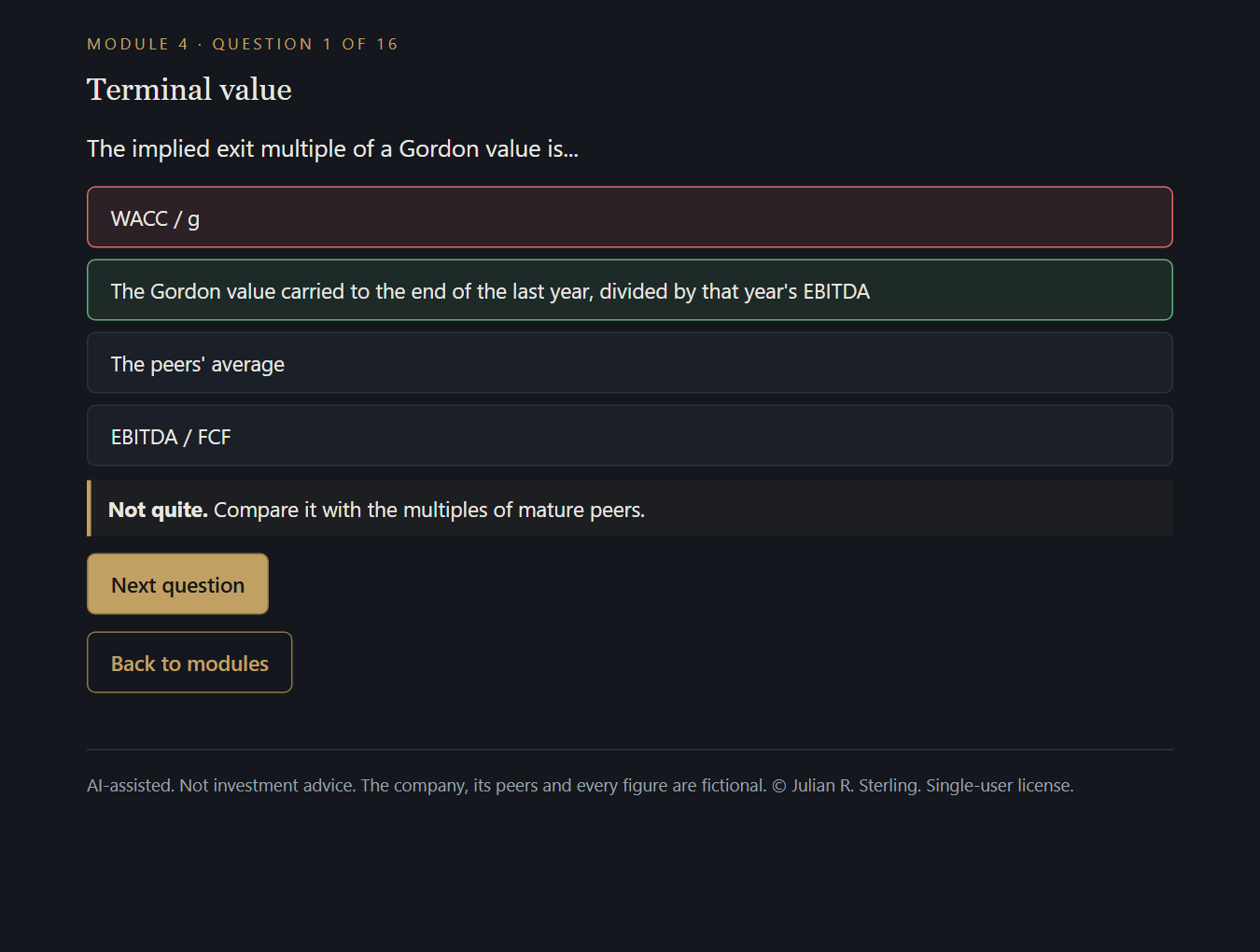
Ten quiz questions. Click an answer: it turns green or red and the explanation appears. The questions use the running case:
Varnhold Medical Systems, Inc. (fictional): a US-listed maker of surgical imaging and patient monitoring equipment, valued at 31 March 2028. FY2027 revenue $1,850.0m, share price $112.00, 36.5m basic shares, three tranches of employee options.
Module 1
1. A DCF discounts unlevered free cash flow at the WACC. The result is...
Answer: Enterprise value. Unlevered cash flow belongs to lenders and shareholders together.
Module 1
2. Going from a DCF enterprise value to equity value, the noncontrolling interest is...
Answer: Subtracted. The parent consolidates 100% of the subsidiary's cash flow; the minority's share is not the parent's.
Module 1
3. An equity-method investment is added in the bridge because...
Answer: Its earnings are not in the consolidated EBIT or cash flow. Add it at fair value, or it is lost.
Module 1
4. Which business suits a DCF best as the primary method?
Answer: A mature medical equipment maker with steady cash flows. Stable, positive and forecastable cash flows.
Module 1
5. Banks are usually valued on equity cash flows because...
Answer: Debt is their raw material, not their financing. Separating operating and financing cash flows makes no sense for a bank.
Module 2
6. Why is the tax in unlevered free cash flow computed on EBIT?
Answer: The interest tax shield is counted once, in the after-tax cost of debt of the WACC. Using actual taxes after interest would count the shield twice.
Module 3
7. The WACC weights should be...
Answer: Target market weights. The structure the company keeps over the long run.
Module 4
8. For a growing company, the terminal value is typically...
Answer: Most of enterprise value. 60% to 80% is common.
Module 5
9. The mid-year convention assumes the cash of each year arrives...
Answer: On average in the middle of the year. It reflects cash collected all year.
Module 6
10. Why build sensitivity cells as formulas rather than Excel data tables?
Answer: They recalculate in any software and can be audited cell by cell. Data tables may not recalculate elsewhere.
Try the module 1 exercises
The 7 results that close module 1, from the data of the case. Type your answers: they are checked at once. No sign-up.
Inside the course
Your certificate
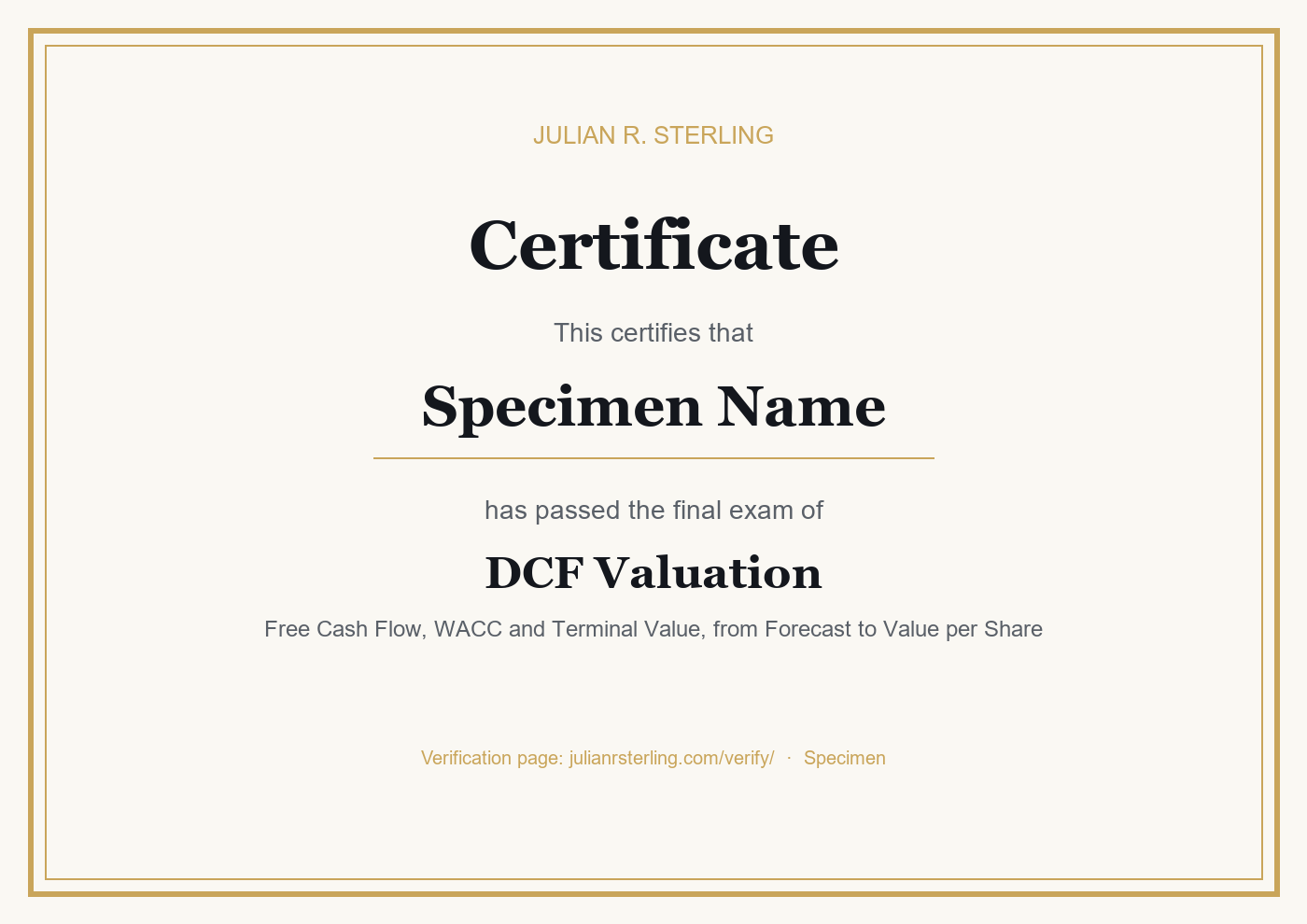
Pass the online exam (40 questions, 60 minutes, 80%) and you receive a certificate of completion with a public verification page, to add to your profile or your CV.
How you learn
What you receive
| File | What it is |
|---|---|
| Online reader | Each module online in your learner account: the full text, then the Excel build with its cells and expected values. |
| Course_Book.pdf | The 6 modules with worked examples, pitfalls, summaries, practice questions, glossary, answers and dated sources. |
| Case_Workbook.xlsx | Varnhold Medical Systems at 31 March 2028: market, free cash flow, WACC, terminal value, value per share, sensitivities, football field, checks. |
| Step_Files | 12 workbooks: a start file and a solution file for each module. |
| Exercise_Workbook.xlsx | 6 exercise tabs, 43 answers checked automatically, hidden solution tabs. |
| Quiz_App.html | 96 questions, 16 per module, with explanations. |
| Certificate exam | Online from your order page or your account: 40 questions from a private bank, 60 minutes, 80% to pass, verifiable certificate. |
The running case
Varnhold Medical Systems, fictional, is valued at 31 March 2028 on a five-year plan:
| Measure | Value |
|---|---|
| Revenue FY2027A / FY2032E | $1,850.0m / $2,557.9m |
| Unlevered free cash flow FY2028E / FY2032E | $188.8m / $305.0m |
| Relevered beta / WACC | 1.141 / 8.90% |
| Terminal value: perpetuity at 3.0% / implied multiple | $5,472.1m / 9.9x |
| Enterprise value / equity value | $4,784.5m / $4,381.5m |
| Value per share / share price | $115.93 / $112.00 |
Not ready yet?
Join the reader list: one short email when a new course, case or correction goes up. No spam, unsubscribe in one click.
Join the reader list Run by MailerLite. How your address is used.
Questions people ask
Who is the course for?
Analysts and associates in investment banking, private equity, corporate development, FP&A and transaction services, and anyone who has to build or review a DCF. You need basic Excel and to know what EBIT, depreciation and a balance sheet are.
Is there video?
The course is read online module by module with an Excel build for each module; video lessons are being added and come at no extra cost.
How long is it?
6 modules and 30 written lessons: about 1.9 hours of reading, plus about 2.0 hours of Excel builds, exercises and quizzes.
What do I get exactly?
Right after payment: the course zip (Course Book PDF, Case Workbook with 340 live formulas, 12 step files, Exercise Workbook, Quiz App) and the course online in your learner account, module by module. The certificate exam opens from your order page or your learner account.
Is it US GAAP or IFRS?
The case reports under US GAAP, and every lesson where the standards differ shows both: leases under ASC 842 and IFRS 16, stock-based compensation, noncontrolling interests, diluted shares under ASC 260 and IAS 33. The valuation mechanics are the same.
Where do the market inputs come from?
The case uses its own risk-free rate, equity risk premium and peer betas, set against dated published references that the course paraphrases and dates. Check current figures before any real valuation.
How does the certificate exam work?
40 questions drawn at random from a private bank, 60 minutes, graded on the server, 80% to pass, retake as often as you need. You receive a certificate with a public verification page. How certificates work.
Can I get a refund?
Yes. Every course has a 14-day money-back guarantee: write to [email protected] within 14 days of your purchase and you get a full refund, no reason needed. Details in the terms of sale.
Is it investment advice?
No. Varnhold Medical Systems, its peers and every figure are fictional. The course teaches how a DCF works and how to test it. Prepared with AI assistance.
DCF Valuation: $149
The online modules, the Course Book, the Case Workbook, the step files, the exercises, the quiz app and the certificate exam. 14-day money-back guarantee.
AI-assisted. Not investment advice. The company and every figure of the case are fictional.
Want every course? All Access opens all of them, with their certificate exams.
Related
- LBO ModelingThe sponsor's model of a leveraged buyout, from sources and uses to returns.
- Infrastructure ValuationThe fair value of an operating infrastructure asset for a fund.
- All coursesEvery course of the academy.