Courses · Video course
Automate a Fund Reporting with AI: controls, procedure and sign-off for a weekly NAV
How to hand a recurring fund report to an AI assistant without losing control of it: the expected NAV, six controls with tolerances, a variation test and an attribution, a sign-off with minutes built by formula, a data pack that feeds the reports, and the written procedure the assistant follows. You build the control pack of a weekly NAV in Excel along the way.
$149, or included in All Access
26 short video lessons (about 60 minutes of video), 11 of them built live in Excel, the Case Workbook of a weekly NAV control, a start file and a solution file for every build lesson, an Exercise Workbook that checks your answers, a 48-question quiz app, a Course Summary, a Procedure and Prompt Kit to adapt, and the certificate exam online. Download right after payment.
Secure checkout by Stripe. 14-day money-back guarantee. Not sure yet? Watch module 1 and a build lesson free, read the summary of module 1 and try ten questions below.
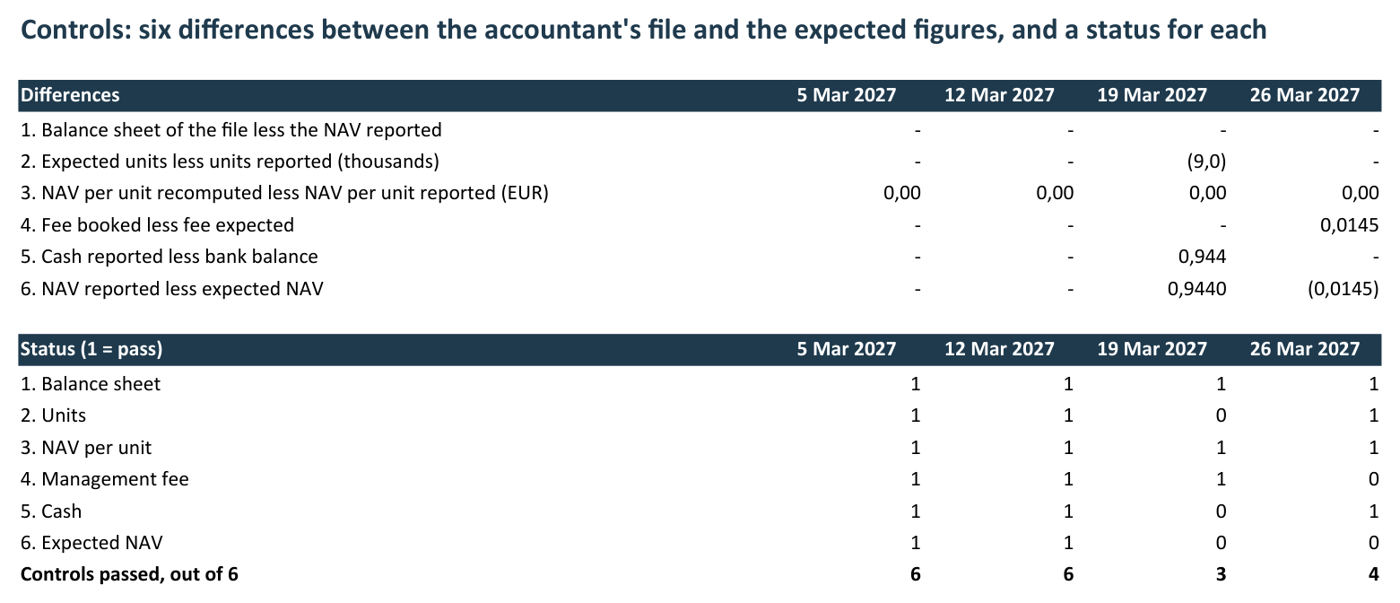
Most AI courses for finance teach prompts. This one teaches a process. Over four Fridays, a fund accountant sends four NAV files; two are wrong. One error overstates the NAV by €944 thousand and leaves the price per unit exactly right. The other is worth one cent per unit. The controls you build catch both, and the assistant you instruct stops instead of signing.
What you will be able to do
- Choose which recurring task to automate first, with three tests.
- Rebuild a NAV by roll-forward from independent sources, before reading the accountant's file.
- Write six controls with tolerances and turn them into statuses an assistant can act on.
- Test a weekly variation, attribute it per unit, and have the commentary drafted from the table only.
- Write the procedure, the stop rules and the reusable instructions an assistant follows.
- Build a sign-off summary and minutes by formula, and keep the approval human.
- Feed regulatory and investor reports from one data pack that ties, and test the whole process on past periods with planted errors.
The program
Six modules. Concept lessons explain on animated slides; build lessons fill the workbook on screen, cell by cell, with the formula shown, while you build the same cells in the start file.
- 1. What to automateWhy recurring reporting is the right first target, the three tests of a task, the case, and the expected NAV built by roll-forward. Lessons: 1.1 Why reporting is the first thing to automate. 1.2 Three tests: repetitive, rule-based, verifiable. 1.3 The case: a weekly NAV. 1.4 The expected NAV by roll-forward (build).
- 2. Controls before AIA control is a rule with a tolerance: balance, units, NAV per unit, fees, cash, and a status for each. What the assistant computes and what it must not. Lessons: 2.1 A control is a rule with a tolerance. 2.2 Balance, units and NAV per unit (build). 2.3 Fees, cash and the expected NAV (build). 2.4 A status for every control (build). 2.5 What the assistant computes, and what it must not.
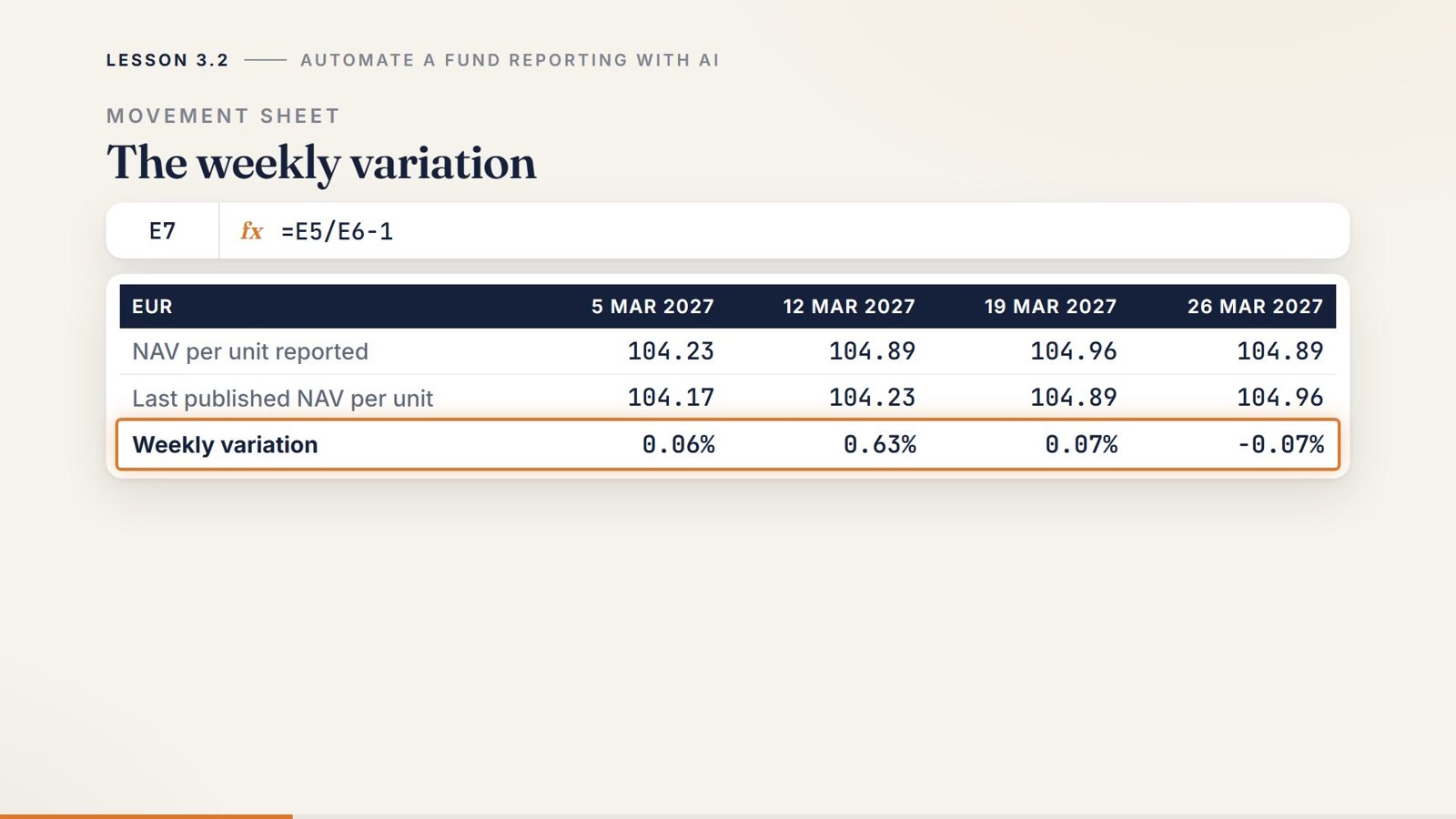
- 3. Explaining the movementThe weekly variation against a threshold, the attribution per unit, and a commentary drafted from the table. Lessons: 3.1 A variation needs a threshold. 3.2 The weekly variation (build). 3.3 Attribution per unit (build). 3.4 The commentary: drafted from the table.
- 4. Procedure and sign-offThe written procedure the assistant follows, the sign-off summary, the minutes built by formula, the human approval, and prompts that work. Lessons: 4.1 Write the procedure first. 4.2 The sign-off summary (build). 4.3 Minutes built by formula (build). 4.4 The human in the loop. 4.5 Prompts that work.
- 5. From the NAV to the reportsOne source mapped once: the reporting data pack, its tie-outs, and the rules on confidentiality and audit trail. Lessons: 5.1 One source, mapped once. 5.2 The reporting data pack (build). 5.3 Tie-outs of the pack (build). 5.4 Confidentiality, access and audit trail.
- 6. Run it for realTesting on past periods with planted errors, the time saved and the payback, the failure modes, and a rollout plan. Lessons: 6.1 Test on past periods. 6.2 Time saved and payback (build). 6.3 How automations fail. 6.4 A rollout plan.
Try it free
All of module 1 and one build lesson. The four lessons of module 1, and lesson 2.2, where the units control catches a file whose price looked perfect.
The summary of module 1. Download the free sample of the Course Summary (PDF).
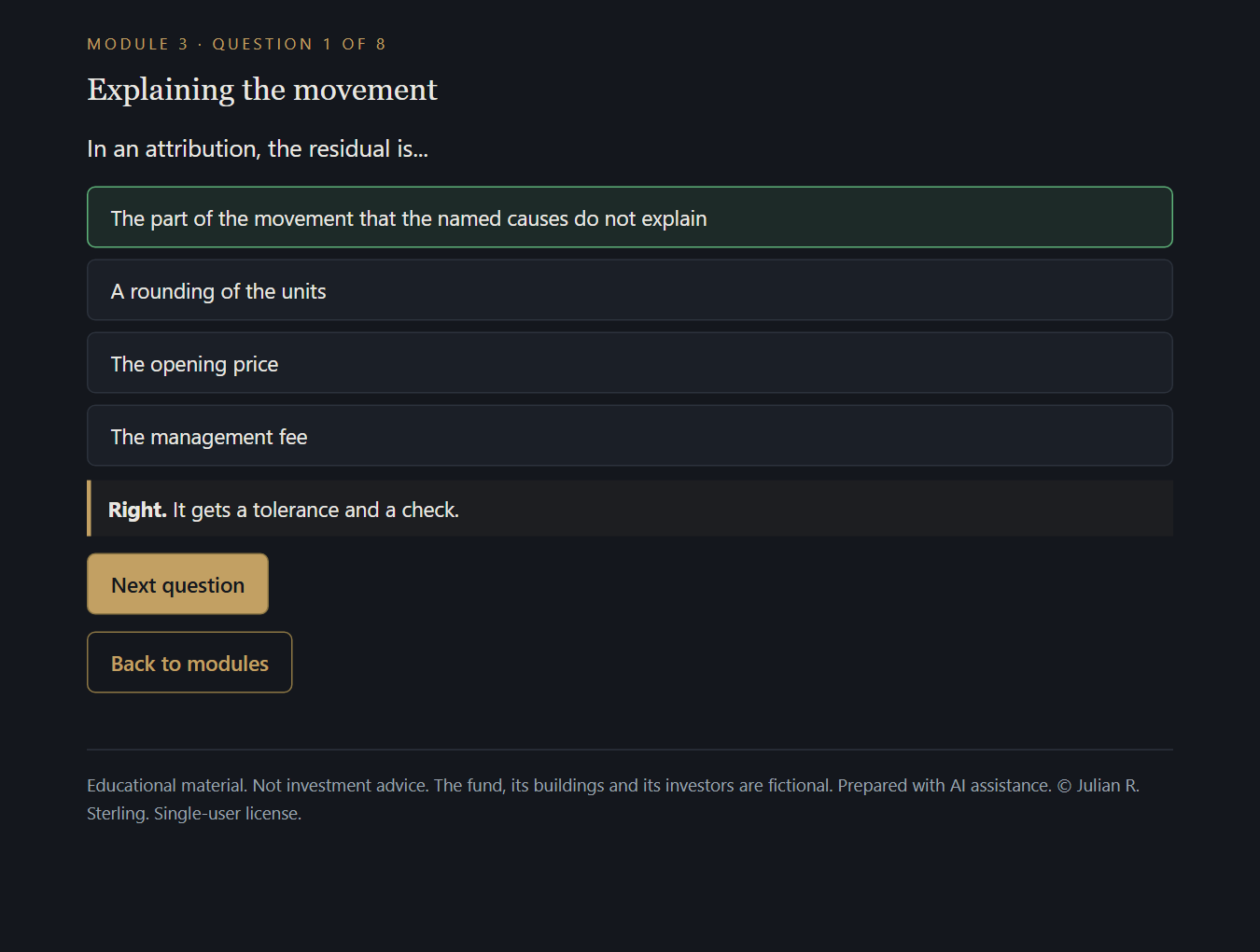
Ten quiz questions. Click an answer: it turns green or red and the explanation appears. The questions use the running case:
Lindenmoor Property Income Fund (fictional): an open-ended property fund of €250m with a NAV every Friday. The fund accountant computes the NAV; the manager controls it against the transfer agent, the bank and its own records, signs it or returns it. Management fee 1.20% a year.
Module 1
1. Which three tests make a task a good candidate for automation?
Answer: Repetitive, rule-based, verifiable. The third test matters most.
Module 1
2. A task is verifiable when...
Answer: Its output can be checked against an independent source or an identity. For example units = opening + subscribed - redeemed.
Module 1
3. Who is responsible for the published NAV per unit in the case?
Answer: The manager, even though the fund accountant computes it. The manager controls, signs and publishes.
Module 1
4. On 19 March the reported NAV per unit is exactly right, yet the file is wrong. Why?
Answer: A subscription booked twice inflates the NAV and the units together. The price alone proves nothing.
Module 1
5. The roll-forward of each week starts from...
Answer: The last NAV the manager validated. An error not corrected would carry forward.
Module 1
6. On 5 March, 18.0 thousand units are subscribed at the last published price of EUR 104.17. Subscriptions in the roll-forward?
Answer: EUR 1.875m. Units x last published price / 1,000.
Module 2
7. A control has three parts:
Answer: A comparison, a tolerance and an action. Two figures that should agree, how far apart they may be, and what happens if not.
Module 3
8. Variance analysis is...
Answer: Comparing a figure with a reference and explaining the difference above a threshold. A control of understanding, not of accuracy.
Module 4
9. Which six sections make a procedure?
Answer: Purpose, inputs, steps, controls, stop rules, outputs. One page a new colleague could follow alone.
Module 5
10. A data pack is...
Answer: One table of validated figures, with their sources, from which every report is filled. Validate once, use everywhere.
Inside the course
What you receive
| File | What it is |
|---|---|
| Videos, one zip per module | 26 lessons in 1080p, about 60 minutes of video, with English subtitles (.srt) and chapters. |
| Case_Workbook.xlsx | Lindenmoor Property Income Fund, four weekly NAVs: roll-forward, six controls, variation and attribution, sign-off and minutes, data pack, tie-outs, time saved. |
| Step_Files | 22 workbooks: a start file and a solution file for each of the 11 build lessons. |
| Exercise_Workbook.xlsx | Six exercise tabs, 36 answers checked automatically, hidden solution tabs. |
| Quiz_App.html | 48 questions, eight per module, with explanations. |
| Course_Summary.pdf | Two pages per module: key ideas, the case in numbers, the mistakes to avoid; glossary and dated sources. |
| Certificate exam | Online from your order page or your account: 40 questions from a private bank, 60 minutes, 80% to pass, verifiable certificate. |
The running case
Lindenmoor Property Income Fund, fictional, publishes a NAV per unit every Friday. In March 2027 the manager controls four files from its fund accountant:
| NAV date | Controls passed | Price reported | Decision |
|---|---|---|---|
| 5 Mar 2027 | 6 of 6 | €104.23 | Sign |
| 12 Mar 2027 | 6 of 6 | €104.89 | Sign with a commentary: the price moved by 0.63% |
| 19 Mar 2027 | 3 of 6 | €104.96 | Return: a subscription booked twice, the price still right |
| 26 Mar 2027 | 4 of 6 | €104.89 | Return: a fee at an old rate, one cent per unit |
On the assumptions of the case, the review of a prepared pack takes 35 minutes instead of 180, about 170 hours a year with the quarterly reports, and the setup pays back in about 13 weeks. These are assumptions you can change in the workbook, not promises.
Part of AI for Finance
This is the first course of the AI for Finance track. It builds on the fund courses: NAV & Investor Reporting, AIFMD & Annex IV Reporting and European Real Estate Funds. See certifications.
Questions people ask
Who is the course for?
Fund controllers, portfolio and fund managers, middle-office and reporting teams, and the compliance colleagues who must approve the use of AI on fund data. You need basic Excel. No coding is required.
How long is it?
26 video lessons of two to four minutes, about 60 minutes of video, in six modules. With the build lessons, the exercises and the quizzes, most learners need five to seven hours.
Which AI tool does it use?
None in particular. The method works with any assistant that can read files, follow written instructions and run a spreadsheet or code. The course teaches what does not change with the tool: the controls, the procedure, the stop rules, the sign-off and the tests. Use only tools your firm has approved for the data involved.
Is the case real?
The workflow is the anonymised version of a real one: the weekly NAV review and the regulatory reporting of a fund management team. Every name and figure is fictional, and the two errors in the fund accountant's files are planted for the course.
What do I get exactly?
Right after payment: the course zip (Course Summary, Case Workbook with 213 live formulas, 22 step files, Exercise Workbook, Quiz App, and a Procedure and Prompt Kit to adapt) and one video zip per module, with subtitles and chapters. The certificate exam opens from your order page or your learner account.
How does the certificate exam work?
40 questions drawn at random from a private bank, 60 minutes, graded on the server, 80% to pass, retake as often as you need. You receive a certificate with a public verification page. How certificates work.
Does the assistant compute the NAV?
No. Formulas compute and compare; the assistant fills the inputs, reads the controls, drafts the commentary from a table and prepares the sign-off. A person approves. That division of work is the subject of the course.
Who is the narrator?
Lessons use AI-generated narration. The scripts, the case and every figure on screen were written and computed for this course and checked by script against the workbook.
Can I get a refund?
Yes. Every course has a 14-day money-back guarantee: write to [email protected] within 14 days of your purchase and you get a full refund, no reason needed. Details in the terms of sale.
Is it legal or regulatory advice?
No. Whether and how an AI tool may be used on fund data depends on your firm, its regulator, its contracts and its policies. The course gives the questions to ask and a method to work safely.
Automate a Fund Reporting with AI: $149
The videos, the Case Workbook, the step files, the exercises, the quiz app, the Course Summary and the certificate exam. Download right after payment.
Want every course? All Access opens all of them, with their certificate exams, for $299 a year.
Related
- NAV & Investor ReportingThe quarterly close of a fund: NAV, capital accounts, investor reports.
- AIFMD & Annex IV ReportingLeverage, liquidity and the regulatory report of a fund.
- AI for FinanceThe track: what to automate in a finance team, and how to keep control.
- All coursesReal estate, private credit, fund finance, project finance, data centers, LBO, funds, reporting, infrastructure, credit documentation and AI.