Book · Julian R. Sterling
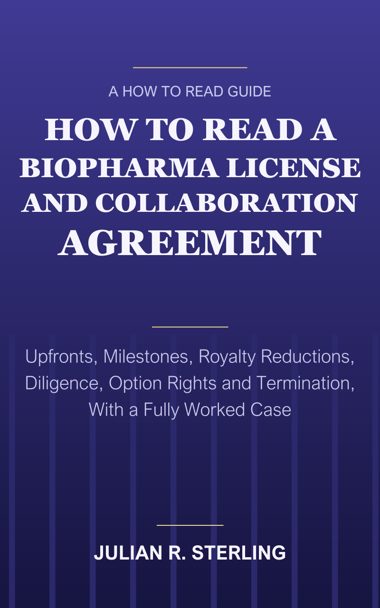
How to Read a Biopharma License and Collaboration Agreement
Upfronts, Milestones, Royalty Reductions, Diligence, Option Rights and Termination, Clause by Clause, With a Fully Worked Case
Apple Books Google Play PDF edition
About the book
A license and collaboration agreement is the contract on which a biotechnology company's value often rests: it sets what the partner pays, when, and on what conditions. The headline number on the press release is rarely what the licensor will receive. This guide reads the agreement clause by clause and puts a value on each clause for both sides.
How to Read a Biopharma License and Collaboration Agreement goes through the grant, field, territory and sublicensing; the upfront payment, the equity purchase and the development, regulatory and sales milestones, with the gap between headline value and risk-adjusted value; tiered royalties, net sales and the royalty term; reductions for biosimilar entry and third-party licenses, and the floor under them; the joint steering committee and the final say; commercially reasonable efforts, hard deadlines and the cost of delay; options, co-development, co-promotion and profit sharing; patents, enforcement and patent term extension; regulatory, supply and safety data duties; and termination, change of control and the licensor's bankruptcy under section 365(n) of the Bankruptcy Code. One fictional antibody is followed from signature to the end of the royalty term, twenty years in the United States and Europe and a little longer in Japan.
What is inside:
- 12 chapters, from why the license is the asset to the complete case, clause by clause
- A fully worked case, Ellisford Therapeutics and Wexbury Pharmaceuticals: a $40 million upfront payment and $10 million of equity, $430 million of milestones that make a headline value of $470 million, a probability-weighted value of $148.0 million and a risk-adjusted present value of $100.1 million; royalties of 8, 11 and 14 percent by tier in three sales scenarios; a biosimilar reduction that reaches its floor; an option on a second indication; a declined profit-share right, which would have paid $121.5 million against a $42.3 million royalty in a peak year; and two termination tests
- A reading checklist of 40 questions for any license and collaboration agreement
- 8 example clauses written for the book, each with a plain-English annotation
- A glossary of 50 terms
Written for buy-side and sell-side biotech analysts, for business development heads at biotechnology and pharmaceutical companies, for junior lawyers in life sciences, for royalty investors, for biotech finance chiefs and for technology transfer lawyers. The example clauses, the case, its companies, antibody, payments, rates, probabilities, sales and dates are written for this book; the figures are fictional teaching assumptions, not market data or forecasts, and no clause is taken from any real agreement or form. Statutes and filed agreements are paraphrased and cited as of the dates given in the book. This book is for education only and is not legal, investment, tax or accounting advice. No regulator, court, company or university has reviewed or endorsed it.
What is inside
- Chapter 1: Why the License Is the Asset: Deal Architecture, Parties and the Public Filing
- Chapter 2: The Grant: Exclusivity, Field, Territory, Sublicensing and Retained Rights
- Chapter 3: Upfront, Equity and Milestones: Headline Value Versus Risk-Adjusted Value
- Chapter 4: Royalties: Tiers, Net Sales, Royalty Term and Step-Downs
- Chapter 5: Royalty Reductions: Biosimilars, Third-Party Licenses and the Floor
- Chapter 6: Governance: the Joint Steering Committee, Escalation and the Final Say
- Chapter 7: Diligence: Commercially Reasonable Efforts, Hard Deadlines and the Cost of Delay
- Chapter 8: Options, Co-Development, Co-Promotion and Profit Sharing
- Chapter 9: Intellectual Property: Ownership, Prosecution, Enforcement and Patent Term
- Chapter 10: Regulatory Responsibility, Supply, Safety Data and Know-How Transfer
- Chapter 11: Termination, Change of Control and the Licensor's Bankruptcy
- Chapter 12: Ellisford and Wexbury, Clause by Clause: the Complete Worked Case
- Appendix A: Example Clauses Written for This Book, Annotated
- Appendix B: The Reading Checklist: Forty Questions for Any License and Collaboration Agreement
- Appendix C: Glossary
Also by Julian R. Sterling
Related titles. The full list is on the author page.