Book · Julian R. Sterling
The Winery Owner
Running a Small Winery by the Numbers: Cost per Bottle and per Case, Grapes and the Vineyard, Bulk and Bottled Inventory, Tasting Room and Wine Club, Direct Shipping and Distributors, Federal Excise Tax and Permits, Harvest Cash Flow, SBA and Farm Lending, Buying a Winery and What It Is Worth
About the book
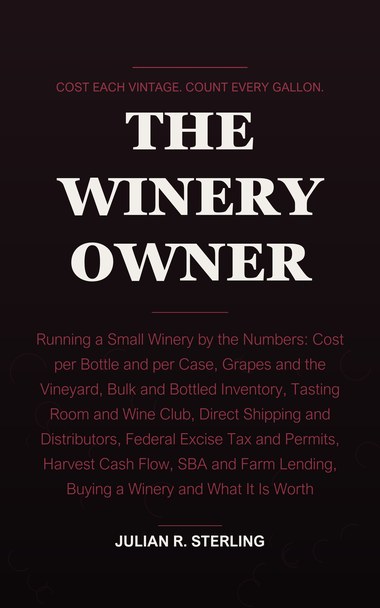
November 2026. The owner of a small estate winery, a former assistant winemaker who bought it from its founder for $3,935,600 with an SBA 7(a) loan, a seller note and her own cash, reviews two fiscal years: revenue up from $1,951,453 to $2,201,835, EBITDA up from $615,310 to $736,957, a spring frost on the Chardonnay, cash net of the line at -$53,561 after the spring bottlings, and two open questions: whether to move 500 cases from the distributor to the club, and what the winery would be worth to a buyer.
The Winery Owner is a practitioner's guide to the economics of a small independent winery in the United States: grapes and the vineyard, tons to gallons to cases, the cost of each vintage and each bottle, bulk and bottled wine inventory, the tasting room, the wine club and its charges held as a liability, direct shipping and the distributor, federal permits, labels and the excise tax with the small producer credit, state licenses and sales tax, harvest cash flow and the seasonal line, SBA and farm lending, depreciation of vines and buildings, and what a winery and its land are worth. One fictional winery, every number from one model.
Some of what the arithmetic shows: why the 2025 white cost $7.47 a bottle while the frost pushes the next harvest's bottles to $9.53 in the calculator; why the winery covers its fixed costs at 2,844.5 cases against 6,313.4 sold; why moving 500 cases to the club is worth $50,460 a year in the case only if the members exist and stay; why FY2026 EBITDA of $736,957 becomes $591,058 once the founder's cheap wine is replaced by the winery's own; and why a buyer's SBA 7(a) loan at the case's value of $4,748,010 would be covered 0.95 times, below the 1.25 a lender looks for, when the same structure reaches 1.25 at $3,747,000.
The model is not described, it is supplied. Seven companion workbooks hold the cost per bottle and per case, channel margins, bulk and bottled wine inventory, excise and the small producer credit, the break-even and the calculator, harvest cash and coverage, and the purchase and the value, by live formula, each with a Checks tab, and the check-lists come as an editable document. The closing pages say where to find them.
What you will be able to do:
- Cost each vintage and each bottle, and see what the cost leaves out
- Keep bulk and bottled wine, club charges, excise and sales tax straight, month by month
- Compare what a bottle earns in the tasting room, the club, direct shipping and the distributor
- Compute the break-even in cases and the cash a harvest and a bottling will take
- Lay out the sources and uses of a purchase and test a buyer's SBA loan before naming a price
Sixteen chapters in four parts and four appendices: a guide to the workbooks with seven exercises, eight check-lists, seventy-four questions for the TTB, the state regulator, counsel, a distributor, a grower, the insurance agent, the outside CPA, the lender, a seller and a buyer, and a glossary of fifty terms.
Written for owners, founders and buyers of small independent wineries, growers who want to make their own wine, and the lenders and advisers who read their numbers. The case, its winery, lender, grower, distributor and founder and their figures are fictional teaching assumptions, not market norms; federal rules are dated as of November 2026, and state rules differ. This book is for education only. It is not legal, tax, alcohol regulatory, insurance, lending or accounting advice.
How this book was made: written with the help of artificial intelligence tools, under the author's direction; every figure was computed by a model and every rule was checked against its source.
Read next: How much do winery owners make?
Read next: How much does it cost to start a winery?
Read next: How much is a winery worth?
Also available as a standalone free template: winery cost per bottle and break-even calculator.
The companion files
The book prints this address for its readers. The seven workbooks reproduce the figures of the case, Kellowan Hill Winery, with live formulas and a Checks tab; workbook 5 holds the calculator's figures, not the case's. Type your own winery over the blue cells. No sign-up, no email address.
Chapter 4
Winery_1_Cost_per_Bottle_and_per_Case.xlsx
One vintage of one wine costed from its crush supplies, vineyard costs, cellar overhead and bottling: cost per bottle and per case.
Download11 KBChapters 5 to 8
Winery_2_Channel_Margins.xlsx
One bottle's price, card fees, shipping not charged and margin in the tasting room, the club, direct shipping and the distributor.
Download12 KBChapters 3 and 12
Winery_3_Bulk_and_Bottled_Wine_Inventory.xlsx
The bulk wine roll in gallons and dollars and the bottled wine roll in bottles and dollars, for one fiscal year.
Download11 KBChapter 10
Winery_4_Excise_Tax_and_the_Small_Producer_Credit.xlsx
One quarter's federal excise tax from the bottles removed, with the small producer credit on the winery's own wine.
Download11 KBChapter 15
Winery_5_Break_Even_Cases_and_the_Calculator.xlsx
The full version of the free calculator: cost a bottle, margins by channel, EBITDA, break-even cases, coverage and two levers.
Download14 KBChapters 12 and 14
Winery_6_Harvest_Cash_the_Line_and_Coverage.xlsx
A month's interest on the line and the real estate loan, the year's debt service and the owner's coverage.
Download11 KBChapters 13 and 16
Winery_7_Buying_a_Winery_Sources_Uses_and_Value.xlsx
A purchase's uses and sources, the SBA 7(a) loan split in two parts, and the value by the case's method.
Download12 KBAppendix B
Winery_Owner_Check_Lists.docx
The eight check-lists of the book, editable.
Download42 KB
The seven workbooks, the check-lists and a short guide, 00_START_HERE.md.
The case and its figures are fictional teaching assumptions, not market norms. Federal rules on winery permits, labels, records, excise tax, depreciation and SBA loans are paraphrased as in force in November 2026, and state rules on licenses, direct shipping, distribution, sales tax and alcohol liability differ: confirm them with counsel, the TTB, the state alcohol regulator, the outside CPA, the insurance agent and your lender.
What is inside
- Part I: The Winery and Its Wine
- Chapter 1: What a Small Winery Actually Sells
- Chapter 2: Grapes and the Vineyard
- Chapter 3: From Grapes to Gallons to Cases
- Chapter 4: Cost per Bottle and per Case
- Part II: Selling the Wine
- Chapter 5: The Tasting Room
- Chapter 6: The Wine Club
- Chapter 7: Direct Shipping to Consumers
- Chapter 8: Distributors and the Three-Tier System
- Part III: Rules, Taxes and Cash
- Chapter 9: Federal Permits, Bonded Premises and Labels
- Chapter 10: Federal Excise Tax and the Small Producer Credit
- Chapter 11: State Licenses, Sales Tax and Insurance
- Chapter 12: Harvest Cash Flow, Inventory and the Seasonal Line
- Part IV: Buying, Financing and Value
- Chapter 13: Buying a Winery: The Purchase and Its Sources
- Chapter 14: The Loans, Coverage, Depreciation and Farm Lending
- Chapter 15: The Statements, Break-Even and the Calculator
- Chapter 16: What a Winery Is Worth
- Appendix A: The Workbooks
- Appendix B: The Winery Owner's Check-Lists
- Appendix C: Questions to Ask
- Appendix D: Glossary
Also by Julian R. Sterling
Related titles. The full list is on the author page.