Book · Julian R. Sterling
The Equity Method Accounting Handbook
ASC 323 for Investors and Preparers: Significant Influence, Basis Differences, Intra-Entity Profits, Losses Below Zero, Impairment, Dilution and Changes in Method, with IAS 28 Comparisons
About the book
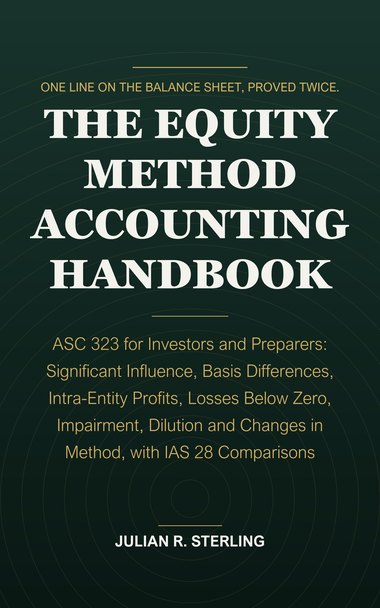
An equity method investment is one line on the balance sheet, and nothing in the general ledger forces it to agree with anything else. That is why it has to be proved. For one fictional US manufacturer, a 30 percent stake in a coatings maker and a 40 percent interest in a storage project company run through three years of judgment: a memo purchase price allocation with $900,000 of equity method goodwill, a dilution gain of $477,500, an impairment of $700,000, losses that run past zero into a $1,500,000 member loan, and a gain of $4,232,500 when control is obtained. Each carrying amount is reached twice, once by the roll-forward and once as the share of the investee's net assets plus the basis differences.
The Equity Method Accounting Handbook is a practitioner's guide to ASC 323, with IAS 28 compared side by side: significant influence and its indicators, partnerships and LLCs, initial measurement and the memo purchase price allocation, basis differences year by year, the share of earnings and other comprehensive income, dividends and the statement of cash flows, intra-entity profits downstream and upstream, losses beyond zero, reporting lags, other-than-temporary impairment, dilution and partial sales, moving into and out of the equity method, the fair value option and hypothetical liquidation at book value, presentation and disclosures, and the close. Two investees are followed from 2024 to 2026, and every figure comes from one model.
What you will be able to do:
- Weigh the significant influence indicators and write a memo that an auditor can follow
- Build a memo purchase price allocation and roll every basis difference forward through equity in earnings
- Prove the carrying amount each year as the share of net assets plus the basis differences
- Eliminate intra-entity profits in both directions and run losses past zero into a loan and a suspended memo
- Compute a dilution gain, judge an impairment and hand two amounts to acquisition accounting when control is obtained
- Present the single line, disclose what sits behind it and close the books with controls that reach every number twice
Sixteen chapters and four appendices: a guide to the companion workbook with three exercises, the preparer's toolkit, thirty review questions with answers, and a glossary.
Written for controllers, financial reporting managers, senior and technical accountants and auditors who prepare, review or rely on equity method figures. The case, its companies, its people and its places are fictional, and its figures are teaching assumptions; the standards are paraphrased as read in November 2026. This book is for education only. It is not accounting, legal, tax or investment advice. Part of The Private Markets Career Guides.
How this book was made: written with the help of artificial intelligence tools, under the author's direction; every figure was computed by a model and every rule was checked against its source.
Read next: What are the journal entries under the equity method?
Read next: How do you amortize an equity method basis difference?
Read next: What happens when equity method losses exceed the investment?
Free: the equity method investment model in Excel
A memo purchase price allocation, the basis differences rolled forward, three years of equity in earnings with the proof that the carrying amount equals the share of net assets plus the basis differences, eliminations both ways, and losses run past zero into a member loan. Live formulas, no macros, nothing locked.
Companion files
The workbook that rebuilds every figure of the book, free, no sign-up. It builds the memo purchase price allocation of the Quillmark purchase, rolls every basis difference forward, picks up three years of equity in earnings and proves each carrying amount as the share of net assets plus the basis differences, computes the 2025 dilution, eliminates intra-entity profits both ways, runs the Fennick Ridge losses past zero into the member loan and a suspended memo, and ends with a Checks tab of thirteen ties that must read ALL PASS.
-
Appendix A
Equity_Method_Model.xlsx
Tabs: Inputs, MemoPPA, BasisDiff, Quillmark, Dilution, IntraEntity, Fennick, Impairment, StepUp, Disclosure, Checks. With the case typed in, the Quillmark carrying amount is proved at $10,217,500 on 31 December 2026, the day control is obtained.
Download the workbook33 KB -
Read first
00_START_HERE.md
What each tab holds, the case figures to reproduce first, and the conventions behind every number.
Workbook and read-me, one archive30 KB
Three numbers to reproduce first
| Memo purchase price allocation, 1 January 2024 | cost $9,150,000 = 30 percent of book net assets $6,000,000 + inventory $150,000 + plant and equipment $1,200,000 + customer relationships $900,000 + equity method goodwill $900,000 |
| The proof, 31 December 2024 | 30 percent x Quillmark net assets $22,200,000 = $6,660,000, plus remaining basis differences $2,730,000 = $9,390,000, the carrying amount |
| Dilution gain, 1 July 2025 | deemed proceeds $2,100,000 less one sixth of the carrying amount $1,627,500, plus $5,000 of other comprehensive income reclassified = $477,500, outside equity in earnings |
The Quillmark carrying amount, year by year
| Line | 2024 | 2025 | 2026 |
| Opening carrying amount | $9,150,000 | $9,390,000 | $10,175,000 |
| Equity in earnings | $480,000 | $692,500 | $367,500 |
| Share of other comprehensive income | $60,000 | ($80,000) | $75,000 |
| Dividends received | ($300,000) | ($300,000) | ($400,000) |
| Dilution of 1 July 2025 | $0 | $472,500 | $0 |
| Closing carrying amount | $9,390,000 | $10,175,000 | $10,217,500 |
What is inside
- Introduction: One Line on the Balance Sheet, Three Years of Judgment
- Chapter 1: Significant Influence, and Where It Starts and Stops
- Chapter 2: Partnerships, LLCs and In-Substance Common Stock
- Chapter 3: Initial Measurement and the Memo Purchase Price Allocation
- Chapter 4: Basis Differences, Year by Year
- Chapter 5: Recording the Share of Earnings and Other Comprehensive Income
- Chapter 6: Dividends, Distributions and the Statement of Cash Flows
- Chapter 7: Intra-Entity Profits, Downstream and Upstream
- Chapter 8: Losses Beyond Zero
- Chapter 9: Reporting Lags and Intervening Events
- Chapter 10: Other-Than-Temporary Impairment
- Chapter 11: Dilution and Partial Sales
- Chapter 12: Into and Out of the Equity Method
- Chapter 13: The Fair Value Option and Hypothetical Liquidation at Book Value
- Chapter 14: Presentation, Disclosures and Summarized Financial Information
- Chapter 15: Closing the Books on Equity Method Investments
- Chapter 16: The Brackenfield File, 2024 to 2026
- Conclusion: A Number Reached Twice
- Appendix A: Using the Companion Workbook
- Appendix B: The Equity Method Toolkit
- Appendix C: Review Questions and Answers
- Appendix D: Glossary
Also by Julian R. Sterling
Related titles. The full list is on the author page.
- The Consolidation Accounting Handbook
- The Purchase Price Allocation Handbook
- The Statement of Cash Flows Handbook
- The Foreign Currency Accounting Handbook
- The Debt and Equity Accounting Handbook
The workbook is provided as it is, without warranty of any kind. Brackenfield Industries, Inc., its investees and its people are fictional; prices, fair values and results are the book’s teaching assumptions, not market data. Not accounting, legal, tax or investment advice.