Book · Julian R. Sterling
The ABA Therapy Practice Owner
Running an Independent Autism Therapy Practice by the Numbers: Payer Contracts and Authorizations, Billing Codes and Rates, BCBA and RBT Staffing, Supervision, Utilization and Cancellations, Clinic and Home Models, Buying or Starting a Practice, SBA Financing, a Second Center and What It Is Worth
About the book
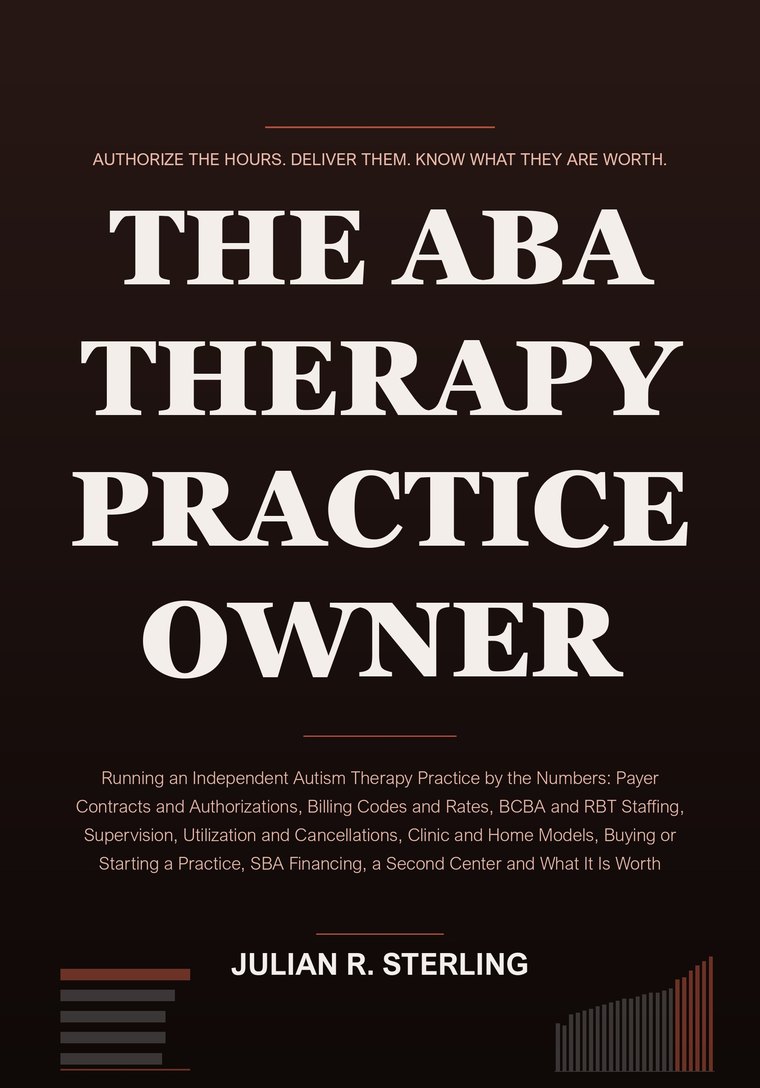
November 2026. The owner of an independent ABA practice for autistic children, a BCBA who bought it from its founder two years ago with an SBA loan, reviews two fiscal years: net revenue up from $2,226,787 to $3,245,981, EBITDA up from $307,989 to $531,542, a second center opened from scratch in April 2026, RBT turnover at 45 percent, and a Medicaid plan's recoupment paid from a provision. A letter of intent from a platform backed by a private equity fund sits on the desk, not answered.
The ABA Therapy Practice Owner is a practitioner's guide to the economics of an independent applied behavior analysis practice in the United States: who may own a practice, as a question for counsel, and what the certifier requires; Medicaid's EPSDT benefit and managed care plans; commercial plans, self-funded employers, parity and the family's share; authorizations and the five levels of hours; codes, units and rates; utilization and cancellations; RBT and BCBA cost, supervision and the margin per billed hour; intake, privacy, hiring, turnover, clinic and home; documentation, denials and recoupments; the break-even; buying a practice with an SBA 7(a) loan and the credentialing transition; a second center; and what a platform pays. One fictional practice, two fiscal years, month by month, every number from one model.
Some of what the arithmetic shows: why one active client brings in $5,472.31 of net revenue a month on a Medicaid plan and $6,725.55 on a commercial plan, and leaves $2,812.61 after RBT, BCBA and session costs, $35.46 per billed hour; why five more points of utilization are worth $85,114 a year; why the first center needs 21 active clients to cover $57,435 of fixed costs a month, and 28 once the purchase loan is paid; and how a letter at 6.0 times the buyer's adjusted EBITDA, $3,347,130, turns into $1,061,372 in cash at closing once the debt, the fees, the recoupment escrow and the rollover come off, before taxes.
The model is not described, it is supplied. Seven companion workbooks hold hours and revenue per client, staff cost and supervision, utilization and break-even, RBT turnover, a second center, the purchase with an SBA loan and the offer, by live formula, each with a Checks tab, and the check-lists come as an editable document. The closing pages say where to find them.
What you will be able to do:
- Follow an authorization through scheduled, rendered, billed and paid hours
- Turn rates per 15-minute unit into net revenue per client, by payer and at the mix
- Cost RBT and BCBA time and the certifier's supervision, and read the margin per billed hour
- Turn fixed costs into active clients, and a purchase into sources and uses with an SBA loan
- Read a letter of intent from adjusted EBITDA to the cash at closing, line by line
Sixteen chapters in four parts and four appendices: a guide to the workbooks with seven exercises, eight working check-lists, seventy questions for counsel, the outside CPA, a founder who sells, the banker and the SBA lender, a BCBA candidate, the payers, the billing staff, the landlord and a platform buyer, and a glossary of fifty terms.
Written for BCBAs who own, co-own or plan to buy or start an independent ABA practice of one to three centers, for the salaried clinical director who considers buying, and for an entrepreneur who is not a clinician. It is about the business: it gives no clinical advice, names no payer, plan or platform, and leaves state law and taxes to counsel and the outside CPA. The case and its figures are fictional teaching assumptions, not market norms; rules are dated as of November 2026. This book is for education only. It is not legal, tax, accounting or clinical advice. Part of The Private Markets Career Guides.
How this book was made: written with the help of artificial intelligence tools, under the author's direction; every figure was computed by a model and every rule was checked against its source.
Read next: How much does an ABA practice make?
Read next: How to start or buy an ABA therapy practice
Read next: How much is an ABA practice worth?
Free: the ABA Practice Utilization, Revenue per Client and Break-Even Calculator
The cells of the book’s break-even workbook on their own, in Excel: net revenue and contribution per active client, the margin per billed hour, the break-even in active clients before and after the purchase loan’s payment, and what five more points of utilization are worth. With the case’s inputs it returns $6,036.27 of net revenue per client a month, $2,812.61 of contribution, $35.46 per billed hour, 21 and 28 active clients, and $85,114 a year.
The companion files
Printed in the book: the seven workbooks of Appendix A and the check-lists of Appendix B, free to download, with no sign-up. Tamberwick Autism Therapy, the practice of the case, and every figure in the files are fictional teaching assumptions.
No macros, no dates, no links between files, no password; the only functions are ROUND, ROUNDUP, MIN, MAX, IF and AND; cell A1 of every tab says what the tab does, every input carries the cell name Appendix A uses, and each workbook ends with a Checks tab that reads OK or CHECK. The workbooks recalculate in Excel, LibreOffice or Google Sheets.
-
Chapters 5 and 6 · Workbook 1
Hours and Revenue per Client
One active client a month, from the hours a payer authorized to the hours scheduled, rendered and billed, and from rates per 15-minute unit to net revenue, for a Medicaid plan, a commercial plan and at the payer mix. Tabs: Inputs, Hours, Revenue, Checks.
Download ABA_1_Hours.xlsx13 KB -
Chapter 8 · Workbook 2
Staff Cost, Supervision and Margin per Billed Hour
What the same client’s hours cost: RBT hours paid, billable or not, BCBA hours, the certifier’s supervision, direct costs, contribution and the margin per billed hour. Tabs: Inputs, Staff, Margin, Checks.
Download ABA_2_Staff.xlsx13 KB -
Chapters 7 and 12 · Workbook 3
Utilization and Break-Even
The whole client against the center’s fixed costs: the break-even in active clients, of EBITDA and after debt service, and what five more points of utilization are worth. Tabs: Inputs, Client, BreakEven, Checks.
Download ABA_3_BreakEven.xlsx16 KB -
Chapter 10 · Workbook 4
RBT Turnover and Replacement Cost
What it costs to replace one RBT, and what the year’s turnover costs at the average headcount. Tabs: Inputs, Turnover, Checks.
Download ABA_4_Turnover.xlsx10 KB -
Chapter 14 · Workbook 5
Second Center Budget and Payback
What a second center costs before it earns, the practice’s own cash beyond the loan, and the simple payback on the latest quarter. Tabs: Inputs, Budget, Checks.
Download ABA_5_SecondCenter.xlsx10 KB -
Chapter 13 · Workbook 6
Purchase, Transition and SBA Loan
The purchase: project, equity injection, the seller note that counts, the SBA loan, the first year’s coverage and the revenue lost while the payers credentialed the buyer. Tabs: Inputs, Purchase, Checks.
Download ABA_6_Purchase.xlsx10 KB -
Chapter 16 · Workbook 7
Offer to Cash
The platform’s letter from EBITDA to SDE, adjusted EBITDA, enterprise value and the owner’s cash at closing, and what a multiple applied to SDE would wrongly add. Tabs: Inputs, Bridge, Checks.
Download ABA_7_Offer.xlsx11 KB -
Appendix B
ABA_Practice_Owner_Toolkit.docx
Authorizations and the five levels of hours; Billing, denials and documentation; Supervision, hiring and turnover; Intake, referrals, reviews and privacy; The monthly numbers review and the break-even; Buying a practice; Opening a second center; Preparing for a sale.
Download the toolkit41 KB -
Read first
00_START_HERE.md
What each file holds, which workbook answers which chapter, and how to use the workbooks on your own practice.
Download the read-me5 KB
Three numbers to reproduce first
| A client | 97.92 hours authorized a month, 79.31 rendered and billed, $6,036.27 of net revenue at the payer mix; less $3,223.66 of RBT, BCBA and session costs, $2,812.61 of contribution, $35.46 per billed hour |
| A month | $57,435 of fixed costs over $2,812.61 a client: 21 active clients to break even before loan payments (28 after the purchase loan’s $20,047 a month), against an actual 39 |
| The offer | Adjusted EBITDA $557,855 x 6.0 = $3,347,130; after $1,635,701 of debt, $140,414 of fees, a $167,357 recoupment escrow and a $342,286 rollover, $1,061,372 in cash at closing, before taxes |
What is inside
- Part I: The Practice You Run
- Chapter 1: What an ABA Practice Owner Actually Runs
- Chapter 2: Who May Own the Practice: Licensure, Certification and the Entity
- Chapter 3: Medicaid: EPSDT, Managed Care Plans and the Authorization Clock
- Chapter 4: Commercial Plans, Self-Funded Employers, Parity and Families
- Part II: The Economics of a Client
- Chapter 5: Authorizations and the Five Levels of Hours
- Chapter 6: Codes, Units and Rates: Net Revenue per Client
- Chapter 7: Utilization, Cancellations and the Schedule
- Chapter 8: RBTs, BCBAs, Supervision and the Margin per Billed Hour
- Part III: Staff, Compliance and Cash
- Chapter 9: Intake, Referrals, Reviews and Privacy
- Chapter 10: Hiring, Turnover, and Clinic or Home
- Chapter 11: Documentation, Denials, Audits and Recoupments
- Chapter 12: The Monthly Numbers: Income Statement, Cash and Break-Even
- Part IV: Buying, Growing and Selling
- Chapter 13: Buying a Practice: Price, Credentialing and the SBA Loan
- Chapter 14: Opening a Second Center
- Chapter 15: Quality of Revenue: What a Buyer Will Test
- Chapter 16: What It Is Worth: The Platform's Letter
- Appendix A: The Workbooks
- Appendix B: The Owner's Toolkit
- Appendix C: Questions to Ask
- Appendix D: Glossary
Updates
Federal rules in the book (Medicaid’s EPSDT benefit and managed care plans, ERISA and mental health parity, the overpayment rule, the False Claims Act and the anti-kickback statute, HIPAA, the FTC’s rule on consumer reviews, the federal wage rules, the SBA’s rules for 7(a) loans) and the certifier’s handbooks are dated as consulted in November 2026. State rules on who may own a practice, licensure, insurance mandates and Medicaid are not covered and are for counsel in the practice’s state. This page will note material changes.
Also by Julian R. Sterling
Related titles. The full list is on the author page.
- Business ValuationValuing larger companies: enterprise and equity value, forecasts, the DCF, the cost of capital and multiples.
- Buying a Small BusinessThe buyer's path for any small company: reading the seller's numbers, financing, diligence and the first year.
- The Audiology Practice OwnerA hearing care practice by the numbers: diagnostics and hearing aids, conversion, provider pay, a second site and value.